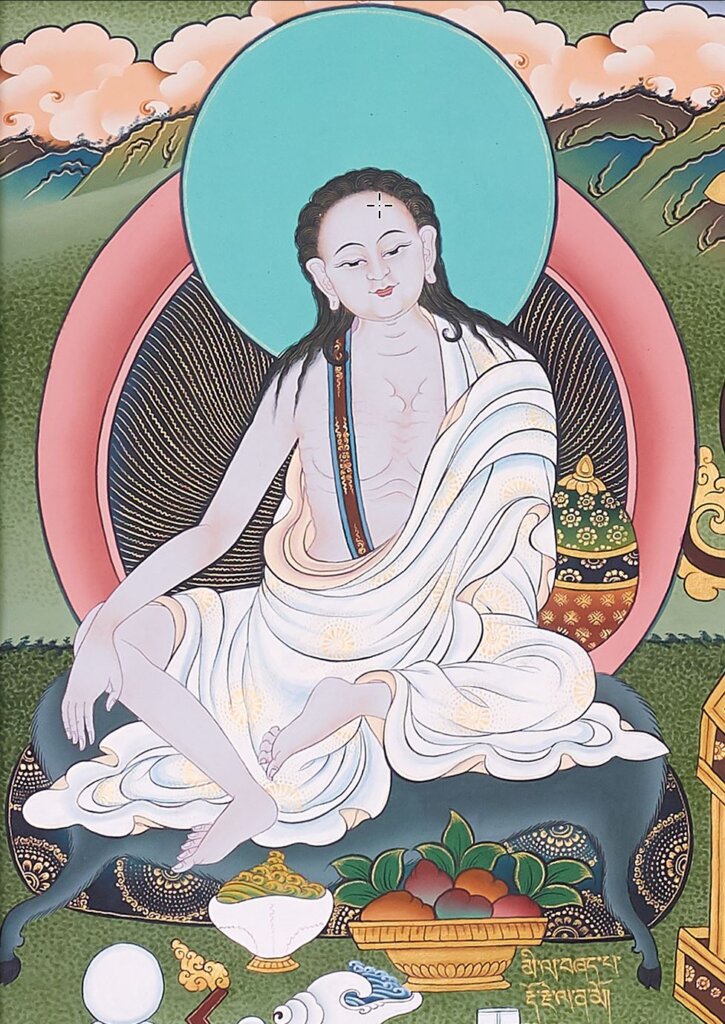
Milarepa's profound assertion, "My realization came not from texts but from the silence of the cave," invites us to consider the transformative power of direct experience over intellectual understanding. In a world saturated with information, this quote challenges the notion that wisdom is solely derived from written words or scholarly study. Instead, it emphasizes the importance of personal insight gained through solitude and contemplation, suggesting that true understanding often emerges from the quiet spaces within us.
This reflection on silence and experience resonates deeply within the spiritual journey. Milarepa, a revered figure in Tibetan Buddhism, spent years in isolation, cultivating his understanding through meditation and introspection. His words remind us that the essence of spiritual awakening often lies beyond the confines of language and doctrine, urging us to seek our own truths in the stillness of our hearts and minds. In an age where distractions abound, this call to silence becomes ever more relevant, inviting us to explore the depths of our own consciousness.
The image / the metaphor
The imagery of a cave evokes a sense of both physical and metaphorical depth. Caves are often associated with darkness, solitude, and introspection, providing a sanctuary where one can retreat from the chaos of the outside world. The act of silence within this cave symbolizes a profound inner journey, where the noise of thoughts and external influences fades away, allowing for a deeper connection to one's true self. The verbs in Milarepa's quote—"came" and "realization"—suggest a process of emergence, as if understanding is not something to be acquired but rather something that naturally unfolds in the quietude of being.
Diving deeper into the metaphor, the cave represents not just a physical space but also the inner landscape of the mind and spirit. It is within this sacred silence that one can confront the shadows of fear, doubt, and confusion, ultimately leading to clarity and insight. The cave serves as a crucible for transformation, where the alchemy of silence can transmute the raw materials of experience into the gold of wisdom. In this way, Milarepa's words invite us to embrace our own caves, recognizing that they hold the potential for profound realization.
In the speaker's tradition
Milarepa's journey and teachings are deeply rooted in the Tibetan Buddhist tradition, which emphasizes the importance of direct experience in the pursuit of enlightenment. Concepts such as *dharma* (the path of truth), *sunyata* (emptiness), and *prajna* (wisdom) are integral to understanding his perspective. In this context, Milarepa's emphasis on silence reflects the practice of *kenosis*, or self-emptying, where one relinquishes attachments to concepts and beliefs to make space for genuine insight. This aligns with the notion that true wisdom arises from the depths of one's own experience rather than from external sources.
In the *Songs of Milarepa*, his poetic expressions often highlight the significance of personal realization through solitary practice. For instance, his verses frequently recount moments of deep meditation where he encountered profound truths about existence and the nature of suffering. This mirrors the teachings found in other Buddhist texts, such as the *Heart Sutra*, which articulates the essence of emptiness and the liberation that comes from transcending dualistic thinking. Milarepa's journey underscores the idea that while texts can guide us, it is the silence of our own caves that ultimately leads to true understanding.
Living the teaching
In contemporary life, the teaching of Milarepa can be applied in various scenarios, particularly in moments of overwhelm or confusion. Imagine a busy professional grappling with the demands of work and personal life, feeling lost amidst the noise of expectations and responsibilities. By intentionally carving out time for silence—whether through meditation, nature walks, or simply sitting in stillness—this individual can reconnect with their inner wisdom. Such practices allow for clarity to emerge, revealing insights that may have been obscured by the clamor of daily life.
Moreover, this teaching can profoundly impact relationships. Consider a situation where conflict arises between partners, fueled by misunderstandings and emotional turmoil. By embracing the silence of reflection before reacting, each person can gain perspective and cultivate empathy. This pause allows for deeper listening and understanding, transforming potential discord into an opportunity for growth and connection. In both personal and relational contexts, the silence of the cave serves as a powerful reminder of the wisdom that lies within, waiting to be discovered.
A reflection
As we contemplate Milarepa's assertion, we are invited to explore the role of silence in our own lives. What truths might emerge if we were to spend time in our own caves, away from the distractions of the world? In what ways can we cultivate silence to deepen our understanding of ourselves and our experiences? This inquiry encourages us to embrace the stillness, recognizing it as a fertile ground for realization and insight.
