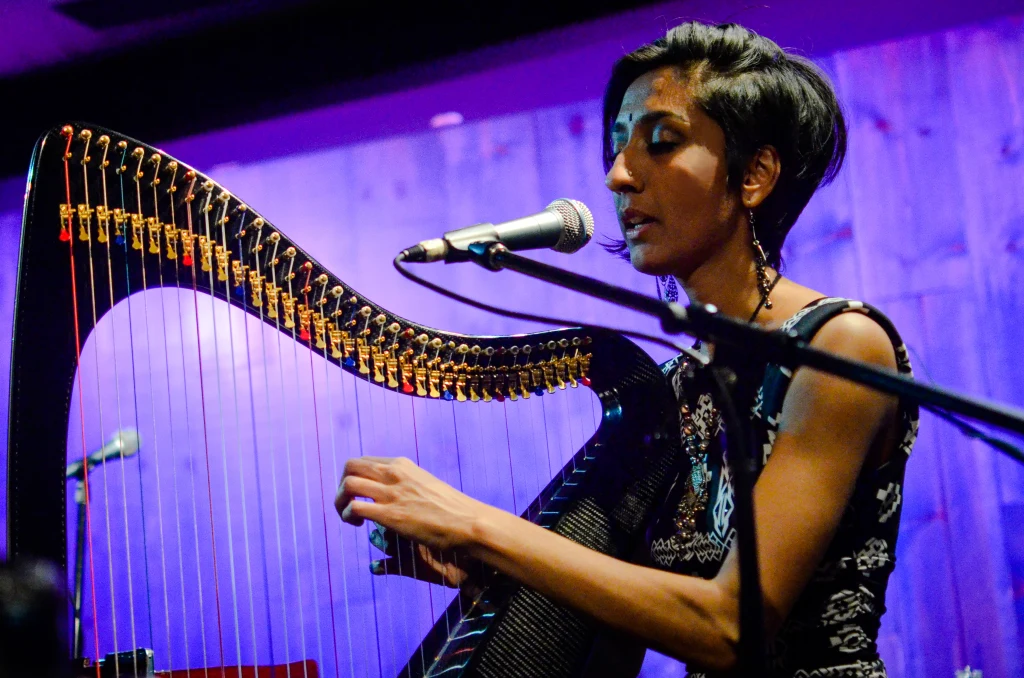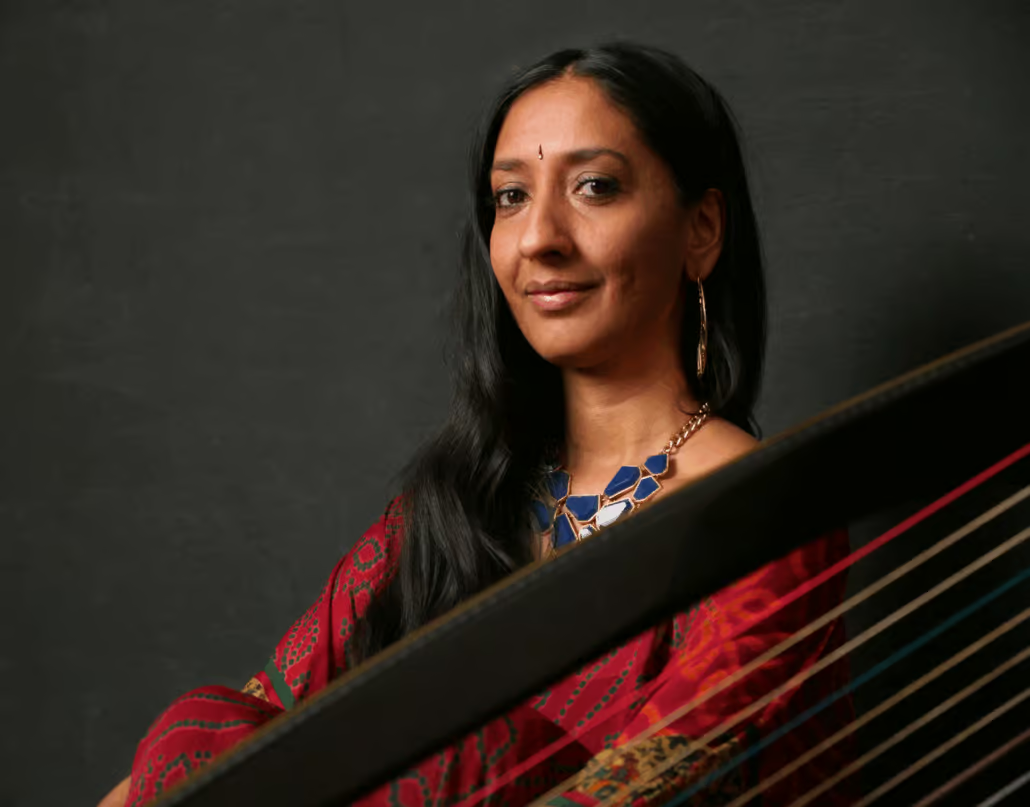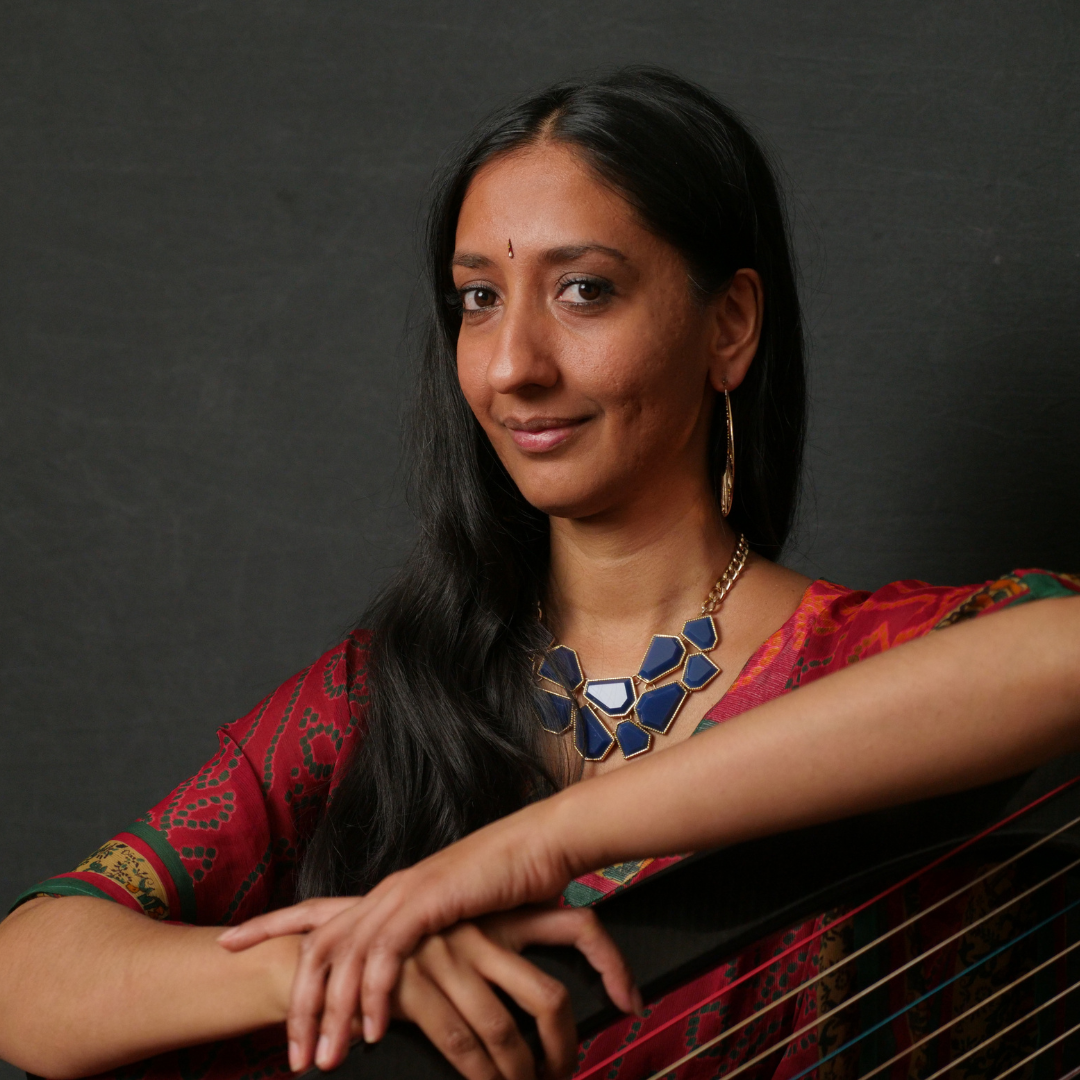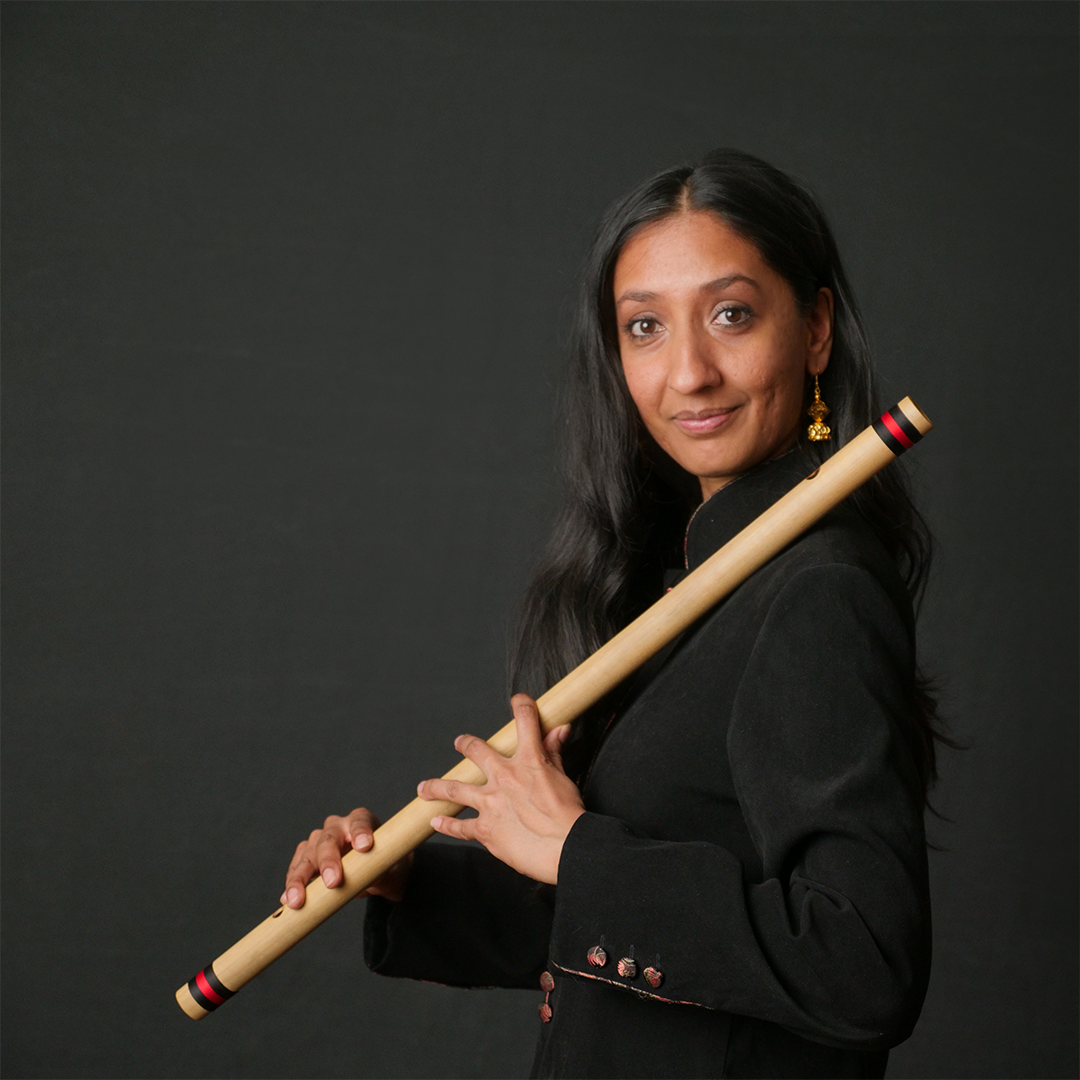

When Sheela Bringi's voice enters a recording, it arrives as a precise instrument—not merely a vehicle for devotional sentiment, but a carefully trained classical voice shaped by North Indian vocal techniques. Her sound world is built on three primary textures: the human voice trained in raga, the breathy intimacy of the bansuri flute, and the shimmering resonance of the harp she plays in ragas rather than Western scales. This is not fusion for fusion's sake—it's a deliberate architecture where Hindustani melodic structures meet the harmonic possibilities of Western instruments reconfigured for Indian modes.
The bansuri appears in her work not as exotic ornament but as a lead voice, its bamboo tone cutting through or weaving beneath vocals in counterpoint. The harp—her "raga harp"—is perhaps her most distinctive contribution to the kirtan and devotional music landscape. Where most contemporary kirtan artists rely on harmonium, guitar, and percussion, Bringi's harp brings cascading arpeggios and sustained resonances that bloom around melodic phrases. It's a string instrument that breathes like a wind instrument, creating space rather than filling it.
Bringi operates primarily within the bhakti tradition—the yogic path of devotional music—but her approach is firmly grounded in classical rigor. Her North Indian classical training provides the skeletal structure: the rules of raga development, the patience of alap (slow melodic exploration), the rhythmic sophistication that distinguishes trained musicians from enthusiastic chanters. She applies these principles to kirtan, the call-and-response devotional singing that has become a fixture in Western yoga studios and spiritual communities.
What sets her apart is the refusal to simplify. Many Western kirtan artists reduce complex ragas to three-chord progressions. Bringi preserves melodic integrity—her Yaman sounds like Yaman, her Bhairavi retains its characteristic phrases. She's working within Vedic and Hindu devotional frameworks, singing to Hanuman, Krishna, and various manifestations of the divine, but the musicality never becomes subordinate to the message.
Bringi's discography reads like a map of the conscious music landscape's hidden infrastructure. She's appeared on over fifty new age and world music recordings—not as a headliner but as the sonic detail that elevates production. Her voice, flute, or harp often provides the "sacred" element in albums that might otherwise feel earthbound.
The Grammy nomination for "Bhakti Without Borders" marked a public recognition of work she'd been doing quietly for years: building sonic bridges between Indian devotional practice and American spiritual seekers. This wasn't about watering down tradition for Western consumption, but about finding where two musical languages could speak simultaneously. Working alongside her partner Brent—with whom she co-founded the Sacred Sound Lab—her collaborative practice extends beyond recording into teaching, workshops, and online education.
A newcomer to Bringi's music should prepare for slowness. Her work operates at the tempo of meditation practice, not concert entertainment. Phrases unfold gradually, melodies spiral through variations rather than rushing toward choruses. If you're accustomed to kirtan's rhythmic drive and group energy, her solo work may initially feel spare.
What surprises: the specificity. This isn't ambient music for passive listening. The ragas demand attention to pitch, to the microtonal bends in vocal lines, to the silence between harp notes. Her voice doesn't soar or belt—it articulates. Each syllable of Sanskrit mantra is pronounced with clarity, each melodic ornament placed with intention.
The texture is both intimate and expansive. A bansuri melody might float above a single-note drone for three minutes before voice enters. The harp creates vertical sound—notes stacking and sustaining—that contrasts with the horizontal, linear movement of Indian melody. This tension between vertical and horizontal, Western and Eastern, is where her music lives.
Within conscious music, Bringi occupies a particular niche: too traditionally rigorous for the wellness industrial complex, too devotionally focused for the world music festival circuit, yet accessible enough for yoga teacher trainings and spiritual workshops. She exists in the overlap between preservation and innovation—maintaining classical integrity while translating sacred sound for contemporary practice.
Her work shares DNA with artists like Jai Uttal (who also bridges kirtan and world music) but with less percussion, more space. She's closer to the patient melodic development of Ravi Shankar than to the ecstatic energy of Krishna Das. The Sacred Sound Lab positions her as educator, not just performer—someone invested in transmitting technique, not merely reproducing atmosphere.
In an era when "sacred music" often means vague spiritual aesthetics, Bringi offers something more demanding: actual tradition, performed with skill, adapted without dilution.