






Juan Lucangioli
Musician
À propos
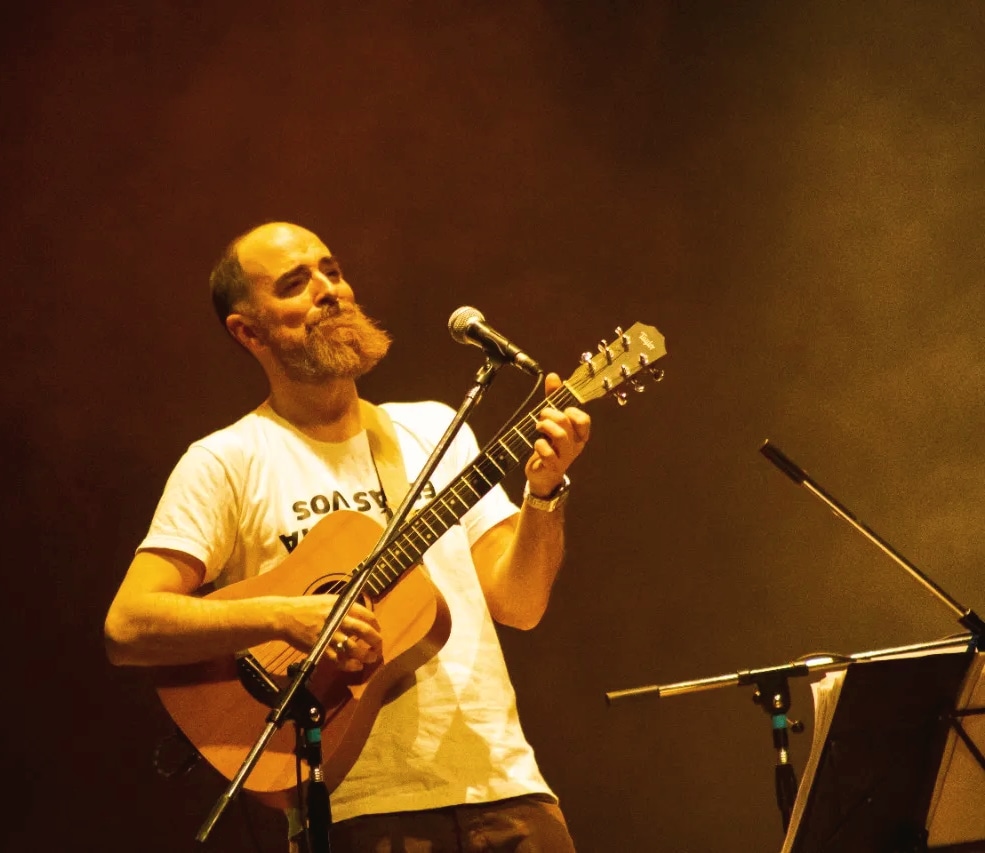
Juan Lucangioli is a musician, author, and meditation content creator based in the Spanish-speaking world, known for work that treats songwriting and written correspondence as technologies of consciousness exploration. His practice blends original songs, prose letters, and guided contemplations into a body of work concerned with what he calls the direct exploration of Being.
Juan Lucangioli is a musician, author, and meditation content creator based in the Spanish-speaking world, known for work that treats songwriting and written correspondence as technologies of consciousness exploration. His practice blends original songs, prose letters, and guided contemplations into a body of work concerned with what he calls the direct exploration of Being.
His creative output operates across three primary formats: recorded albums, published books, and a YouTube channel titled "Songs and Consciousness." The 2024 album Caleidoscopio represents his most recent full-length musical statement, while his written work includes the book Cartas a mi Madre and a free downloadable volume titled ¿Qué puedo decirte en un minuto?. His song "Nos escribimos cartas" exemplifies his thematic focus on epistolary connection as spiritual practice. The YouTube channel functions as a central hub where these forms converge, hosting meditations, reflections, original songs, and excerpts from his books.
Lucangioli's approach distinguishes itself through its insistence on correspondence as a contemplative discipline. He publishes a weekly newsletter called Notas del Camino, subtitled as a dose of inspiration and an invitation to contemplate the miracle in the everyday, which he frames explicitly as letters written to friends who share an orientation toward beauty and truth. This epistolary method extends the tradition of spiritual letter-writing into a digital-era format, positioning the newsletter as both teaching vehicle and relational practice.
His work draws from lineages of consciousness exploration and meditative inquiry, though his public materials emphasize direct experience over sectarian affiliation. The recurring motifs in his catalog include the soul, everyday miracle, and the meeting point between aesthetic experience and inner knowing. His songs function less as performance pieces than as instruments for attention, composed to invite listeners into states of reflection rather than entertainment.
Lucangioli's distribution model prioritizes accessibility. His book ¿Qué puedo decirte en un minuto? is offered as a free download, and his YouTube channel operates as an open archive. The weekly Notas del Camino newsletter reaches subscribers without paywalls, consistent with a broader ethos that treats contemplative content as commons rather than commodity. His audience consists largely of Spanish-speaking seekers drawn to the intersection of music, meditation, and written reflection.
His current work continues to unfold across the same three channels: new music released through streaming platforms, ongoing newsletter correspondence via Notas del Camino, and regular uploads to the Songs and Consciousness YouTube series. His catalog remains small but coherent, built around the conviction that songs, letters, and guided silences can serve as portals to presence.
For someone encountering Lucangioli's work today, his output offers a sustained invitation to treat listening, reading, and silence as co-equal practices in the exploration of consciousness.
FAQ
Questions
Juan Lucangioli is a musician, author, and meditation content creator whose practice centers on the intersection of consciousness exploration and contemplative songwriting. His work—spanning the album Caleidoscopio (2024), books including Cartas a mi Madre and ¿Qué puedo decirte en un minuto?, and a weekly newsletter called Notas del Camino—operates at a slower frequency than most digital content, positioning itself as an invitation to notice the sacred in ordinary moments. What distinguishes him is his refusal to separate the musician from the author from the meditation guide; listeners and readers encounter the same sensibility across formats. His recent song "Nos escribimos cartas" exemplifies his core preoccupation with correspondence—the idea that connection itself is a form of contemplative practice. Those who follow him tend to be seekers already attuned to meditative music and the kind of spiritual philosophy that unfolds through lived experience rather than doctrine.
While the available data doesn't specify a formal lineage or teacher lineage, Lucangioli's work sits squarely within the contemporary meditation and consciousness-exploration traditions that emerged from North American and European engagement with Eastern contemplative practices, particularly around mindfulness, non-dual awareness, and the poetics of Being. His emphasis on correspondence, everyday miracle-noticing, and the soul's interior landscape aligns more closely with the Romantic-mystical strain within Western spirituality than with devotional or guru-centered traditions. The structure of his newsletter—framed as letters to friends who love beauty and truth—echoes the epistolary spiritual correspondence tradition, reminiscent of practices found in Christian contemplative writing and the Sufi letter-writer's approach to teaching. His songwriting practice suggests an integration of meditative music composition with what might be called the "consciousness exploration" lineage, wherein music becomes a direct vehicle for encountering states of awareness rather than a tool for inducing them.
Start with the free downloadable book ¿Qué puedo decirte en un minuto?—it's the lowest-friction entry point and captures his core sensibility: brevity paired with depth, observations about consciousness and soul that don't require prior spiritual study to register. From there, subscribe to Notas del Camino, his weekly newsletter, which functions as a gentle ongoing introduction to his perspective on everyday contemplation without demanding commitment to albums or longer texts. Once you're accustomed to his voice and approach, move into his album Caleidoscopio (2024), which presents meditative music and consciousness exploration in integrated form. For those drawn to the author side, Cartas a mi Madre offers a more personal, narrative entry into his interior landscape. His YouTube channel, "Songs and Consciousness," presents a curated sequence of meditations, reflections, and songs that can serve as a second pathway in, particularly if you're already a listener rather than a reader.
Lucangioli refuses the separation between artist-as-performer and artist-as-teacher that defines much of the meditation music field; he doesn't offer ambient music designed to fade into the background, nor does he position himself as a guide leading you toward predetermined states. Instead, his work—across Caleidoscopio, his song "Nos escribimos cartas," and his YouTube offerings—asks listeners to bring their own awareness to the encounter, treating each piece as correspondence rather than instruction. Where many meditation-music creators operate in the ambient or neo-classical instrumental space, Lucangioli integrates songwriting, voice, and the specificity of language into his meditative practice, suggesting that consciousness exploration happens through particularized beauty rather than through abstraction. His newsletter and books reveal a sensibility shaped by literary and epistolary traditions, not just musical ones; he's as much a writer thinking through music as a musician thinking through words. The sum of these choices—refusing easy categorization, insisting on the reader's or listener's active contemplation, treating everyday correspondence as a spiritual practice—sets his work apart from both the wellness-industry meditation music and the academic consciousness-exploration content that dominate the space.
Lucangioli's work isn't designed for listeners seeking high-energy, rhythmically propulsive meditation music or the upbeat wellness-industry soundtracks optimized for productivity and gym sessions. His meditative content assumes a listener who's willing to slow down and who finds value in contemplative practice as an end in itself, not a means to optimization or stress reduction. Those looking for explicit spiritual instruction, systematic teaching, or a clear map of consciousness will find his approach—rooted in correspondence, observation, and the poetic—frustratingly indirect; he doesn't offer techniques or step-by-step methodologies. Similarly, his work requires Spanish-language literacy or English translation for full comprehension, which naturally excludes or complicates access for those who only read English and don't engage with the bilingual spiritual culture from which much of his sensibility emerges. And because his material is distributed across multiple formats (newsletter, books, songs, YouTube, Spotify) without a centralized curriculum, listeners seeking one complete, authoritative "way in" may find the fragmentation confusing rather than liberating.
Based on the available material, Lucangioli's music appears to favor intimate, contemplative arrangements that prioritize space and lyrical presence over density or spectacle. His song "Nos escribimos cartas" exemplifies his aesthetic: spare instrumentation, a direct vocal delivery, and a focus on the words themselves as carriers of meaning and consciousness. The album Caleidoscopio (2024) suggests a palette of meditative music that integrates songwriting with deeper exploration of Being, likely featuring acoustic or minimal electric instrumentation, reflecting the contemporary singer-songwriter lineage filtered through a consciousness-exploration lens. Pacing-wise, his work resists the ambient minimalism that dominates meditation music; instead, it moves at the speed of thought and conversation, with songs that develop through attention rather than through production density. His choice to frame his musical work as "Songs and Consciousness" on YouTube indicates that production choices serve the music's relational quality—the song as a meeting point between artist and listener—rather than the immersive or boundary-dissolving effects common in meditation music. The overall aesthetic reads as one of restraint and clarity, valuing what's left unsaid as much as what's articulated.
"Nos escribimos cartas" emerges from the available data as a signature piece, its focus on correspondence and connection suggesting suitability for contemplative listening or as an opening or closing element in a practice setting. His album Caleidoscopio (2024) is explicitly framed as integrating meditative content with songwriting, implying that multiple tracks function as meditation or contemplative practice material. His YouTube channel, titled "Songs and Consciousness," curates meditative music, reflections, and songs, suggesting that Lucangioli himself has identified certain pieces as particularly suited to direct consciousness exploration. Because his work is structured around the weekly Notas del Camino newsletter—framed as an invitation to notice the everyday miracle—his entire sonic and textual body tends toward the contemplative; individual tracks aren't necessarily "meditation music" in the ambient or functional sense, but rather songs that ask for the listener's full attention and interior participation. For those seeking to use his work ceremonially or in structured practice, the YouTube channel likely offers the clearest pathway, as Lucangioli appears to have pre-selected and sequenced material for that purpose.
Lucangioli operates across multiple formats—music, books, and meditative content—without privileging one over the others, which reflects his integrated approach to consciousness exploration and contemplative practice. His music is distributed on Spotify (135 followers, though this undersells his actual reach), and his song "Nos escribimos cartas" and album Caleidoscopio (2024) are discoverable there. His books, Cartas a mi Madre and the free ¿Qué puedo decirte en un minuto?, exist in downloadable form through his Linktree (linktr.ee/juanlucangioli). The primary sustained engagement happens through his weekly newsletter, Notas del Camino, which serves as a throughline for his practice and as the vehicle for deepening connection with his audience. His YouTube channel (@lucangiolijuan) functions as a curated space presenting songs, meditations, reflections, and teachings, making it arguably the most comprehensive single platform for encountering his work across its forms. Those serious about following his practice should subscribe to the newsletter while maintaining awareness of his YouTube channel; Spotify serves primarily as discovery and for those who prefer streaming, though the platform doesn't fully represent the depth and intentionality of his overall practice.
Notas del Camino functions as weekly letters to friends rather than as a mass-distribution broadcast or spiritual teaching series, a framing that fundamentally shapes its tone and content. Each note is described as "a dose of inspiration and an invitation to contemplate the miracle in the everyday," positioning the newsletter not as instruction or motivation toward external goals, but as correspondence between people who share a commitment to beauty and truth. This epistolary structure reflects Lucangioli's broader preoccupation with correspondence as a contemplative practice itself; the act of writing and reading letters becomes a form of consciousness exploration. The tone likely reads as intimate, observational, and invitational rather than prescriptive or authoritative—the voice of someone noticing something and sharing it with trusted friends, not a guru dispensing wisdom. For subscribers, the newsletter serves as a weekly touchpoint that situates spiritual practice within the texture of daily life, explicitly framing the invitation to contemplate as something available in ordinary moments rather than requiring retreat or special circumstances. This positions Lucangioli's work within a distinctly non-hierarchical, friendship-based spiritual tradition that honors the reader's own authority and interior knowing.
Spiritual correspondence for Lucangioli appears to mean the practice of exchanging letters as a form of consciousness exploration and intimate spiritual connection—not as a delivery system for teaching, but as the teaching itself. His book Cartas a mi Madre (Letters to My Mother) and his song "Nos escribimos cartas" (We Write Each Other Letters) both foreground this theme, suggesting that the act of attending to another person through language and care is itself a meditation on Being. His newsletter, Notas del Camino, extends this practice into a public form: weekly letters to friends who share a love of beauty, functioning as ongoing correspondence that honors both the singular reader and the community of readers. This approach challenges the typical spiritual teacher-student hierarchy by positioning all participants as both writers and readers, each person's interiority essential to the exchange. Across his work—music, books, newsletter, and meditative content—Lucangioli treats language, attention, and relational exchange as primary vehicles for consciousness exploration, suggesting that genuine spiritual practice unfolds not in isolation but in the careful, attentive space between people who choose to correspond with one another.


C’est vous ? Revendiquer cette page ›
There's more where this came from.
BrightStar is the global directory of artists, teachers, and healers in the wellness and spiritual movement. Find your next experience — or add yourself.
Discover More Artists
Browse 14,000+ curated profiles across kirtan, yoga, meditation, and beyond.
Explore directory →Find an Event Near You
Kirtan, retreats, sound baths, breathwork, ceremonies — happening this week.
Browse events →Add Your Profile
Are you an artist, teacher, or healer? Get listed — free, AI-assisted, live in minutes.
Get started →