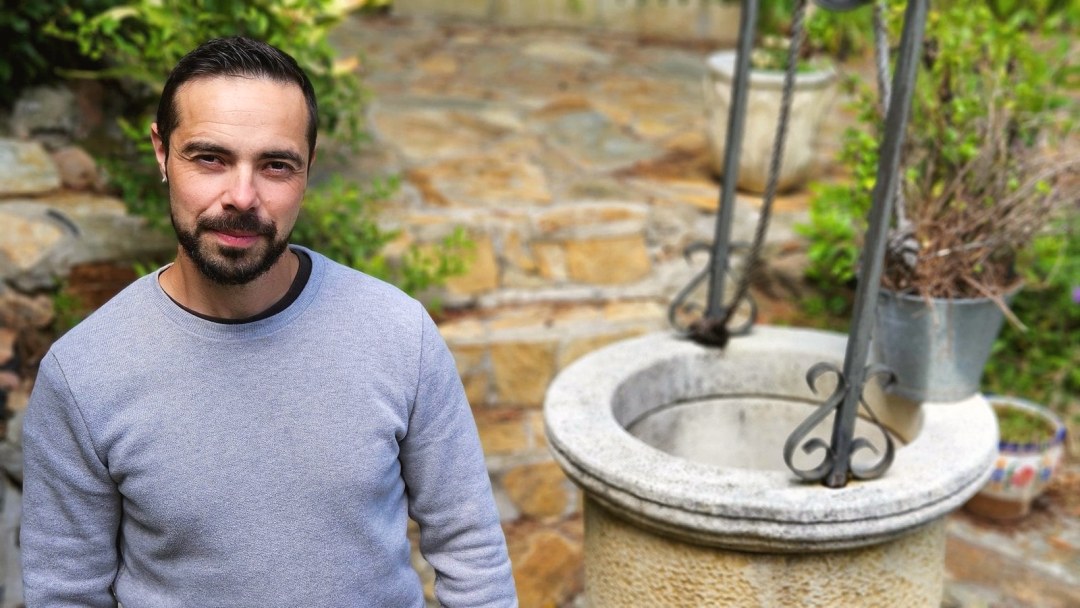

Ismael Abós
Yoga Teacher
À propos
Ismael Abós accompanies people on a path of inner transformation through mindful meditation and spiritual coaching. He describes his purpose as helping people reconnect with their inner wisdom, let go of blocks and live from a place that is deeper, more authentic and more at peace. On his website he puts it this way: "Volver a ti es el viaje más importante que puedes hacer" ("Returning to yourself is the most important journey you can make").
Ismael Abós accompanies people on a path of inner transformation through mindful meditation and spiritual coaching. He describes his purpose as helping people reconnect with their inner wisdom, let go of blocks and live from a place that is deeper, more authentic and more at peace. On his website he puts it this way: "Volver a ti es el viaje más importante que puedes hacer" ("Returning to yourself is the most important journey you can make").
He is a certified Hatha Yoga instructor, a coach accredited by the International Coach Federation (ICF) and a breathwork facilitator, with specialised training in conscious breathing techniques for personal transformation. He has more than 15 years of meditation practice and exploration. In 2012 he created one of the first Spanish-language YouTube channels devoted to guided meditation.
By his own account, his path began with deep questions: why he felt disconnected when he seemed to have everything, and how to come back to himself. The search was not always easy. It included moments of existential crisis that invited him to look inward, release old beliefs and find the tools he now shares.
Today he shares guided meditations designed to help people rest, heal and reconnect with themselves, and he works one-to-one with people going through processes of change.
FAQ
Questions
Ismael Abós is a Hatha yoga instructor, ICF-accredited coach, and meditation guide who has spent over 15 years developing and refining a practice centered on guided meditation and breathwork facilitation. He gained visibility in the Spanish-speaking spiritual community by launching one of the first dedicated YouTube channels for guided meditation in Spanish back in 2012, at a time when such resources were scarce online. What distinguishes his following is not celebrity but consistency—his channel frames itself as a corner of peace, healing and personal growth, and appeals to listeners seeking structured, accessible entry points to meditation practice without the aesthetic pretension of many contemporary yoga influencers. His appeal stems from a grounded pedagogical approach: he works both through recorded meditations (featuring guided sessions, binaural waves, and mantra-based content) and through one-to-one spiritual coaching, which means his work reaches people at different stages of readiness. The through-line of his practice is a single, unglamorous conviction—that transformation is not about accumulating more, but about returning to yourself, a philosophy born from his own early encounters with existential crisis and the search for inner coherence.
Ismael Abós's practice is rooted in classical Hatha Yoga lineage, as evidenced by his formal certification as a Hatha Yoga instructor, but his work draws eclectically from contemporary Western approaches to mindfulness, integral coaching, and somatic breathwork facilitation. His emphasis on guided meditation as a primary tool, rather than asana-focused practice, places him closer to non-dual or Advaita traditions where self-inquiry and return to inner awareness are the real work. The International Coach Federation accreditation indicates he integrates modern coaching methodology—drawn from contemporary psychology and systems thinking—into what might otherwise be purely devotional or contemplative practice. His incorporation of mantras and what he describes as binaural waves suggests familiarity with both ancient chant traditions and modern consciousness research, though the data doesn't indicate affiliation with a specific lineage teacher or guru. In essence, his lineage is synthetic: classical Hatha at the root, plus Western integral coaching, plus somatic breathwork modalities, plus a contemporary understanding of meditation's role in personal development—a common pattern among Spanish-language teachers who trained in the late 2000s and early 2010s when traditional lineage transmission was less accessible in Spain than in the US.
The most accessible entry point is his YouTube channel, which has hosted thousands of guided meditations in Spanish since 2012 and functions precisely as an on-ramp for people with no prior experience. A newcomer should begin with one of his shorter, foundational meditation recordings—likely in the 10-15 minute range—rather than attempting an extended session, since the value lies not in duration but in establishing familiarity with his voice, pacing, and the particular quality of attention he cultivates. What will likely strike a first-time listener is the absence of musical accompaniment in many of his recordings; instead, the work relies on silence, subtle binaural frequencies, and his own voice as the primary instruments, which creates a clarity that can feel either refreshingly direct or, for some, austere. If that resonates, the next logical step is exploring his mantra-based or breathing-focused meditations, which offer more structure and technique than open awareness work. For someone seeking personalized guidance, his one-to-one spiritual coaching practice is the deeper tier, though that requires identifying someone with questions precise enough to warrant professional accompaniment—his coaching is not generic motivation, but targeted work on the beliefs and patterns that keep someone disconnected from their own wisdom.
The defining distinction is that Ismael Abós built his prominence not through asana-focused group classes or the yoga studio circuit, but through pioneer work in Spanish-language online meditation—he founded one of the first YouTube channels dedicated to this work in 2012, at a moment when such resources barely existed outside English-language platforms. This choice reflects a different pedagogical commitment: rather than the body-first, postural yoga that dominates contemporary studio culture, his work privileges return-to-self through sitting practice, breathwork, and mantra, which situates him closer to classical meditation teachers than to the contemporary yoga industry. His dual certification—both Hatha Yoga instructor and ICF-accredited coach—is unusual; most yoga teachers don't carry formal coaching credentials, which means his one-to-one work likely incorporates narrative inquiry, systems thinking, and behavioral coaching alongside meditation technique. The philosophy it's not about doing more, but about returning to yourself is a direct counter to the productivity-driven spirituality that dominates much of contemporary wellness culture—his work is explicitly reductive, not additive. Where many teachers in this space position meditation as a tool for optimization or stress relief, Ismael Abós frames it as fundamentally about authenticity and inner alignment, which appeals to a different seeker: one wrestling with existential questions rather than seeking efficiency.
Ismael Abós's work is not for practitioners seeking vigorous, physically demanding yoga—there's no evidence his teaching emphasizes asana, advanced postures, or the strength-building dimensions of Hatha practice that many yoga students prioritize. It's also not ideally suited for people who require external motivation, goal-oriented frameworks, or the sense of progress that comes from visible achievement; his philosophy of returning to yourself implies a de-emphasis on accumulation or advancement, which can feel like stagnation to ambition-driven practitioners. Someone drawn primarily to devotional chanting, mantra-singing communities, or the aesthetic experience of sacred music will likely find his meditations austere—his use of binaural waves and silence over rich musical arrangements appeals to a more minimalist sensibility. Seekers accustomed to highly personalized, Instagram-friendly spiritual teaching may find his emphasis on consistency and unglamorous interior work ungratifying; there's no evidence of retreat brands, signature courses, or lifestyle commodification. Additionally, his work operates primarily in Spanish and through Spanish-language platforms, which means English-language audiences looking for convenient access or translation will face friction. Finally, because much of his teaching is recorded and asynchronous, people who need real-time, embodied group experience or the accountability of a studio community may find isolated meditation and sporadic coaching insufficient.
His primary platform for new content is his YouTube channel (UCpyK6y297P9tzRA7UGOEM5A), which has been his consistent outlet since 2012 and where he regularly uploads guided meditations, mantra recordings, and reflective content—this should be the first place to check for new releases. His website at ismaelabos.com/sobre-mi/ contains information about his practice, philosophy, and likely pathways to inquire about one-to-one coaching or retreats, though from available data there's no evidence of a structured, published tour schedule or upcoming group events. He maintains a presence on Spotify (artist profile: 0EkwryHIfgxCUjP5FHXLLz), though with minimal followers and no popularity metrics, suggesting his audience remains concentrated on YouTube and potentially private coaching relationships. For those seeking direct connection, his website likely contains contact information for coaching inquiries or retreat arrangements, though these are not announced as public events. The most reliable approach is subscribing to his YouTube channel to receive notifications of new meditation uploads, which is how his existing audience stays connected to his work—this is the authentic venue for his practice, not social media or streaming platforms. If seeking information about retreats, workshops, or group events, direct outreach through his website would be necessary, as his emphasis on one-to-one coaching and recorded guidance suggests he may not maintain a public calendar of offerings.
While Ismael Abós's recorded work offers the most accessible glimpse into his teaching presence, the key characteristic that emerges is restraint—his meditations favor silence, minimal instrumentation, and his voice as the primary guide, which creates an experience of directness rather than immersion in exotic soundscape or elaborate ritual. His teaching assumes a certain readiness in the student; he's not interested in making meditation comfortable or easy, but in offering tools for genuine self-confrontation and return to inner alignment, which means his sessions likely involve discomfort or the encounter with one's own resistance as part of the process. The integration of breathwork facilitation suggests his one-to-one coaching probably moves beyond pure meditation into somatic work—using breath patterns, sensation awareness, and movement to access and release patterns that pure sitting alone might not touch. His description of himself as a lifelong listener and companion indicates a teaching presence defined by attentiveness rather than charisma or instruction-giving—someone who meets students where they are rather than imposing a predetermined narrative of transformation. For group retreats, if they exist, the framework would likely emphasize simplicity, inner work, and the unraveling of complexity rather than the accumulation of new practices or the exotic aestheticization of spiritual experience; his philosophy suggests a retreat would feel more like a deliberate reduction than an expansion.
The core thread running through his work is the question of authenticity and return—how to move from a life of accumulated conditioning, disconnection, and external orientation back toward genuine inner wisdom and presence. His own origin story, rooted in existential crisis (what is the meaning of all this, why feel disconnected when you seem to have everything), indicates his teaching emerges from the specific question: how do we recover coherence and integrity when we're living in misalignment with ourselves? The emphasis on breathwork and conscious breathing for personal transformation suggests he sees the breath as a primary intervention point—where habitual contraction, trauma, and disconnection lodge in the body, and where return becomes physically possible. His repeated assertion that it is not about doing more, but about returning to yourself is not mere philosophy but a working principle that shapes all his offerings, suggesting his meditations and coaching likely deconstruct the achievement orientation that many students bring to spiritual practice. The focus on mantras and mantra-based meditation indicates interest in how repetition, vibration, and sound frequency can alter consciousness and reorganize internal patterns.
Ismael Abós's primary body of recorded material exists as guided meditations and related content on his YouTube channel, which functions as a de facto archive of his teaching accumulated since 2012. These recordings include guided meditations, binaural wave sessions, mantra-based practices, and what he describes as reflective videos, all designed to be accessible for independent study without requiring a teacher present or prior training. While there's no evidence of published books or written teachings in the data, his YouTube channel includes descriptive material, perhaps reflections on practice, and the meditations themselves embed his teaching philosophy through the specific instructions, framings, and pacing he employs. His website may contain additional written material, essays, or recordings not indexed in the current dataset, so direct exploration of ismaelabos.com would be necessary for a complete picture of available teachings. For someone seeking structured, text-based teaching or recorded talks (as distinct from guided meditation recordings), the evidence is limited—his work appears primarily oriented toward experiential guidance through audio rather than intellectual or narrative transmission.
One of the strengths of Ismael Abós's approach is that his YouTube channel functions explicitly as an entry point—he created it as a corner of peace, healing and personal growth designed to serve people at all stages of familiarity with meditation, which means a complete beginner can access his work without prerequisite knowledge or practice. That said, his teaching assumes a certain readiness or openness: he's not interested in selling meditation as a wellness tool or stress-reduction technique, but as a path back to inner authenticity and coherence, which means students benefit from already having asked themselves existential questions or feeling drawn to something deeper. His emphasis on letting go of what blocks you and reconnecting with inner wisdom suggests his meditations may encounter resistance, suppressed emotions, or confrontation with one's own patterns—this is not difficult in the sense of requiring expertise, but in the sense of requiring willingness to be uncomfortable. For his one-to-one coaching, the picture is likely different; coaching relationships typically require clarity about what you're seeking to change or understand, so someone approaching his coaching work should come with at least a question, even if not fully formed. The key distinction is between access (which requires nothing) and effectiveness (which requires honesty). In summary: no technical background is necessary, but emotional honesty and willingness to look inward are implicit requirements; this is beginner-friendly practice, but not comfortable practice.



C’est vous ? Revendiquer cette page ›
There's more where this came from.
BrightStar is the global directory of artists, teachers, and healers in the wellness and spiritual movement. Find your next experience — or add yourself.
Discover More Artists
Browse 14,000+ curated profiles across kirtan, yoga, meditation, and beyond.
Explore directory →Find an Event Near You
Kirtan, retreats, sound baths, breathwork, ceremonies — happening this week.
Browse events →Add Your Profile
Are you an artist, teacher, or healer? Get listed — free, AI-assisted, live in minutes.
Get started →