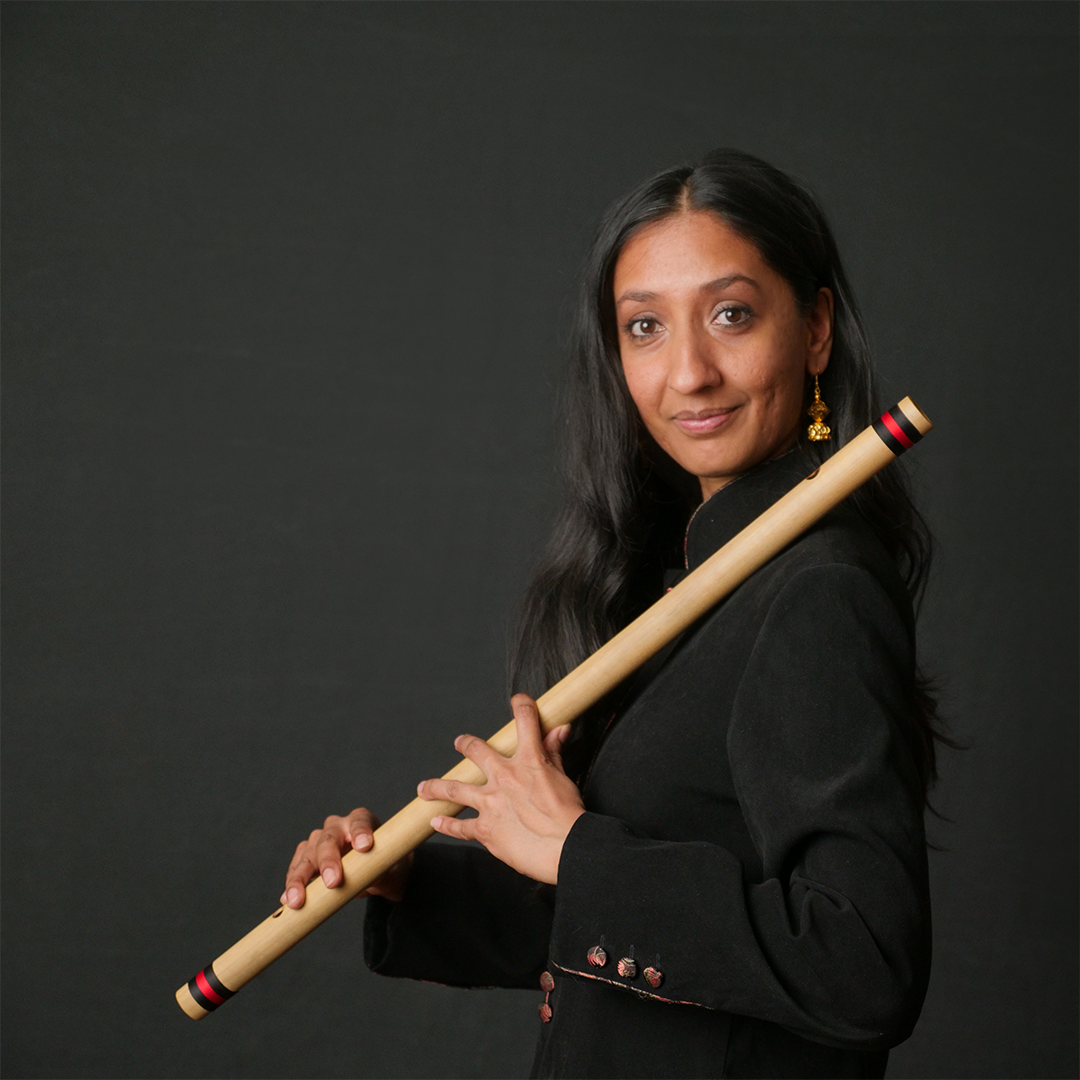

In an era when sacred music often struggles to find authentic voices that can speak across cultural divides, Sheela Bringi has emerged as a rare artist whose work embodies both deep traditional rootedness and genuine accessibility. A vocalist, bansuri flutist, and raga harp player, Bringi has built a career that refuses to choose between reverence and innovation, instead creating a sonic bridge between Indian devotional traditions and contemporary spiritual seekers worldwide.
Her Indian vocals and instrumental virtuosity have graced over fifty sacred chant and world music albums, including the Grammy-nominated "Bhakti Without Borders"—a recognition that speaks to her ability to honor tradition while making it resonate in modern contexts. Yet to understand Bringi purely through accolades would be to miss the essence of an artist whose work is fundamentally about transmission rather than performance.
Bringi's musical journey began in a family where music and spirituality were not separate pursuits but intertwined ways of being. Raised in a multicultural environment that exposed her to diverse musical languages, she pursued rigorous training in North Indian classical music—a discipline that demands not just technical mastery but a philosophical understanding of sound as a spiritual practice.
This classical foundation proved essential. North Indian classical music, with its complex ragas and rhythmic cycles, requires years of dedicated study under the guidance of a guru. For Bringi, this training became more than musical education; it was an initiation into a lineage where music serves as a vehicle for devotion. Her gurus instilled in her the principle that authentic sacred music requires both technical excellence and genuine spiritual intention—a lesson that would shape everything that followed.
Significantly, Bringi also pursued training in Western musical traditions, creating an unusual dual fluency that would later allow her to serve as a cultural translator. This combination of North Indian classical rigor and Western musical literacy gave her the tools to speak to audiences who might find traditional Indian music impenetrable while never diluting the integrity of the source material.
While many musicians with Bringi's credentials might have focused solely on performance and recording, she recognized a deeper need. Alongside her partner Brent, she co-founded the Sacred Sound Lab, an online school dedicated to teaching Indian devotional music to students around the world.
This initiative represents perhaps the most significant aspect of Bringi's legacy. Sacred Sound Lab addresses a crucial gap: how to transmit the practices of Bhakti—the yoga of devotion through music—to people who may have no cultural connection to India but who hunger for practices that engage both heart and voice. Through the platform, Bringi offers not just technique but context, helping students understand the devotional frameworks that give these musical forms their spiritual power.
The decision to build an educational platform reveals Bringi's understanding that sacred music traditions survive through living transmission, not museum preservation. By training others in the authentic practices of kirtan and mantra, she ensures that these traditions continue to evolve while maintaining their essential character.
Bringi's instrumental palette—voice, bansuri flute, and raga harp—is itself a statement about cultural synthesis. The bansuri, a bamboo flute central to both North Indian classical music and Krishna bhakti traditions, carries centuries of devotional associations. In Bringi's hands, its breathy, meditative tones create spaces for contemplation even in contemporary musical settings.
The raga harp, a less common instrument in the Indian classical tradition, represents Bringi's innovative spirit. This instrument allows her to explore the melodic frameworks of raga with a timbral palette that Western ears find immediately accessible, creating yet another bridge between traditions.
But it is perhaps her voice that serves as her primary instrument—trained in the ornamental precision of North Indian classical music yet warm enough to invite listeners unfamiliar with these traditions into the experience.
In an increasingly globalized spiritual landscape, figures like Bringi play a crucial role. She offers something distinct from both the strict traditionalism that can feel exclusionary and the cultural appropriation that strips practices of their depth and context. Her work demonstrates that it is possible to share sacred traditions across cultural boundaries with both authenticity and generosity.
Bringi's contribution to over fifty albums in the sacred chant and world music genres has helped shape how Western audiences encounter Indian devotional music. Her involvement with projects like "Bhakti Without Borders" exemplifies her commitment to music as a practice of connection—not just between musicians, but between traditions, cultures, and seekers.
For yoga practitioners, meditation teachers, and spiritual seekers who have discovered mantra and kirtan as transformative practices, Bringi provides both a model and a guide. She demonstrates that engagement with these traditions need not be superficial, that depth is available to anyone willing to approach with humility and dedication.
As sacred music continues to find new audiences in wellness spaces, retreat centers, and meditation communities worldwide, Sheela Bringi's work stands as evidence that tradition and accessibility need not be opposing forces—that it is possible to honor lineage while serving the genuine spiritual hunger of contemporary seekers.