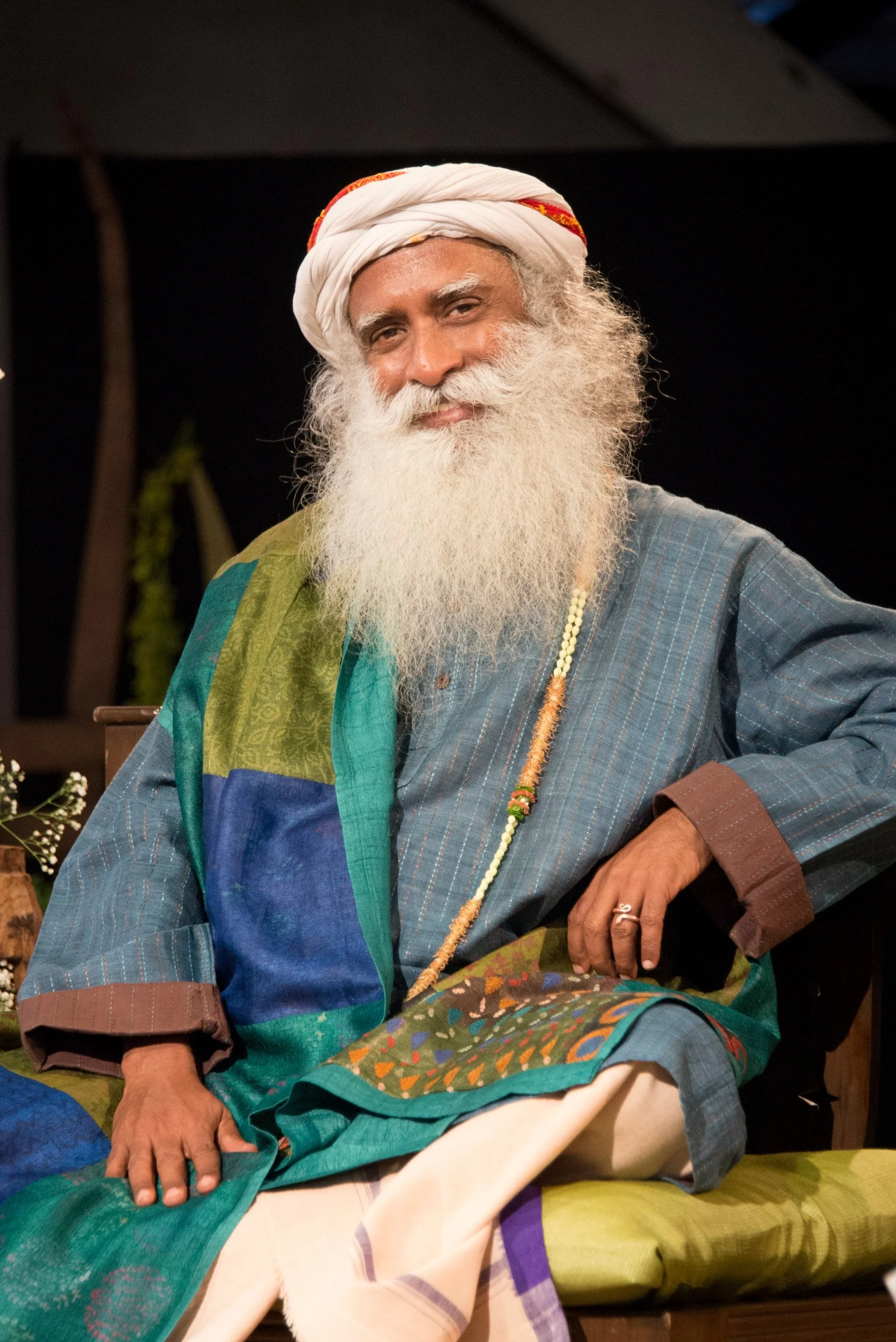

Jaggi Vasudev, known worldwide as Sadhguru, has become one of contemporary spirituality's most recognizable voices—a barefoot mystic equally at home addressing crowds at the United Nations and sharing stage with heads of state as he is seated in meditation. Born in 1957 in Mysore, India, he grew up in a traditional South Indian family, yet his childhood was marked by an unusual affinity for the natural world. He spent hours exploring the forests and hills around his hometown, exhibiting an early independence of spirit that would later characterize his approach to spiritual teaching.
His early years revealed a restless intelligence, a deep curiosity about existence itself that traditional education couldn't fully satisfy. After completing his studies, Vasudev entered the business world, working in various enterprises—an unexpected prelude for someone who would eventually renounce conventional success for a more elusive pursuit.
The trajectory of Vasudev's life pivoted on a single afternoon. Sitting on a rock atop Chamundi Hill, he underwent what he has described as a profound, life-altering experience—a moment of such intensity that the boundary between himself and everything around him dissolved. The details of this transformation remain largely in the realm of personal mysticism, but its effects were undeniable. The young businessman began teaching yoga in 1982, and the path from that moment forward was irreversible.
This wasn't a gradual awakening or a slow accumulation of insight, but rather a sudden rupture in ordinary consciousness that demanded a complete reorientation of life. What followed was not retreat into solitude, but an outward movement—a commitment to share what he had experienced through the systematic transmission of yogic practices.
In 1992, Vasudev established the Isha Foundation, based in Coimbatore, India. The foundation operates an ashram and yoga centre that has become the organizational infrastructure for his work, supporting educational and spiritual activities that reach millions globally. Unlike many spiritual organizations that remain contained within traditional religious frameworks, Isha Foundation has positioned itself at the intersection of ancient wisdom and contemporary life.
The flagship offering is Inner Engineering, a program that distills complex yogic practices into accessible formats for modern practitioners. Combining meditation techniques with yoga, Inner Engineering aims to foster mental clarity and emotional balance—goals that resonate with audiences far beyond traditional spiritual seekers. The program represents Sadhguru's core methodology: taking practices rooted in millennia-old traditions and presenting them without religious trappings, emphasizing direct experience over belief.
What distinguishes Sadhguru's teaching is its resistance to dogma. Drawing from Hindu philosophy and yogic sciences, he nonetheless encourages individuals to verify spiritual truths through their own experience rather than accept them on faith. His books explore spirituality, philosophy, and personal development through this lens of experiential inquiry. His speaking style—conversational, often humorous, sometimes provocative—has made him accessible to audiences who might otherwise dismiss spiritual discourse as arcane or irrelevant.
This approach has earned him platforms at international forums, educational institutions, and conferences where spirituality traditionally finds little space. His ability to discuss inner transformation in the same breath as environmental sustainability or social issues has expanded the context in which spiritual teaching can occur.
Sadhguru's work extends beyond personal transformation into environmental activism. The Isha Foundation has initiated large-scale ecological projects, recognizing that inner well-being and planetary well-being are inseparable concerns. This integration of contemplative practice with worldly engagement challenges the stereotype of the withdrawn mystic, presenting instead a model of spirituality that addresses both consciousness and consequence.
His writings and talks cover vast terrain—from the mechanics of meditation to reflections on mortality, from the nature of mind to practical wisdom for daily living. The breadth reflects his fundamental assertion that spirituality isn't a separate department of life but the very foundation of human existence.
In an era of increasing anxiety and disconnection, Sadhguru has found an audience hungry for practices that promise equanimity without requiring religious conversion. His followers span continents and cultures, from Indian practitioners rooted in yogic tradition to Western seekers navigating secular societies. This cross-cultural appeal speaks to his ability to articulate perennial concerns—suffering, meaning, purpose—in language that transcends cultural specificity.
He represents a particular moment in the globalization of Eastern spiritual practices, where ancient techniques are repackaged for contemporary consumption. Whether this constitutes dilution or skillful adaptation remains debated, but the scale of his influence is undeniable.
Sadhguru embodies contradictions that mirror our complex times: a mystic with millions of social media followers, an advocate of inner silence who speaks prolifically, a teacher of detachment who engages vigorously with the world. These paradoxes may be precisely what makes him relevant—a figure who refuses the binary choice between spiritual withdrawal and worldly engagement.
As he continues teaching, writing, and building the infrastructure of Isha Foundation, Sadhguru represents an ongoing experiment: whether ancient wisdom can genuinely address modern malaise, whether interior transformation can scale, whether one person's experience on a hilltop can ripple outward to touch lives across the planet. The answer, he would likely insist, lies not in belief but in practice.