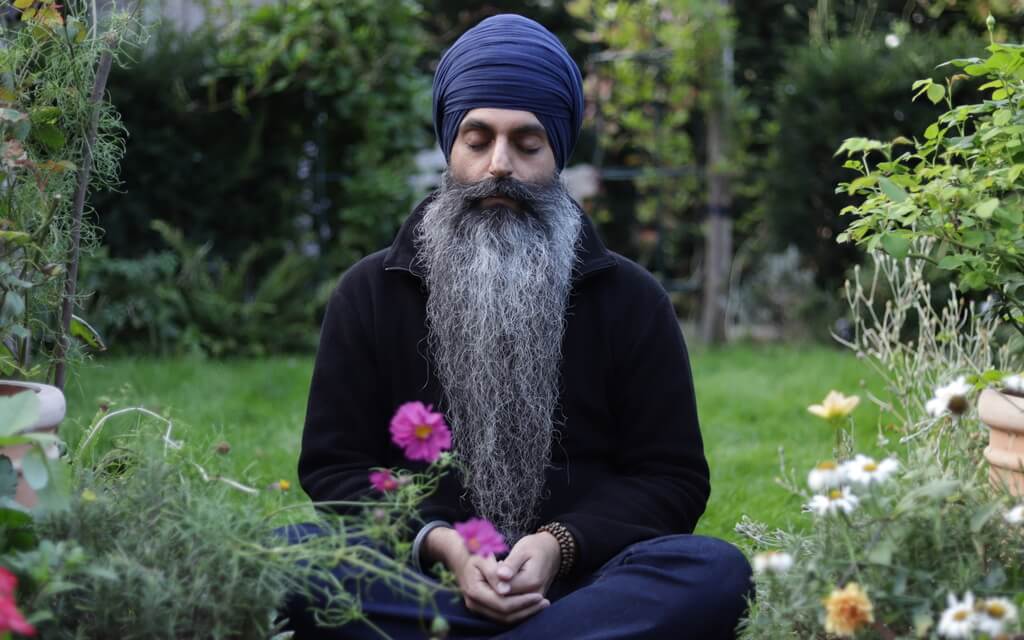

Nanak Naam occupies a distinctive space in contemporary spiritual teaching—an organization devoted to translating the 500-year-old wisdom of Guru Nanak, the founder of Sikhism, into accessible guidance for modern seekers. Rather than operating as a single teacher or guru figure, Nanak Naam functions as a collective spiritual platform, drawing from the profound well of Sikh philosophy while extending its reach far beyond the boundaries of any single faith community.
At its heart lies a radical proposition: that the teachings of Guru Nanak speak to a universal human experience, transcending religious identity to address the fundamental questions of consciousness, connection, and meaning that confront anyone attempting to live with awareness in the contemporary world.
What distinguishes Nanak Naam is its commitment to meeting people where they already are—online, overwhelmed, and searching for practical tools rather than abstract philosophy. The organization has built its presence primarily through digital platforms: podcasts that explore everyday challenges, online videos offering guided meditations, social media content that doesn't shy away from difficult subjects, and live events that create community around shared practice.
This approach reflects an understanding that spiritual teaching in the twenty-first century requires more than preserving tradition—it demands translation. The founders and teachers behind Nanak Naam have dedicated themselves to this work of interpretation, maintaining fidelity to Guru Nanak's core insights while rendering them relevant to lives shaped by technology, globalization, and the particular anxieties of our historical moment.
Central to their teaching is the concept of Gurmat—the wisdom transmitted through the Sikh Gurus—and specifically Guru Nanak's emphasis on the fundamental oneness of existence. This isn't presented as metaphysical abstraction but as practical foundation: a lens through which to cultivate what Nanak Naam calls "emotional and spiritual intelligence."
The core contribution of Nanak Naam lies in demonstrating how an ancient spiritual framework can inform contemporary mindfulness practice. While meditation and mindfulness have become thoroughly secularized in Western wellness culture, Nanak Naam offers something different: practices rooted in devotional tradition, enriched by concepts from Vedanta and nondual philosophy, yet presented without requiring conversion or cultural assimilation.
Their guided meditations incorporate elements often absent from mainstream mindfulness: mantra, chanting, prayer, and the devotional quality of satsang—spiritual gathering and discourse. This represents a fuller spectrum of contemplative practice, acknowledging that the journey toward self-awareness isn't purely secular or psychological, but touches on dimensions of experience that traditional religious language attempts to capture.
What makes this particularly compelling is Nanak Naam's willingness to address what they describe as "often-taboo subjects"—the messy, difficult aspects of human experience that spiritual communities sometimes sidestep. This grounded approach prevents the teachings from floating into escapist spirituality, instead anchoring them in the actual conditions of contemporary life.
With nearly 12,000 followers on Spotify alone, Nanak Naam has cultivated a significant community of practitioners—what might be called a digital sangat, or spiritual community. These aren't necessarily people drawn to Sikhism as a religion, but seekers attracted to depth, authenticity, and teachings that honor both transcendence and the texture of daily life.
The reach extends across demographics that might never encounter each other in traditional religious settings: second-generation Sikhs seeking connection to their heritage through fresh interpretation, mindfulness practitioners looking for wisdom traditions beyond Buddhism, spiritual seekers disillusioned with both dogmatic religion and shallow self-help, and anyone navigating the particular vertigo of modern existence with its fractured attention and manufactured anxieties.
This diverse audience suggests that Nanak Naam has successfully articulated something essential: that Guru Nanak's 500-year-old emphasis on direct spiritual experience, service, and the recognition of divine presence in all beings speaks precisely to our current crisis of meaning and connection.
To speak of Nanak Naam's legacy may be premature—this is work very much in progress, adapting and evolving as it grows. Yet certain contributions are already evident. The organization demonstrates that lineage-based spiritual teaching can thrive in digital spaces without dilution, that devotional practice and contemporary mindfulness can enrich rather than contradict each other, and that ancient wisdom traditions contain resources we've barely begun to tap.
Perhaps most significantly, Nanak Naam models an inclusive approach to sacred tradition—honoring the specificity of Sikh teaching while recognizing its universal application. This represents a third way between cultural appropriation and religious gatekeeping, suggesting that wisdom can be shared across boundaries while maintaining integrity and respect for its origins.
In an era of spiritual fragmentation, where many seek meaning outside institutional religion but hunger for something deeper than therapeutic mindfulness, Nanak Naam offers genuine substance: practices refined over centuries, philosophical frameworks tested by generations, and a vision of human flourishing rooted in recognizing our fundamental interconnection. That such teaching finds resonance with thousands of contemporary seekers suggests both the timelessness of Guru Nanak's insights and the skill with which Nanak Naam translates them for our moment.