
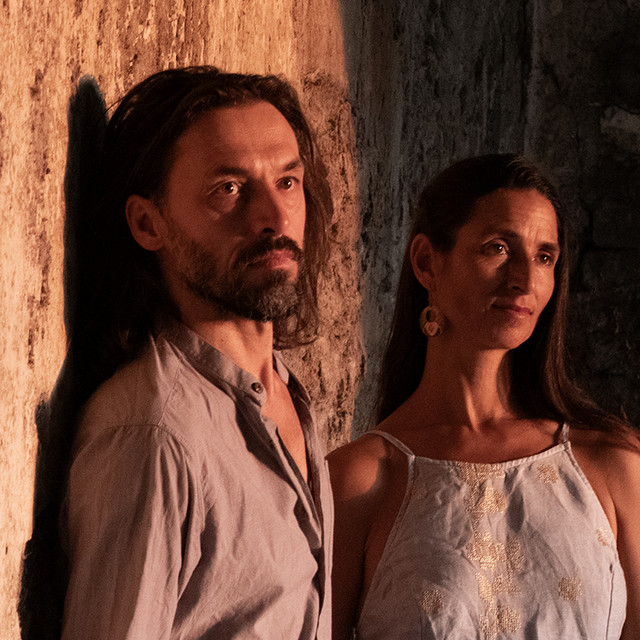
Mirabai Ceiba emerged from an unlikely convergence: Markus Sieber, a German-born musician who grew up exploring instruments and musical traditions across Europe, and Angelika Baumbach, who spent her formative years immersed in Mexico's vibrant cultural landscape. Their individual journeys—his rooted in the classical and experimental traditions of Germany, hers in the warm, devotional currents of Mexican spirituality—would eventually intertwine in the United States, where they discovered a shared vision that transcended their separate histories.
The duo's name itself hints at their synthesis: Mirabai, the 16th-century Indian mystic poet whose bhajans expressed radical devotion, paired with Ceiba, the sacred tree of Mesoamerican tradition. This marriage of Eastern and Western hemisphere symbolism mirrors the couple's own union and artistic philosophy—a bridge between worlds, cultures, and spiritual lineages.
What drew Markus and Angelika together was not simply romantic connection, but a mutual recognition that music could serve as something more than entertainment or even art in the conventional sense. Both had been on parallel spiritual journeys, exploring meditation, mindfulness, and Eastern philosophical traditions. In their partnership, they found an opportunity to create music that functioned as practice rather than performance—or rather, where performance itself became a form of devotional practice.
The formation of Mirabai Ceiba represented a deliberate pivot away from music as career and toward music as calling. Their work would blend chamber music's intimate refinement with world music's boundary-crossing spirit, all filtered through the lens of devotional intention. The result is a sound that resists easy categorization: too sophisticated for the New Age bin, too spiritually intentional for the world music section, too rooted in tradition for the meditation aisle.
The core contribution of Mirabai Ceiba lies in their ability to create sonic environments that facilitate inner work. Their compositions draw from diverse wells—European classical sensibilities, Latin American warmth, Indian devotional forms—yet avoid the pitfall of cultural tourism. Instead, these elements dissolve into something unified and coherent, a musical language that speaks to contemplative practice across traditions.
Their discography reveals a consistent artistic vision while showcasing subtle evolution. Each album functions as an invitation into meditative space, where gentle instrumentation—often featuring guitar, piano, and harmonium alongside Angelika's ethereal vocals—creates atmospheres of tranquility and introspection. The poetic lyrics often explore themes of love, nature, and the divine, but with a lightness that never becomes heavy-handed or dogmatic.
What distinguishes their work from ambient meditation music is its refusal to disappear into background. There is real compositional craft here, melodic development, harmonic sophistication. The music rewards both focused listening and meditative absorption, functioning equally well as concert experience and contemplative tool.
Mirabai Ceiba's live performances extend their recorded work into experiential territory. These aren't concerts in the traditional sense, but rather immersive gatherings where the boundary between performer and audience softens. The couple creates environments where listeners are invited to participate energetically if not vocally, to use the music as a vehicle for their own inner exploration.
This approach has cultivated a devoted following, though their Spotify numbers—just over a thousand followers—suggest they operate somewhat outside mainstream visibility. Yet this modest digital footprint belies their cultural significance within certain communities: yoga studios, meditation centers, spiritual retreats, and spaces where people gather for contemplative practice.
The work of Mirabai Ceiba extends beyond albums into the realm of teaching and spiritual practice. Drawing inspiration from Eastern philosophies, particularly traditions related to meditation and mindfulness, the duo has positioned themselves not merely as musicians but as facilitators of spiritual exploration. Their dedication to these teachings infuses everything they create, lending their work an authenticity that resonates with listeners seeking substance beneath the surface.
This commitment also places them within a lineage of Western artists who have engaged seriously with Eastern spiritual traditions—not as appropriators or dilettantes, but as devoted practitioners whose creative work emerges from genuine practice.
Mirabai Ceiba matters precisely because they refuse to matter in conventional terms. In an era of algorithmic promotion and streaming metrics, they've carved out space for music that serves rather than sells, that invites contemplation rather than consumption. Their cultural significance isn't measured in chart positions but in the quality of attention they inspire.
For those who discover them—whether in a yoga class, a meditation retreat, or through the recommendation of a fellow seeker—Mirabai Ceiba offers something increasingly rare: music that asks nothing of the listener except presence. In creating sonic spaces for stillness and introspection, this husband-and-wife duo continues to demonstrate that gentleness, in art as in life, can be its own form of strength.