
Byron Katie didn't set out to become a spiritual teacher. Born in 1942 in Breckenridge, Texas, she spent her early adult years struggling with depression and a pervasive sense of unworthiness that grew increasingly unbearable. By the mid-1980s, her suffering had become so acute that she found herself in a halfway house for recovering addicts, consumed by darkness and despair.
What happened next would change not only her life but eventually the lives of millions seeking relief from mental suffering.
In 1986, while staying at that halfway house, Katie experienced what she describes as a profound spiritual awakening. The realization that emerged from that experience was disarmingly simple yet revolutionary: her thoughts—not her circumstances—were the source of her suffering. This insight became the foundation for everything that followed.
The awakening didn't offer her a new set of beliefs to adopt or a philosophy to follow. Instead, it revealed something more fundamental: the possibility of questioning the thoughts themselves, of examining the beliefs that create suffering rather than automatically accepting them as truth. This direct, experiential understanding became the seed of what would grow into her life's work.
From that awakening emerged a method of self-inquiry that Katie would eventually formalize as "The Work"—a systematic approach to examining thoughts and beliefs. At its core, The Work consists of four deceptively simple questions that can be applied to any stressful thought. These questions, combined with a process called the Turnaround, invite people to investigate their thinking from different perspectives.
What distinguishes Katie's approach from traditional therapeutic or spiritual frameworks is its accessibility and simplicity. The Work doesn't require adherence to any particular religious tradition or philosophical system. It's not about replacing negative thoughts with positive ones or adopting a new belief system. Instead, it's an invitation to look directly at what we believe to be true and ask: Is it? Can I absolutely know that it's true? How do I react when I believe that thought? Who would I be without it?
This method of inquiry draws from principles found in mindfulness and non-dual spiritual teachings, yet Katie presents it in a way that transcends traditional religious frameworks. The focus remains relentlessly practical: questioning thoughts as they arise in daily life, examining the stories we tell ourselves about reality, and discovering what remains when those stories are seen through clearly.
Over the past twenty-five years, Katie has shared The Work through numerous channels. Her books have become touchstones for those seeking emotional healing and self-understanding. "Loving What Is" stands as perhaps her most well-known title, introducing countless readers to the fundamental practice of self-inquiry. "I Need Your Love—Is That True?" extends the method specifically to beliefs about relationships and the need for approval from others.
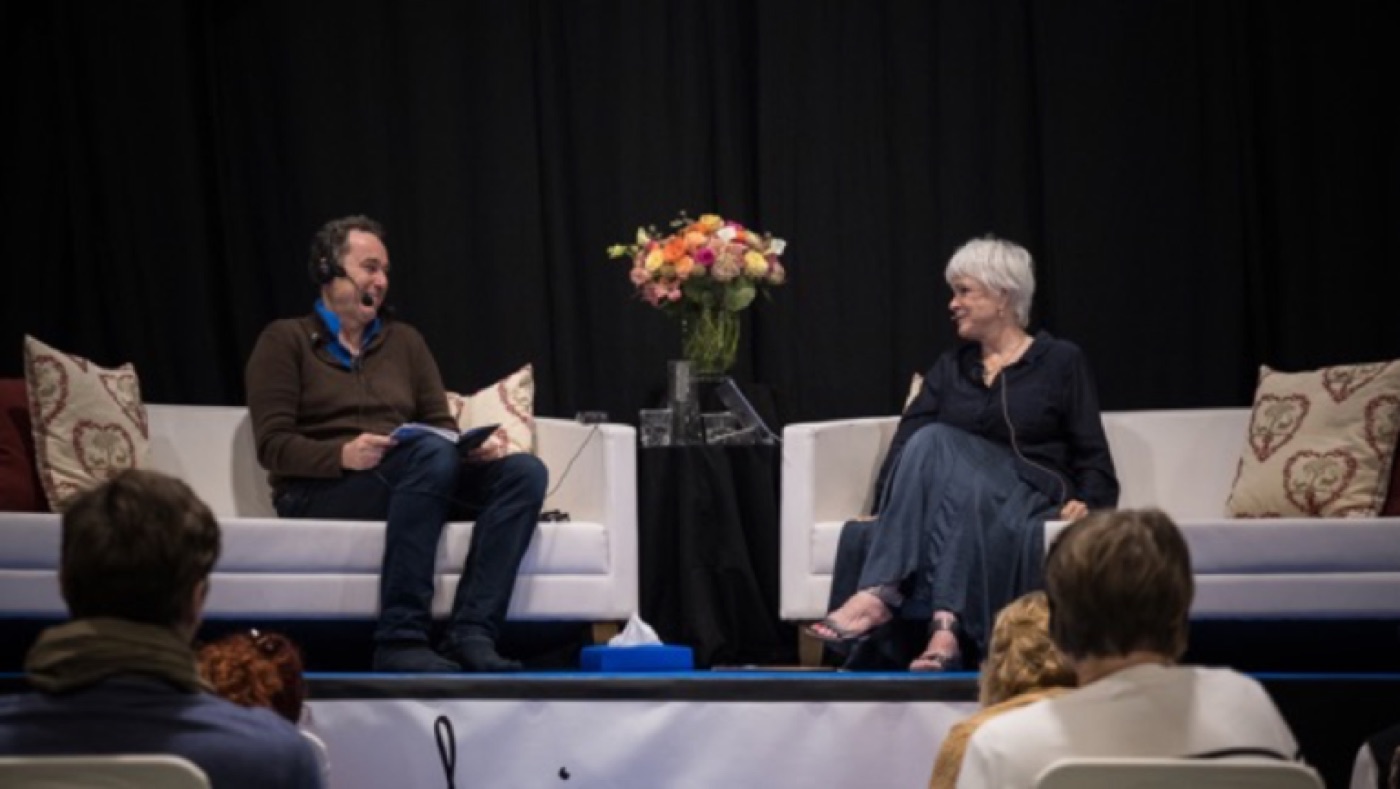
Through workshops and retreats, Katie has worked directly with people from all walks of life, demonstrating The Work in real time. These gatherings aren't lectures but participatory experiences where individuals bring their own suffering to the table—painful thoughts about relationships, health, money, self-worth—and learn to question them systematically. The teaching happens not through abstract philosophy but through concrete examination of the beliefs that cause suffering in the moment.
What makes Byron Katie culturally significant isn't the invention of self-inquiry itself—questioning one's thoughts has roots in ancient wisdom traditions. Rather, it's her ability to present this practice in language that resonates with contemporary seekers who may feel alienated by traditional spiritual frameworks. She speaks the vernacular of everyday suffering: the fight with a partner, the disappointment with one's body, the resentment toward a parent, the fear of failure.
Her work reaches people who might never enter a meditation hall or pick up a sacred text, yet who are desperately seeking relief from mental and emotional pain. In a world increasingly aware of mental health struggles yet often overwhelmed by the complexity of available solutions, The Work offers something rare: a method that's both profound and immediately applicable, requiring no special knowledge or preparation.
Today, Byron Katie's teachings continue to spread through books, online resources, and ongoing workshops. The simplicity of The Work allows it to be shared peer-to-peer, creating a network of practitioners who bring the method into their own communities and professional practices. Therapists, coaches, educators, and healthcare providers have integrated elements of The Work into their approaches, extending its reach beyond Katie's direct teaching.
In an era of stress, anxiety, and information overload, Katie's fundamental message carries particular weight: that we have the capacity to end our own suffering by examining the thoughts that create it. She doesn't promise happiness or enlightenment—only the possibility of freedom from believing painful thoughts that may or may not be true.
Her legacy rests not in building an institution or establishing a following, but in offering a method that anyone can use, regardless of background or belief system. The Work invites a kind of radical self-honesty, a willingness to question even our most cherished stories about reality. For those willing to engage with that invitation, Byron Katie's contribution offers a pathway from suffering to clarity, one question at a time.