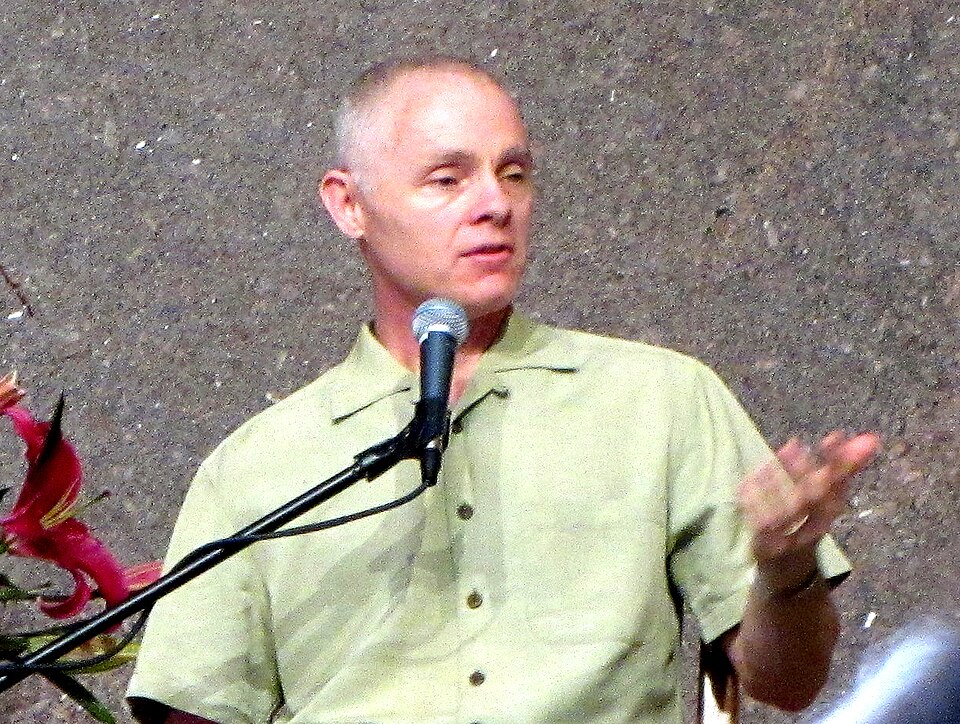
In a clip of about two and a half minutes, Adyashanti offers a small experiment that shifts the usual question about presence. Most people ask whether they are in the present moment or drifting out of it. He asks a different question: where are you looking from? Standing at a window, you can perceive a tree from your eyes, then add the feeling of your heart, then drop attention into your belly, and notice how the same tree and the same day arrive differently each time. The segment, which the video's description says is drawn from his book The Present Perspective, insists that the experiment is playful rather than a test. It also extends to the hardest days, when the usual spiritual techniques stop working and the moment feels confusing, heavy, or lost. His claim is that the quality of your presence can change the quality of the moment you are living in.
The scene he sets is deliberately ordinary. You are at a window. He asks you to reconnect with a version of yourself that is "a little less anxious, little younger," and simply look out. The first position is the eyes. He says, "That's where we look out from, my eyes." This is the default setting most of us never examine, the feeling that consciousness sits somewhere behind the forehead and sends its gaze outward.
Then comes the variation. Adyashanti asks what it would be like to include the feeling of the heart while looking, and then to let the gut participate, "as if my eyes are in my gut." He is careful to undercut the literal reading. "You're not your eyes aren't going to drop down to your gut," he says, "but hey, you can take in information in different parts of your body." The image is a prompt for attention, not an anatomy lesson. Attention is being moved to a new location, and the instruction is simply to notice what changes.
The final position is what he calls "all this all at once," looking from the eyes, heart, and belly together. Each stage is framed as a question you ask of the tree: how does it look from my eyes, how is it when I incorporate my heart, how is it down in the belly of things. The repetition is the method. You return to the same object and let the position of perception be the only variable.
Adyashanti makes a distinction that is easy to skim past. "We know our senses," he says at about the thirty-four-second mark, "visual, auditory, there's the senses. But the subtle senses is what I'm really talking about." The five familiar senses report on the outside world. The subtle senses, in his usage, are the ways a person registers a moment through feeling, through the heart and the belly, rather than through the sensory channels we typically trust.
He does not define this at length in the clip, and it would be a mistake to fill that gap with claims he did not make here. What he does make clear is the practical stance. You are not asked to believe in a particular mechanism. You are asked to test whether a moment is different when it is registered from a different center, and then to notice the difference for yourself. That makes the teaching empirical in tone even though it draws on contemplative language.
The central claim of the clip arrives about three-quarters of the way through. Adyashanti says: "You're noticing how literally your experience of a given moment or a given day is almost entirely dependent on where you're perceiving from." At roughly the 1:19 mark he adds that "you can change an immense amount about how you experience and how you feel about that moment by looking at where you're looking at the moment from."
This is a strong statement and worth sitting with. It suggests that much of the texture of experience, including how heavy or spacious a day feels, is shaped by the posture of attention rather than by the events themselves. The tree is the same tree. What differs is the one looking. For a reader who has ever noticed that the same commute feels unbearable on one morning and fine on another, the claim has an obvious resonance. The clip does not argue this with data or case studies. It invites you to test it on a window, which is a very low-stakes laboratory.
There is also a subtle reframe in the word "perceiving." Presence in this teaching is not only about being somewhere in time. It is about the stance from which you meet what is there. Two people can be equally "present" in the sense of not daydreaming, and still meet the moment from very different places: one from the tight, forward-leaning eyes of the thinking mind, the other from a more settled center. The experiment is designed to make that difference visible.
The most useful part of the clip may be its honesty about bad days. Adyashanti jokes about waking up "on the bad side of the universe," and then describes the situation many meditators know well: the sense of being unable to be present, everything feeling difficult and confusing. Rather than telling you to escape that state, he asks a question about it. Can you enter the moment with all of its discomfort, but with that same curiosity? What is it like to be present with the feeling of being lost, unconnected, or anxious?
Then he applies the three positions to the difficulty itself. How is the uncomfortable moment when seen from the intellect? From the heart? When the belly is included? The point is not to make the discomfort disappear. It is to see whether the experience changes when it is met from a different place. Given his central claim, the discomfort may be partly a function of perspective rather than a fixed property of the situation.
He is also clear that this will not always work. "Some days it's just rough days," he says, "and just the spiritual little tricks of the trade just don't work very well. There's days like that." That admission matters. It keeps the practice from becoming another standard by which a person judges themselves. The clip ends on a steadying line: "Even on a day like that, that's what's happening in your present moment. That can change given the quality of how you meet that present moment, your own presence."
The instructions in the clip are unusually permissive, and that is part of their design. Adyashanti repeatedly says you are "not trying to get it perfect or right," and that you should avoid "getting it too fancy." You are "experimenting" and "playing," and you are "noticing." A workable version, drawn directly from the clip, looks like this:
- Stand or sit at a window, or any place where you can see something outdoors, such as a tree.
- Look from your eyes first, and notice how the object seems.
- Add the feeling of your heart while you look, and notice whether anything shifts.
- Bring attention down into your belly, and notice again.
- Try all three at once, and simply observe what the moment is like.
- Do not grade the result. The aim is curiosity about the difference, not a correct answer.
- On a hard day, bring the same three positions to the discomfort itself.
The exercise is short, and that is an advantage. Two minutes of looking out a window is easy to repeat, and repetition is what allows the difference to become noticeable. Many people will find that the first attempts feel forced or imaginary. Adyashanti's language anticipates this. The point is to play with the variable, not to produce a feeling on demand.
If this clip resonates, the most direct next step is to try the window exercise once a day for a week and keep a few words of notes about what changed when you moved your perception from the eyes to the heart to the belly. The video's description identifies the segment as coming from The Present Perspective, which is the fuller source for these ideas; readers who want more context than a two-minute clip can offer should start there. Watch the clip again on a difficult day, and pay attention to the question it asks rather than the answer it gives. Adyashanti's larger point is that the present moment is not fixed. It is met, and the quality of that meeting is something you can explore.



