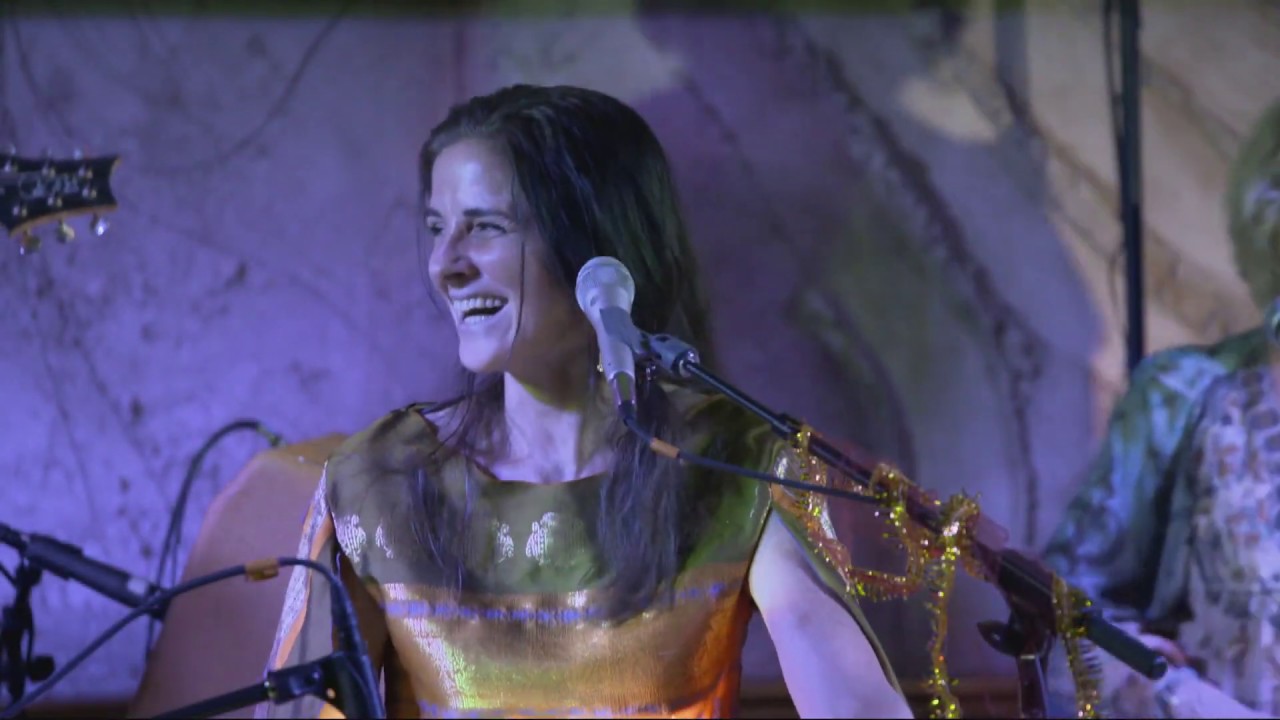
The record crackles first. Then a voice in the cadence of a head of state promises that peace can be made "not only within ourselves but also in the world around us," a peace measured not in days or years but in something lasting, something forever. Before the sentence can settle, a bomb detonates on the soundtrack. Silence, and then a chorus begins to sing in Sanskrit. That collision, a politician's promise cut short by an explosion and answered by an ancient blessing, is the spine of Ragani's "Peace Prayer / Seeing All the World as Divine," a five-minute piece that treats the Sanskrit chant Sarvesham svastir bhavatu as a hook, a prayer, and a dare. It is a hip hop record, a community production, and a meditation on one idea repeated until it becomes a practice: that the world is divine and can be treated that way.
The opening is a setup, and the production is deliberate about it. The crackle of an old record and a voiceover credited in the video as "Presidential Speech Vocal Characterization," performed by Mojo Bone courtesy of Ranchomojo Recordings, establish the tone of official optimism. The speaker says we "possess the power to create this enduring peace," and asks only that we "awaken ourselves to this power." (0:07) The line is sincere in its wording and familiar in its cadence, which is exactly why the bomb matters. At 0:37 the explosion arrives, and the video makes its first argument without any music at all: words of peace do not stop violence on their own.
Ragani does not stay in the realm of the sound effect. The music arrives at 0:45 with the first Sanskrit syllables, Sarvesham svastir bhavatu, and the chorus answers with the same phrase. That move, from a speech about power to a chant about blessing, is the video's thesis in miniature. Political language promises peace through force of will. The chant asks for peace as a state that must be wished for everyone at once.
The credits make clear this was built as a multi-layered production rather than a single voice over a beat. Ragani is credited with the music, lyrics, and executive production, and with the video's sound design. Mr. Logek handles rap vocals, David Vartanian plays electric guitar, and a cast of hip hop dancers, Rhema Love, Ashley Mitchell, Holly Haebig-Wake, Miriam Levie, and Deana Velázquez, carries the choreography, credited to Rhema Love, Ashley Mitchell, and Rhema'LEE Dance Academy. A rooftop breakdancer, Juan "Mijo" Rodriguez, appears in the frame. The genre choice is not decoration. Hip hop is a music of call and response, of crowd and voice, and the chant fits that architecture naturally. The Sanskrit refrain repeats the way a hook does; the English verses unspool like rap bars around it.
There is craft in how the two languages sit together. The chant is not translated and then explained. It is simply sung, and the English lines around it do the explaining. A listener who knows nothing of Sanskrit still learns from the repetition that sarvesham, "of all," is the key word, the word that sends the blessing outward from the singer to everyone. The mantra is not private or ceremonial in this arrangement. It is public, in the way a chorus is public.
Notice the form. Each verse begins with a "we" and moves in a deliberate arc, from the self outward into the world. The first verse starts in the heart: "We make it praying for the others / Living with an open heart / Bringing out the love that's inside." (1:20) The second turns relational: "We show our love for one another / Taking time to make the peace / Seeing all the world as divine." Later verses escalate into shared responsibility: "We got to honor one another / Open up the door to peace," then "We all can make it happen / Standing up to raise the bar / Waking up the love that's inside." The final verses describe service: "We make it serving one another / Lifting others with our love."
That progression matters. Peace here is not a feeling you hold while the world goes on. It has four verbs: pray, show, honor, serve. Each verse ends on the same refrain, "Seeing all the world as divine," so the refrain becomes a lens through which every action is read. The song is saying that prayer for others, open-heartedness, and service are the working parts of a divine view of the world, not optional extras to it.
The refrain itself is the most ambitious line. To see the world as divine is not the same as saying the world is perfect. It is a stance of regard: to look at people and places and treat them as sacred, even when they are violent or unfair. That is the practice the bomb-and-speech opening sets up as a problem. The song's answer is not to argue with the explosion but to keep singing the blessing anyway.
The chant lines in the video are not random. The song cycles through a set of Sanskrit phrases built on the same frame: Sarvesham ("for all"), followed by a word and Bhavatu ("may it be"). The video sings Svastir (well-being), Shantir (peace), Purnam (completeness), and Mangalam (auspiciousness). Read literally, the lines are wishes: may there be well-being for all, may there be peace for all, may there be completeness, may there be good fortune. The structure is a litany, and litanies work by accumulation. Each repetition deepens the wish.
Two other passages deepen the arc. At 3:07 the chorus sings Tamaso ma jyotir gamaya, a line that in its traditional form asks to be led from darkness to light, and is paired with Om Shanti Shanti Shanti, a triple invocation of peace. The Sanskrit here is a traditional prayer, and the song treats it as one, placing it at the climax where the English verses have built the emotional case. A listener does not need to parse each syllable to hear the shift from the unreal, the dark, the mortal, toward the real, the light, the lasting. The song's opening speech promised "a truly lasting peace." The prayer answers with a direction of travel.
The Peace Prayer video is not only a studio performance. Its credits list a long roster of street scene participants, around fifty names including Maggie Kuhn Jacobus, Paula Mitchell, Michael Culotti, Patricia Corrigan Culotti, Kulbir Singh, and Lakshmi Grace Phoenix, who is also credited as street scene photographer. Three young girls, Sky Kruse, Maya Sankpal-Tatera, and Anjali Sankpal-Tatera, appear as well. Nine cinematographers, including Bryce Richards, Ed Poser, and Dawn Haase, shot the footage, and Jimmy Sammarco handled post-production.
This is the detail that makes the piece more than a music video. The refrain asks viewers to see the world as divine; the cast is the world, rendered as a crowd of ordinary people in a shared street. A prayer for others, sung over a city of named participants, enacts the verse it is singing. The video's argument is communal by construction. The divine is not located in the singer. It is spread across the faces the camera holds.
The video was published on June 4, 2017, and the upload carries a view count of 72,347 at the time of this writing. The description points viewers to a download on iTunes and to lyrics published on the artist's site, which means the song was built to travel beyond the frame, into playlists and personal practice. A piece that began with a 2017-era political cadence, the rhythm of a speech about lasting peace, now reads as a time capsule of a particular kind of hope: the hope that a song can do the work that speeches often cannot.
Whether that hope has aged well is a question the listener has to answer for themselves. What the song offers is not a verdict but a method. Begin with the open heart. Show love and take the time to make peace. Stand up, honor, serve. Sing the blessing for all, and keep singing it after the explosion.
If the song has stayed with you, the most useful next step is to listen again with the chant lines in mind, following the arc from verse to verse rather than the hook alone. Read the lyrics on the artist's site, and notice how each verse adds a verb. If you want the Sanskrit sources, search the traditional prayers the chant lines come from, Sarvesham svastir bhavatu and Asato ma sad gamaya, and compare the classical texts with how Ragani has set them against a hip hop beat. Then look at the street scene credits and watch the faces. The video's most persuasive argument is that a blessing for everyone is easiest to believe when you can see who everyone is.