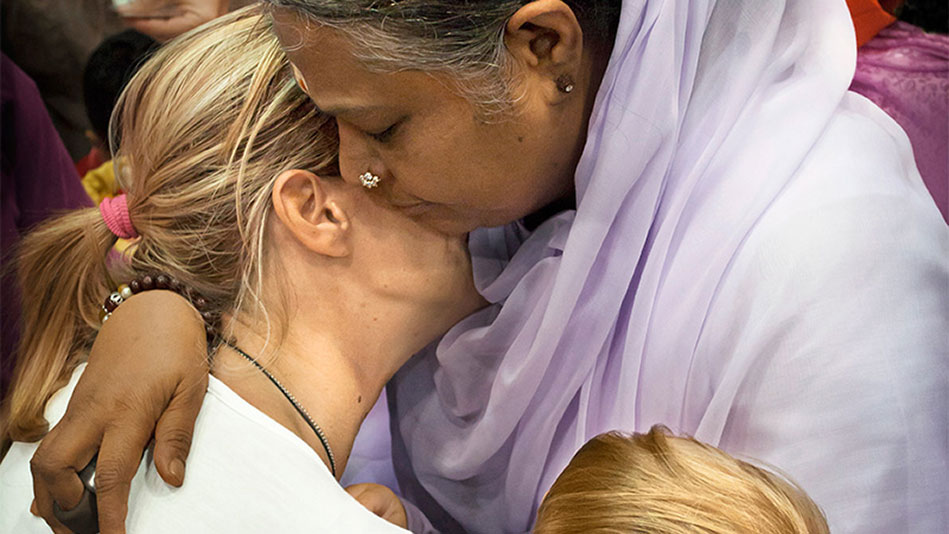
Amma's poignant words, "What we give, we receive. What we hold, we lose," invite us into a profound exploration of the dynamics of generosity and attachment. At first glance, this statement seems simple, yet it encapsulates a deep spiritual truth that resonates across cultures and traditions. The stakes are high: in a world often driven by accumulation and self-interest, understanding this principle can transform our relationships, our sense of self, and ultimately, our experience of life itself.
In a society that frequently equates success with possession, Amma's teaching serves as a gentle yet firm reminder of the impermanence of material wealth and the enduring nature of love and connection. By emphasizing the act of giving as a pathway to receiving, she challenges us to reconsider our priorities. This quote encourages us to cultivate a spirit of openness and generosity, suggesting that true fulfillment lies not in what we cling to, but in what we freely share with others.
The image / the metaphor
The imagery in Amma's quote evokes a dynamic interplay between two fundamental actions: giving and holding. The verb "give" suggests an active, outward motion, a release of what we possess, while "hold" implies a grasping, a desire to retain. This contrast creates a felt sense of tension between the freedom that comes with generosity and the confinement of attachment. In essence, Amma paints a picture of life as a flowing river, where the act of giving allows us to remain in the current, while holding onto things can lead to stagnation.
In the speaker's tradition
Amma's teachings are deeply rooted in the bhakti tradition, which emphasizes devotion and love as pathways to spiritual realization. Central to this tradition is the concept of "dharma," or righteous living, which encourages individuals to act in ways that promote harmony and connection. The idea of "kenosis," or self-emptying, resonates here as well; by letting go of our ego-driven desires, we create space for divine love to flow through us. In this context, Amma's quote becomes a call to embody the principles of bhakti, where the act of giving is both a spiritual practice and a means of aligning with a higher purpose.
Furthermore, we can draw parallels to the Buddhist concept of "sunyata," or emptiness, which teaches that clinging to the self leads to suffering. Just as Amma suggests that holding onto what we possess ultimately results in loss, the teachings of sunyata remind us that attachment to the self can obscure our true nature. In both traditions, the emphasis is on the transformative power of letting go, allowing us to experience the fullness of life through connection and compassion.
Living the teaching
Consider a modern scenario where this teaching resonates: a friend is going through a difficult time, and you have the opportunity to offer support. In this moment, you can choose to give your time, your presence, and your empathy. By doing so, you not only help your friend but also open yourself to the richness of shared experience and the deepening of your relationship. This act of giving creates a reciprocal bond, where both parties feel valued and connected, illustrating Amma's wisdom in action.
Another application of this teaching can be found in the realm of personal relationships. Imagine a situation where you find yourself holding onto past grievances with a loved one. By choosing to let go of these resentments and instead focus on forgiveness and understanding, you create space for healing and renewal. In this way, the act of releasing what you hold allows for a deeper connection to flourish, embodying the essence of Amma's message: that true richness comes from what we share, not what we cling to.
A reflection
As we contemplate Amma's profound words, we are invited to reflect on our own lives: What are the things we hold onto that may be preventing us from experiencing deeper connections? In what ways can we practice the art of giving, not just materially but emotionally and spiritually? By engaging with these questions, we can begin to uncover the layers of attachment that may be limiting our capacity for joy and connection, ultimately leading us toward a more fulfilling existence.