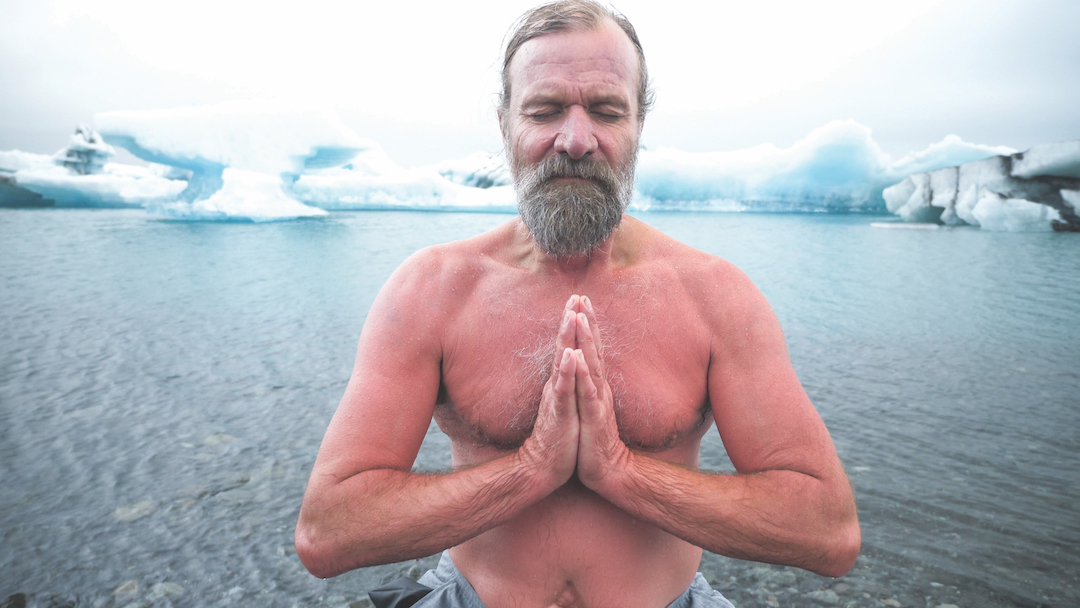


What is Wim Hof Method?
The Wim Hof Method (WHM) is a training system developed by the Dutch athlete Wim Hof, born 20 April 1959 in Sittard, Netherlands. He is widely known as “The Iceman.” People searching “what is Wim Hof Method” or “Wim Hof Method meaning” will usually find it described as three pillars: a specific breathing technique, progressive cold exposure, and a commitment or mindset practice. The breathing is the core. It is a cycle of deep, rapid inhalations followed by a breath hold. It is not a religious tradition. It has no creed, lineage of initiation or canonical scripture, although Hof and his instructors often describe it in terms of self-regulation and resilience.
Origins & lineage
Hof says he began regular cold-water immersion around 1979, including swims in Amsterdam canals. He says he developed his breathing and cold practices through self-experimentation. His account often cites the death of his wife, Olaya, in 1995 as a turning point in his dedication to the practice. In the 2000s he gained media attention for stunts in extreme cold. Among them were a climb on Mount Everest in shorts in 2007, which stopped well short of the summit, a barefoot half marathon above the Arctic Circle in Finland in 2009, and several Guinness-recognized ice-immersion records. Hof has said he taught himself, and no earlier teacher is generally credited with the method. Journalists and researchers have often compared it to tummo (“inner fire”), a Tibetan Buddhist heat-generating practice that combines breath, visualization and retention. Hof’s method has no documented institutional connection to that tradition, and the resemblance is a point of comparison rather than a lineage. His books include Becoming the Iceman (2011) and The Wim Hof Method (Sounds True, 2020).
How it’s practiced
The standard breathing round involves about 30 to 40 deep breaths. Each is a full inhalation through the nose or mouth, followed by a relaxed, unforced exhalation. After the last exhalation, the practitioner holds the breath with lungs mostly empty until a strong urge to breathe arises. A recovery breath follows: one deep inhalation, held for roughly 15 seconds. Practitioners usually do three or four rounds. Common sensations include tingling in the hands and face, lightheadedness, a feeling of warmth, and a quiet or still state during the retention. Cold exposure usually begins with ending a warm shower with 30 seconds of cold water and builds toward longer showers and ice baths. Hof’s instructions say the breathing should never be done in or near water, while driving, or in any setting where fainting could cause harm.
Wim Hof Method today
Seekers now meet the method in many forms. Hof’s company offers a paid mobile app with guided breathing and a free introductory video course. There are also in-person workshops, retreats and multi-day cold-exposure trips, and a certified instructor network. Many yoga studios, breathwork teachers, gyms and athletic coaches teach WHM-style sessions, some without certification. The practice has also spread through documentaries and podcasts, and through scientific research.
The research is mixed and still developing. A 2014 study by Matthijs Kox and colleagues, published in PNAS, followed 24 healthy men injected with bacterial endotoxin. Twelve of them had been trained in the method. The trained group reported fewer flu-like symptoms, and they showed higher adrenaline and a shifted inflammatory response. A 2018 brain-imaging study by Otto Muzik and colleagues, in Frontiers in Human Neuroscience, suggested a role for the periaqueductal gray in the pain and stress response. A 2016 Dutch trial on cold showers, which was not specific to WHM, reported fewer sick days. Critics point to small samples, the difficulty of separating breathing from cold and expectation effects, and the absence of large trials establishing health benefits.
Common misconceptions
- It is not a cure. Claims that it treats autoimmune disease, depression or other conditions are not backed by large clinical trials.
- It is not ancient. Although it resembles older breath traditions, it is a modern method based on one person’s experiments and later on a limited amount of research.
- It is not risk-free. Hyperventilation lowers carbon dioxide and can suppress the urge to breathe. Deaths from shallow-water blackout have been reported among people who practiced breath-holding in water, and Hof’s own guidance warns against that. People with epilepsy, cardiovascular disease, or who are pregnant are generally advised to consult a doctor first.
- It is not the same as tummo. The two share some features, but their aims, context and techniques differ.
- Cold is not the whole method. Breathing and mental training are taught as equal parts.
How to begin
For Wim Hof Method for beginners, the usual entry point is the free introductory course on the official site, or the guided breathing in the official app. Practice seated or lying down in a safe, dry place, and start with short cold showers rather than ice baths. A certified instructor workshop gives live correction and safety guidance. Hof’s book The Wim Hof Method covers the full protocol and the science as he presents it. Anyone with a heart condition, a seizure history or high blood pressure should speak with a physician first.