BrightStar

すべてのEventsを見る

意識ある集いに出会う

events

Yoga
Meditation
Breathwork
Qigong
Tai Chi
Sacred Music
World Music
Medicine Music
Sound Healing
Ecstatic Dance
人気の目的地
BaliSedonaLos AngelesCosta RicaNew YorkSan FranciscoAustinMiamiJoshua TreeTulum
すべてのカテゴリを見るすべての目的地を見る

すべての機能を探索

イベントを成長させる強力なツール

プラットフォーム機能

スマートダイナミックプライシング
チケットカテゴリ
座席指定
カート放棄リカバリー
訪問者リカバリー
寄付とスライディングスケール
アフィリエイトシステム
チケットスキャナー
クーポンコード
カスタム質問
チケット共有
アップセルとアドオン
分析とレポート
メールシーケンス
ウェイトリスト / 通知 / リマインダー
人と場所
Artists & TeachersEvent OrganizersVenues & StudiosKnowledge BaseGlossaryInspiration
すべての機能を見る私たちについて
料金ブログ
Language
Saved events
すべてのイベントを見る

events

YogaMeditationBreathworkQigongTai ChiSacred MusicWorld MusicMedicine Music

人気の目的地

BaliSedonaLos AngelesCosta RicaNew YorkSan Francisco

人と場所

Artists & TeachersEvent OrganizersVenues & StudiosKnowledge BaseGlossaryInspiration

プラットフォーム機能

スマートダイナミックプライシングチケットカテゴリ座席指定カート放棄リカバリー訪問者リカバリー寄付とスライディングスケールアフィリエイトシステムチケットスキャナークーポンコードカスタム質問チケット共有アップセルとアドオン分析とレポートメールシーケンスウェイトリスト / 通知 / リマインダー
すべての機能を見る私たちについて
料金ブログ
ログイン探求者クリエイター
  • すべてのイベントを見る
  • 探求者向け
  • ヨガ
  • 瞑想
  • ブレスワーク
  • 気功
  • 太極拳
  • 聖なる音楽
  • ワールドミュージック
  • メディスンミュージック
  • サウンドヒーリング
  • エクスタティックダンス
  • リトリート
  • ワークショップ
  • すべてのカテゴリ →
  • Bali
  • Sedona
  • Los Angeles
  • Costa Rica
  • Tulum
  • Byron Bay
  • San Francisco
  • Austin
  • New York
  • San Diego
  • Denver
  • Seattle
  • Portland
  • Miami
  • すべての都市 →
  • Join the Movement
  • Sell Globally
  • クリエイター向け
  • チーム向け
  • ライター向け
  • 講師向け
  • キルタンアーティスト向け
  • スタジオ向け
  • フェスティバル向け
  • リトリートセンター向け
  • 非営利団体向け
  • ブランドアンバサダー
  • 事例紹介
  • 無料チケット販売
  • Elevate
  • Amplify
  • 50万人以上のバイヤーネットワーク
  • カート放棄リカバリー
  • スマートダイナミックプライシング
  • チケットカテゴリ
  • 定期イベント
  • 座席指定
  • アフィリエイトシステム
  • ウェイトリスト / 通知
  • チケットスキャナー
  • 埋め込みウィジェット
  • イベント配信
  • メッセージセンター
  • インテグレーション
  • レポート
  • すべての機能 →
  • 概要
  • エコシステム
  • ブログ
  • 用語集
  • インスピレーション
  • ヘルプセンター
  • お問い合わせ
  • APIドキュメント
  • ブランドアセット
  • 採用
  • プレス
  • 利用規約
  • プライバシーポリシー

イベント

  • すべてのイベントを見る
  • 探求者向け
  • ヨガ
  • 瞑想
  • ブレスワーク
  • 気功
  • 太極拳
  • 聖なる音楽
  • ワールドミュージック
  • メディスンミュージック
  • サウンドヒーリング
  • エクスタティックダンス
  • リトリート
  • ワークショップ
  • すべてのカテゴリ →

目的地

  • Bali
  • Sedona
  • Los Angeles
  • Costa Rica
  • Tulum
  • Byron Bay
  • San Francisco
  • Austin
  • New York
  • San Diego
  • Denver
  • Seattle
  • Portland
  • Miami
  • すべての都市 →

クリエイター向け

  • Join the Movement
  • Sell Globally
  • クリエイター向け
  • チーム向け
  • ライター向け
  • 講師向け
  • キルタンアーティスト向け
  • スタジオ向け
  • フェスティバル向け
  • リトリートセンター向け
  • 非営利団体向け
  • ブランドアンバサダー
  • 事例紹介
  • 無料チケット販売
  • Elevate
  • Amplify

機能

  • 50万人以上のバイヤーネットワーク
  • カート放棄リカバリー
  • スマートダイナミックプライシング
  • チケットカテゴリ
  • 定期イベント
  • 座席指定
  • アフィリエイトシステム
  • ウェイトリスト / 通知
  • チケットスキャナー
  • 埋め込みウィジェット
  • イベント配信
  • メッセージセンター
  • インテグレーション
  • レポート
  • すべての機能 →

会社

  • 概要
  • エコシステム
  • ブログ
  • 用語集
  • インスピレーション
  • ヘルプセンター
  • お問い合わせ
  • APIドキュメント
  • ブランドアセット
  • 採用
  • プレス
  • 利用規約
  • プライバシーポリシー
BrightStar
© 2026 BrightStar. 全著作権所有.
Watch

Hare Krishna Harmonium: Teaching a Melody as Living Language

Gaura Vani
Gaura Vani
Aug 1, 2022
読了 約5分
視聴 · 7

Gaura sits at a harmonium camera mounted before him, ready to teach. He begins not with theory or history but with a melody—the descending Hare Krishna tune, what he calls "one of the classics." In the next ten minutes, he will do something unusual: he will teach the same melody twice, in two completely different ways, and in doing so, he will expose the hidden architecture of how sacred music actually breathes.

読む · 6セクション

Why This Melody Matters

The first thing Gaura tells you about the descending Hare Krishna tune is personal: he loves it. Specifically, he loves it for meditation. "I often use it for very meditative kirtans," he explains, and notes that while the tune can accelerate, for him "it just carries me effortlessly." That word—effortless—is not casual. It speaks to a quality of movement through a melody so natural it feels inevitable, as if gravity itself were singing.

He loves it for a second reason too: it works with harmony. "It's really good for doing harmonies," he says, and describes it as "very spacious"—a melody that leaves room for voices to gather and interweave without crowding each other. A spacious tune is one that trusts silence as much as sound, that knows the difference between fullness and congestion.

The Simplified Version: Learning Architecture

Gaura begins with the skeleton. He plays the descending Hare Krishna melody in C major, calling out the chords as he goes: straightforward, diatonic, the kind of harmonic bedrock you can build understanding on. He plays it cleanly, demonstrating each section. He even catches himself mid-teaching—"actually that's technically that's a minor chord," he admits, self-correcting—and you can hear the honesty in it, the refusal to perform infallibility.

This first teaching is pedagogically sound. It gives you something to hold onto. The chords resolve logically. The melody sits where you expect it. This is the version that fits on a page, that can be learned and remembered as discrete units: D minor, C major, A minor, F, back to C. It is music made teachable through reduction.

The Harmonium as Its Own Instrument

But then something shifts. Gaura pauses and offers a confession that reframes everything: "I know the harmonium as in its own instrument—it's almost like its own language for me." Not a keyboard. Not a chord-playing device. Its own language. The distinction matters because language is not the same as notation; it is lived, embodied, evolved through use.

He continues: "I don't even...I like I said it's all C major, then I realize I'm playing no no it's actually got a couple of minors in there." This stumbling, this uncertainty caught mid-sentence, is not a weakness in the teaching. It is the teaching. He is showing you what happens when you stop trying to fit the melody into a theoretical grid and start feeling what your hands are actually doing on the instrument.

The Gap Between Instruction and Practice

Now Gaura shows you the second version—the version he actually plays in kirtan. He calls it out plainly: "So now I'm going to play the harmonium really the way I actually play it." The shift is immediate and profound. The strict chord structure releases into something more fluid. Melody and harmony no longer exist in separate lanes; they weave together. His hands move across the keys not with the precision of someone following a map but with the ease of someone who knows the terrain so well they can move without looking.

He describes what he is doing: "I would add a little more melody and a little less chord." This is not a small edit. The balance of weight between harmonic support and melodic line has fundamentally shifted. The chords become a scaffold that the melody drapes over, sometimes filling, sometimes revealing empty space. He plays part two and notes, "I kind of like it better with just those two notes"—removing harmonic density in favor of clarity.

The Honest Practice

What Gaura has modeled is not just how to play a melody, but a philosophy of learning. The simplified version was not a lie; it was a threshold. You need the structure to understand the shape. But the living practice—the version that actually breathes in kirtan—is something different. It is less about rules and more about relationship: your relationship to the instrument, to the melody, to the moment when someone else will sing over what you are playing.

The title of the video promises to show "mistakes" and emphasizes that everything is "always a work in progress." This is not false modesty. It is a statement about how sacred music exists in time. A melody is not a finished object; it is a living thing, evolving with each player who takes it up, each gathering where it is sung. To play it well is not to play it perfectly but to play it truthfully—to let your hands and ear work together to find what the melody wants to be in this moment, with this breath, in this room.

Where to go from here

If you are drawn to kirtan and harmonium, the real invitation here is not to memorize the chords. It is to develop an ear for the space between what the book says and what your hands know. The descending Hare Krishna melody is a threshold—one of the classics precisely because it is simple enough to learn quickly and spacious enough to practice in for a lifetime. Sit with it both ways: learn the structure, then forget the structure and feel what happens when you let the melody and instrument find their own conversation. The gaps you discover in that conversation are not mistakes to fix. They are invitations to keep learning.

Comments

Loading the conversation…

Transcript

[0:02] howdy bowl everybody

[0:03] nice to be with you uh here is a video

[0:06] on a simple hari krishna descending hari

[0:09] krishna melody one of the classics like

[0:10] the simple classic

[0:13] and uh i

[0:15] i love this melody i often use it for

[0:17] very meditative kirtans it can get

[0:19] faster

[0:20] but for me it feels like it just carries

[0:23] me

[0:25] effortlessly this tune

[0:28] so i also love it because it's really

[0:30] good for doing harmonies

[0:33] and feels very spacious this tune simple

[0:36] hari krishna classic hari krishna tune

[0:39] so i've got here a

[0:43] a little harmonium

[0:45] camera for you

[0:47] hi harmonium camera

[0:50] so

[0:52] um

[0:54] i'm going to play this for you here let

[0:56] me uh just focus on the harmonium

[0:59] for a moment

[1:04] [Music]

[1:06] so in the key of c

[1:14] it's all c major so it's pretty

[1:16] straightforward chords

[1:19] [Music]

[1:24] actually that's technically that's a

[1:26] minor chord

[1:28] um

[1:30] but

[1:31] the uh it's all it's all these uh simple

[1:33] keys let's go through it hari krishna

[1:37] [Music]

[1:44] [Music]

[2:06] that's part one

[2:08] [Music]

[2:11] so

[2:12] uh

[2:14] i'll do that a couple of times

[2:15] so that you can

[2:17] experience

[2:22] [Music]

[2:48] so i think you can see that

[2:50] uh i know the harmonium

[2:53] as in its own instrument it's almost

[2:55] like its own language for me i don't

[2:56] even i like i said it's all c major then

[2:59] i realize i'm playing no no it's not

[3:00] it's actually got a couple of minors in

[3:02] there

[3:02] so some of the way that i play is

[3:05] simplify just to make it easier

[3:10] [Music]

[3:14] so those are the first two chords

[3:16] [Music]

[3:30] krishna

[3:31] [Music]

[3:42] so i guess i'm thinking this is a

[3:44] d minor

[3:47] c major

[3:53] and i think this is a

[3:55] a minor

[3:58] sorry this is how i know it so on the

[4:00] harmonium

[4:01] so uh

[4:02] a minor

[4:04] brahmarama

[4:06] that's an f

[4:08] back to c

[4:10] to d minor

[4:11] [Music]

[4:37] up

[4:43] [Applause]

[4:44] [Music]

[4:50] try and call out the chords

[4:53] see

[4:58] [Music]

[5:00] sorry

[5:05] [Music]

[5:15] [Music]

[5:21] f

[5:23] [Music]

[5:33] one more time all the way with the

[5:35] mantra

[5:42] [Music]

[5:59] [Music]

[6:15] so now

[6:16] i'm going to play the harmonium

[6:19] really the way i actually play it so

[6:21] that was a kind of a simplified version

[6:23] just to keep it simple but now i'm going

[6:25] to show you if i was actually playing it

[6:27] in kirtan i would add a little more

[6:28] melody and a little less chord so this

[6:30] is just part one

[6:32] i'll quickly show you part two in a

[6:33] minute but um

[6:36] uh here's uh

[6:37] here's how i'd play part one

[6:48] chris

[6:51] [Applause]

[6:51] [Music]

[7:08] [Applause]

[7:09] [Music]

[7:15] foreign

[7:18] [Music]

[7:28] i

[7:32] [Music]

[7:54] now to quickly just show you so that

[7:56] it's all in one video in case you want

[7:58] it part two

[8:00] it starts up here

[8:06] [Music]

[8:19] put it on

[8:22] [Music]

[8:37] and they can find a fuller cord

[8:39] but

[8:41] [Music]

[8:56] i kind of like it better with just those

[8:58] two notes

[9:02] [Music]

[9:08] it on

[9:18] [Music]

[9:34] krishna

[9:38] is

[9:40] [Music]

[9:50] is

[9:52] [Music]

[10:07] all right my friends

[10:08] i hope that was helpful

[10:11] love to hear your thoughts

Gaura Vani
ArtistGaura Vani

Gaura Vani is a kirtan musician and storyteller, raised by monks and later a Hollywood actor, who has toured globally for two decades and recorded 10 albums.

プロフィールを見るウェブサイト
トピックを見る
Kirtan-musicHarmonium-instructionHare-krishna-chantDevotional-practiceInstrument-technique

ご質問はありますか?

よくある質問

Gaura teaches it in C major with chords progressing through D minor, C major, A minor, and F. However, he emphasizes that the formal chord structure is only the foundation—the actual playing involves mixing melody and harmony more fluidly based on what feels right to your ear and hands.
Playing with strict chords creates a clear harmonic foundation, while blending chords with more melody adds fluidity and space. Gaura demonstrates both approaches with this tune, showing how the lived practice leans toward more melody and less rigid harmonic support.
Yes—the descending Hare Krishna tune is described as 'one of the classics' and is straightforward to learn because it is simple and meditative. However, truly inhabiting it takes longer, as it requires developing an intuitive relationship with both the melody and the instrument.
The descending Hare Krishna tune carries an effortless, spacious quality that feels natural for meditation. It is also excellent for harmony because it leaves room for voices and improvisation without becoming crowded.
Gaura suggests that correctness is not just technical accuracy but truthfulness to the moment. The simplified chord version gives you structure, but your real guide is listening—if the melody flows effortlessly and feels spacious, you are likely on the right track. Mistakes are part of the learning process.
Learning the basic chord structure (like D minor, C major, A minor, F in this case) gives you a foundation, but Gaura emphasizes that the instrument has its own language. Rather than rigidly following chords, he recommends letting your ear guide your hands once you understand the underlying structure.

読みつづける

More from Gaura

すべて表示
From Broken Glass to Love: The Dhruva Mantra's Timeless Power
Inspire

From Broken Glass to Love: The Dhruva Mantra's Timeless Power

At the same London venue where Prabhupāda spoke, Gaura Vani offers an ancient mantra and the teaching that transforms seeking from broken gl…

1 min read
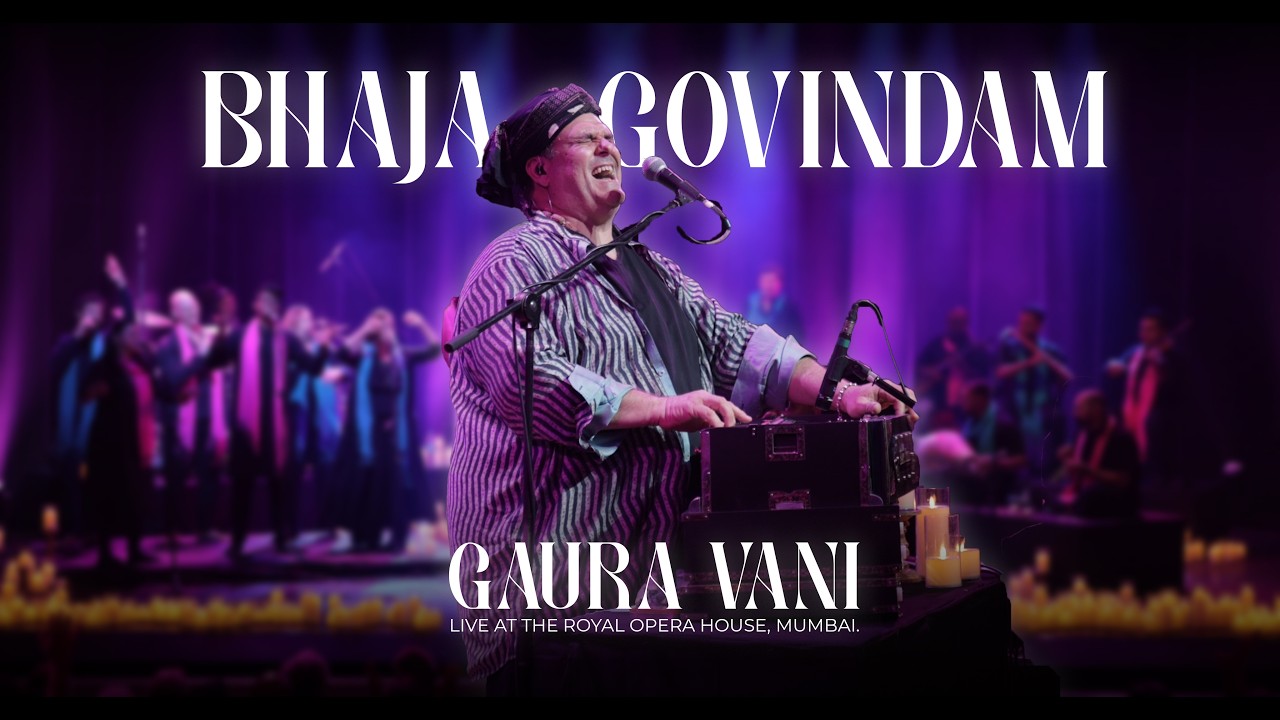
Bhaja Govindam: Where Ancient Wisdom Meets Contemporary Sound
Inspire

Bhaja Govindam: Where Ancient Wisdom Meets Contemporary Sound

An ensemble bridges 8th-century Sanskrit philosophy and contemporary Mumbai rap. The performance proves ancient wisdom and modern consciousn…

1 min read
Govinda Jaya: How Sacred Sound Awakens the Heart
Inspire

Govinda Jaya: How Sacred Sound Awakens the Heart

Radhika Das channels the liberating power of mantra through a luminous kirtan performance at Medicine Festival, invoking divine names to pur…

1 min read
Om Namah Shivaya Chant: Ecstatic Trance Meditation
Inspire

Om Namah Shivaya Chant: Ecstatic Trance Meditation

Jai Uttal guides listeners into an ecstatic chant trance with Om Namah Shivaya, the Sanskrit invocation of Shiva consciousness. A 91-second …

1 min read

探索を続ける

旅をつづける

BrightStarのディレクトリから、さらなる智慧と集いを。

もっと記事を読む

教え、インタビュー、ガイドのライブラリ全体をご覧ください。

すべての記事に戻る →

講師とアーティスト

コンシャスな世界の系譜、音楽家、導き手を探しましょう。

アーティストを探す →

イベントを見つける

キルタン、リトリート、サウンドバス、ブレスワーク、フェスティバル — まもなく開かれます。

イベントを見る →