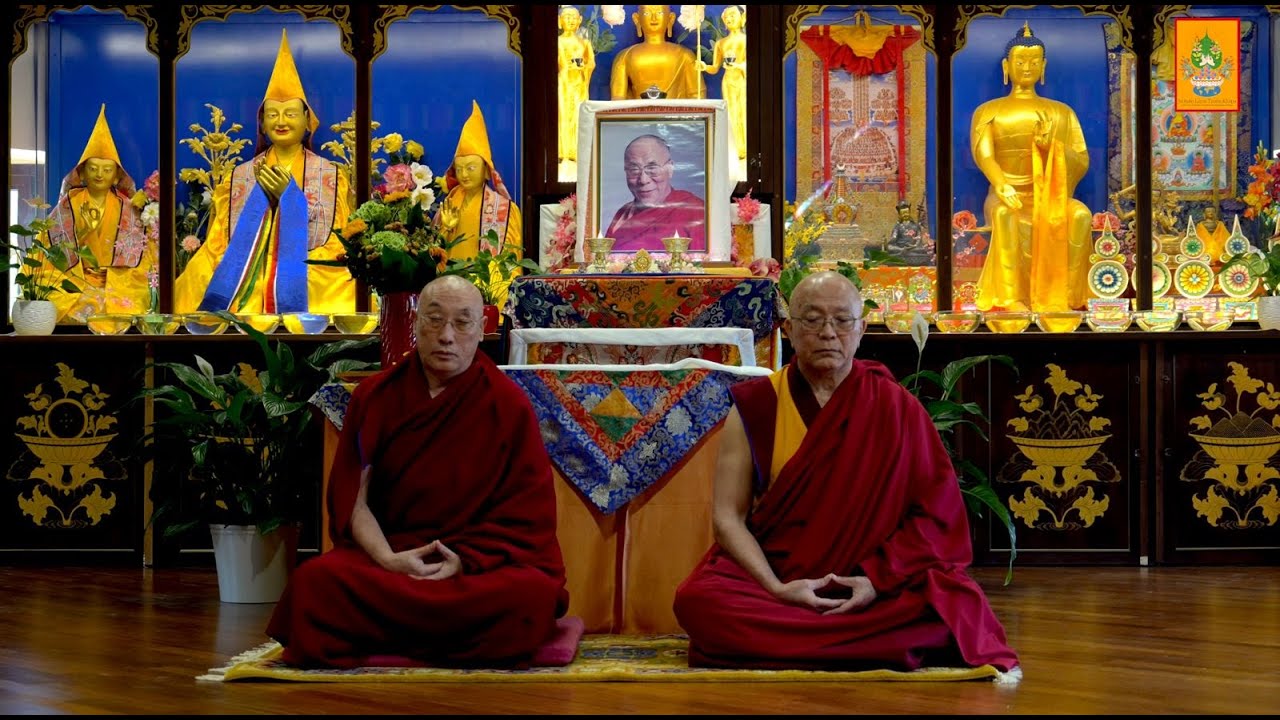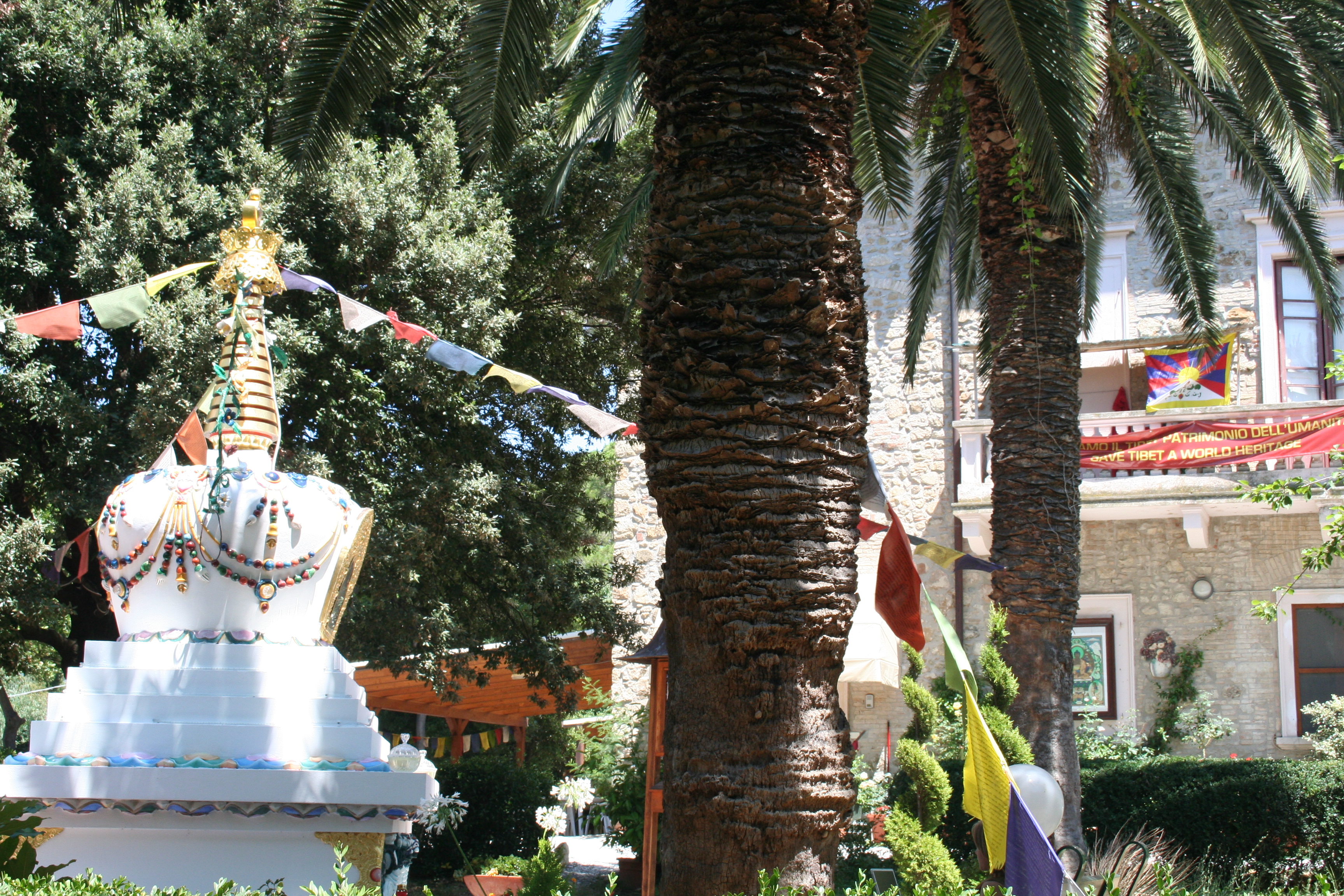
The garden at Lama Tzong Khapa Institute holds its own kind of silence. It is here that one of Lama Yeshe's first-generation Western students witnessed a teacher in profound repose—fresh from waking, absorbed in the aftermath of night practice, the body illusory. Looking at him, the observer thought: this is what the deepening of sacred practice actually does to a human being. The light in his eyes was so concentrated that simply to look at him was to find one's own mind settling into focus. Everything about him was magnificent.
Fabrizio Pallotti carries this memory ninety years after Lama Yeshe's birth, and it is not nostalgia that animates his recollection but rather an attempt to render visible something that most teachings can only point toward: the tangible reality of liberation as lived practice. When Pallotti speaks of his teacher, he is describing not an historical figure but a presence that continues to move through the lineage and its students—a presence transmitted, paradoxically, through the most ordinary of human gestures: the way someone laughed, the way they touched another person, the manner of their walk.
The Avalanche of Teaching and Life Example
Lama Yeshe was present in the West for what Pallotti describes as "very few years"—a brief window of direct encounter that nonetheless became foundational for the entire FPMT (Foundation for the Preservation of the Mahayana Tradition) lineage in the West. But the temporal measure is almost irrelevant. What Pallotti emphasizes is not duration but transmission: "he gave us an avalanche of teachings, but most of all life example."
This distinction matters profoundly. In the Buddhist context, teachings refer to the doctrinal content, the intellectual scaffolding of dharma. Life example is something else entirely—it is the embodiment of that teaching in the specific, unrepeatable particularity of a single human being's choices, reactions, and way of moving through the world. A teacher can deliver perfect doctrine and leave students unchanged. But a teacher who demonstrates liberation in the texture of their ordinariness—in the humility and normality with which they conducted themselves—offers something that no text can contain.
Pallotti recalls that Lama Yeshe remained "extremely humble and normal" even as he proved "pivotal in leading masses into the dharma into developing the real root of liberation and enlightenment." This paradox is central to understanding his impact. He did not position himself as a remote authority dispensing wisdom from an elevated platform. Instead, his ordinariness became the gateway through which students could recognize that liberation was not a distant, exotic state but something accessible, grounded, human.
The Radical Democracy of Gratitude
What strikes Pallotti most forcefully now, decades later, is something he calls "the gratefulness that he show to everybody." This gratitude was not discriminate or performative. It extended equally to everyone who crossed his path—people the teacher knew intimately and those he had never encountered before, Buddhists and non-Buddhists alike, men and women, children and the elderly. The gratitude was exactly the same. Always.
This consistency points to something deeper than politeness. Pallotti connects it directly to the Buddhist teachings: "Exactly like in the teachings, like a mother looks at her own single child with an incredible affection, love, but supported with kindness." The metaphor of the mother is classical in Buddhist literature—the wish that all beings experience the warmth and protection that a mother naturally radiates toward her child. But Pallotti's observation is that Lama Yeshe did not merely teach this; he enacted it, with every person, without exception.
The kindness Pallotti emphasizes is not sentimental. It is rooted in what he calls "feeling grateful of others"—a recognition that one's own development, one's own qualities and capacities, arise entirely from the kindness and generosity of others. Lama Yeshe was, by all accounts, a teacher of extraordinary realization and skill. And yet, Pallotti says, "whatever lama had in his qualities, he was fully aware that they all came from the kindness of others and he did nothing but to show this openly to everyone."
This is a radical statement. It suggests a teacher who understood gratitude not as a polite response to specific favors but as a fundamental orientation toward existence—a recognition that the self is woven entirely from the gifts of others, and that to live authentically is to acknowledge and radiate that awareness. To "show this openly" means that his gratitude was not hidden in his heart; it was visible in gesture, word, and presence.
Presence as Transmission
The account from the Lama Yeshe Wisdom Archive that Pallotti quotes captures something essential about how teaching travels in living lineages. "The way he laughed, touched people, even the way he walked brought dreams to your mind." The specificity here matters. It is not that his teachings were philosophical innovations. Rather, his presence itself was transformative. To be in the room with him, to observe the quality of his attention, to feel the texture of his touch, was to have access to dharma in a form that bypassed intellectual understanding and worked directly on the nervous system, the emotional body, the subtle dimensions of consciousness.
"He was so skillful and so fast," the account continues. This too deserves attention. In Buddhist contexts, skillfulness refers to an extraordinary sensitivity to the specific needs and capacities of each student, a capacity to offer precisely the intervention or teaching that will catalyze growth. Speed, in this context, refers not to rushing but to an absence of delay—the ability to perceive an opportunity for transformation and meet it immediately, without the hesitation that usually accompanies self-consciousness or doubt.
These are not qualities that can be copied or transmitted through text alone. They require the presence of a teacher to whom students can expose themselves fully, whose example can be studied in real time, and whose way of being can be gradually internalized through proximity and sustained attention.
Where to Go From Here
Ninety years after Lama Yeshe's birth, the lineages he co-founded continue to offer teachings and practice. The FPMT maintains centers and resources worldwide, and the Lama Yeshe Wisdom Archive preserves recordings, writings, and recollections of the teacher and his work. For students seeking to understand how authentic dharma transmission functions—how the marriage of intellectual understanding and embodied presence creates genuine transformation—Pallotti's testimony offers a clear window. The garden remains. The practices continue. The example endures.