
BrightStar

すべてのEventsを見る

意識ある集いに出会う

events

Yoga
Meditation
Breathwork
Qigong
Tai Chi
Sacred Music
World Music
Medicine Music
Sound Healing
Ecstatic Dance
人気の目的地
BaliSedonaLos AngelesCosta RicaNew YorkSan FranciscoAustinMiamiJoshua TreeTulum
すべてのカテゴリを見るすべての目的地を見る

すべての機能を探索

イベントを成長させる強力なツール

プラットフォーム機能

スマートダイナミックプライシング
チケットカテゴリ
座席指定
カート放棄リカバリー
訪問者リカバリー
寄付とスライディングスケール
アフィリエイトシステム
チケットスキャナー
クーポンコード
カスタム質問
チケット共有
アップセルとアドオン
分析とレポート
メールシーケンス
ウェイトリスト / 通知 / リマインダー
人と場所
Artists & TeachersEvent OrganizersVenues & StudiosKnowledge BaseGlossaryInspiration
すべての機能を見る私たちについて
料金ブログ
Language
Saved events
すべてのイベントを見る

events

YogaMeditationBreathworkQigongTai ChiSacred MusicWorld MusicMedicine Music

人気の目的地

BaliSedonaLos AngelesCosta RicaNew YorkSan Francisco

人と場所

Artists & TeachersEvent OrganizersVenues & StudiosKnowledge BaseGlossaryInspiration

プラットフォーム機能

スマートダイナミックプライシングチケットカテゴリ座席指定カート放棄リカバリー訪問者リカバリー寄付とスライディングスケールアフィリエイトシステムチケットスキャナークーポンコードカスタム質問チケット共有アップセルとアドオン分析とレポートメールシーケンスウェイトリスト / 通知 / リマインダー
すべての機能を見る私たちについて
料金ブログ
ログイン探求者クリエイター
  • すべてのイベントを見る
  • 探求者向け
  • ヨガ
  • 瞑想
  • ブレスワーク
  • 気功
  • 太極拳
  • 聖なる音楽
  • ワールドミュージック
  • メディスンミュージック
  • サウンドヒーリング
  • エクスタティックダンス
  • リトリート
  • ワークショップ
  • すべてのカテゴリ →
  • Bali
  • Sedona
  • Los Angeles
  • Costa Rica
  • Tulum
  • Byron Bay
  • San Francisco
  • Austin
  • New York
  • San Diego
  • Denver
  • Seattle
  • Portland
  • Miami
  • すべての都市 →
  • Join the Movement
  • Why we list
  • Sell Globally
  • クリエイター向け
  • チーム向け
  • ライター向け
  • 講師向け
  • キルタンアーティスト向け
  • スタジオ向け
  • フェスティバル向け
  • リトリートセンター向け
  • 非営利団体向け
  • ブランドアンバサダー
  • 無料チケット販売
  • Elevate
  • Amplify
  • 50万人以上のバイヤーネットワーク
  • カート放棄リカバリー
  • スマートダイナミックプライシング
  • チケットカテゴリ
  • 定期イベント
  • 座席指定
  • アフィリエイトシステム
  • ウェイトリスト / 通知
  • チケットスキャナー
  • 埋め込みウィジェット
  • イベント配信
  • メッセージセンター
  • インテグレーション
  • レポート
  • すべての機能 →
  • 概要
  • エコシステム
  • ブログ
  • 用語集
  • インスピレーション
  • ヘルプセンター
  • お問い合わせ
  • APIドキュメント
  • ブランドアセット
  • 採用
  • プレス
  • 利用規約
  • プライバシーポリシー

イベント

  • すべてのイベントを見る
  • 探求者向け
  • ヨガ
  • 瞑想
  • ブレスワーク
  • 気功
  • 太極拳
  • 聖なる音楽
  • ワールドミュージック
  • メディスンミュージック
  • サウンドヒーリング
  • エクスタティックダンス
  • リトリート
  • ワークショップ
  • すべてのカテゴリ →

目的地

  • Bali
  • Sedona
  • Los Angeles
  • Costa Rica
  • Tulum
  • Byron Bay
  • San Francisco
  • Austin
  • New York
  • San Diego
  • Denver
  • Seattle
  • Portland
  • Miami
  • すべての都市 →

クリエイター向け

  • Join the Movement
  • Why we list
  • Sell Globally
  • クリエイター向け
  • チーム向け
  • ライター向け
  • 講師向け
  • キルタンアーティスト向け
  • スタジオ向け
  • フェスティバル向け
  • リトリートセンター向け
  • 非営利団体向け
  • ブランドアンバサダー
  • 無料チケット販売
  • Elevate
  • Amplify

機能

  • 50万人以上のバイヤーネットワーク
  • カート放棄リカバリー
  • スマートダイナミックプライシング
  • チケットカテゴリ
  • 定期イベント
  • 座席指定
  • アフィリエイトシステム
  • ウェイトリスト / 通知
  • チケットスキャナー
  • 埋め込みウィジェット
  • イベント配信
  • メッセージセンター
  • インテグレーション
  • レポート
  • すべての機能 →

会社

  • 概要
  • エコシステム
  • ブログ
  • 用語集
  • インスピレーション
  • ヘルプセンター
  • お問い合わせ
  • APIドキュメント
  • ブランドアセット
  • 採用
  • プレス
  • 利用規約
  • プライバシーポリシー
BrightStar
アプリを入手
App StoreからApp StoreGoogle Playで手に入れようGoogle Play
© 2026 BrightStar. 全著作権所有.
Inspiration

Why Your Mind Won't Switch Off at Night: Stop Fighting Thoughts

Preethaji
Preethaji
Nov 9, 2026
読了 約8分

出典:Sri Preethaji & Sri Krishnaji

視聴 · 7

Lie down, close your eyes, and the body is ready: limbs heavy, the room quiet, nothing left to do. Then the mind starts up. A to-do list surfaces, then an old conversation, then a hypothetical about next week that has no business being examined at one in the morning. The harder you push to shut it off, the louder it seems to get. In a 90-second clip published on the Sri Preethaji & Sri Krishnaji channel on November 9, 2026, Preethaji takes up exactly this problem, and the answer runs against the instinct most people bring to it. The way to quiet the mind, Preethaji says, is not to fight it, not to reduce the number of thoughts, and not to try to change the thinking. What helps instead is stepping back to watch each thought arise and cease, without clinging to it, pushing it away, or judging it. Overthinking, the teaching suggests, loses its grip once it is observed rather than argued with.

読む · 8セクション

Why does the mind keep racing when the body is ready to sleep?

The clip opens with a question that many people have asked themselves at night: even when the body is tired and ready to rest, why does the mind keep thinking, making it hard to fall asleep, and what is happening inside at that moment? The question is put to Preethaji at about the 0:14 mark. The answer begins at 0:29, and it is direct: this happens for most people who have given in to overthinking.

The distinction matters. Tiredness is a bodily state, and the body can be fully ready while attention keeps moving. Sleep does not arrive simply because the body wants it. It arrives when the mind stops producing the material that keeps the system alert, and overthinking is precisely the habit of producing that material on a loop.

Why does overthinking feel like it is protecting you?

One of the more useful observations in the clip is about motive. At around 0:29 to 0:44, Preethaji notes that people sometimes come to believe overthinking helps them cope with a danger, with something that is going to hurt them. The logic feels reasonable from the inside: if I keep turning the problem over, I will eventually find the angle that saves me. Thinking more, in this belief, is a way of staying in control.

The teaching's answer is that this belief does not hold up. As Preethaji puts it at about 0:49, overthinking in itself is such a drain. The mind keeps reaching for a solution it cannot reach through repetition alone, and each pass through the same material leaves the nervous system a little more worked up and no closer to resolution. What felt like protection turns out to be a cost that keeps being paid.

What is the feedback loop of overthinking?

The most striking claim in the clip is about how overthinking reinforces itself. The more you get into the groove of overthinking, Preethaji says, the more you tend to think even more. Then comes the line that reverses the usual approach: even if you are trying to stop it, it is going to become more. Even if you try to make it less, you will see it becoming more.

This is the paradox at the centre of the teaching. A thought that is fought becomes a thought that is attended to, and attention is exactly what keeps a thought alive. The channel's own description puts it plainly: the more you fight your thoughts, the more attention you give them. Every act of resistance, every silent command to stop, is one more mental event feeding the loop. The mind, trying to control itself, becomes its own most engaged audience.

What does it mean to step back and observe?

The alternative in the clip is a change of posture rather than a technique for suppression. At about 1:06, Preethaji says:

"For the first time you need to find courage and step back and begin to observe the thinking."

The instruction is to go back, sit back, and observe every thought that is arising and ceasing. The phrase arising and ceasing carries most of the weight. A thought is not a permanent fixture of the self; it appears, it holds the stage for a moment, and it passes. When you watch that process rather than being absorbed into the content, the thought loses its air of urgency. It becomes an event you are witnessing, not a command you must obey.

This is why the stance is sometimes described as stepping back. You are not required to win an argument with the mind. You are asked to notice that the argument is happening, and to let it run without climbing into the ring.

Why should you avoid clinging, pushing away, or judging thoughts?

The clip names three things to avoid, spoken at about 1:17 to 1:24: do not cling to a thought, do not try to shove it off, and do not try to judge it. Each one is a different way of staying entangled.

  • Clinging gives a thought more authority. Holding onto a worry as though it deserves your full attention confirms that it matters, and the mind reads that confirmation as a reason to bring it back.
  • Pushing away looks like the opposite of clinging but is the same movement in reverse. You still have to keep track of the thought in order to push it away, so it remains at the center of your attention.
  • Judging adds a second layer of commentary. A thought about a thought, such as "I shouldn't be thinking this," becomes one more item for the loop to chew on.

Taken together, these three describe the usual habits of a restless mind. The teaching asks you to drop all three and simply watch, which is harder than it sounds, and which is why the clip calls it a matter of finding courage.

How long does a quiet mind take to arrive?

The clip's final promise is measured rather than dramatic. If you observe in this way, Preethaji says at about 1:29, you will begin to see that your thoughts, the overthinking, the flood of thinking, slows, slowly quietens down, and then you really think what is needed. Three words in that sentence matter: slows, slowly, and then. The change is gradual, and it ends not in blankness but in clear, purposeful thinking.

That is a useful expectation to bring to bedtime. The clip does not claim that one observed thought will send you straight to sleep. It describes a process in which the flood thins over time, and the mind returns to a state where it can think what is needed rather than everything at once.

How can you try this observing stance at bedtime?

The clip is brief and does not lay out a detailed method, so anything beyond its core instruction is an interpretation. Still, the logic points in a clear direction. When a thought arrives in the dark, you can notice it as a thought rather than as a fact about tomorrow. You can let it be there without grabbing it, without shoving it away, and without scolding yourself for having it. Then you can gently return attention to something neutral, such as the breath or the sensations of the body. Each time a thought surfaces, you repeat the stepping back. The aim is not to produce silence on demand, which the teaching explicitly says will not work, but to stop feeding the loop.

If sleep trouble is persistent or distressing, it is worth speaking with a doctor or sleep specialist as well. A short clip about attention and overthinking is not a substitute for that kind of care.

Where to go from here

The central idea of this clip fits in a sentence: the mind does not quiet because you forced it to, but because you stopped feeding it. If you want to explore it further, watch the full range of teachings on the Sri Preethaji & Sri Krishnaji channel, where the subject of the mind and awareness is taken up in more depth than a ninety-second excerpt allows. For the next few nights, try one small experiment: when you notice yourself deep in a thought at bedtime, name it simply as thinking, watch it arise and cease, and see whether the flood begins to slow. The teaching makes no promises about speed. It asks only that you look.
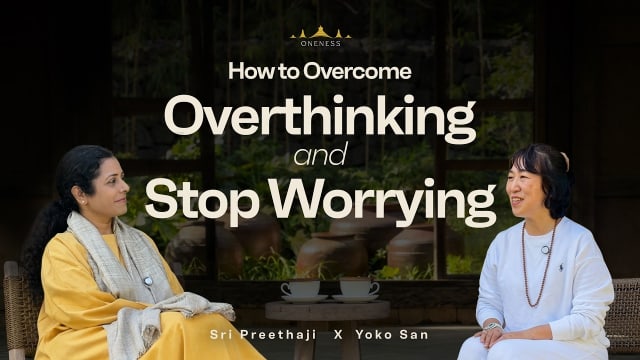
Comments

Loading the conversation…

Transcript

[0:01] The only way to kind of

[0:04] quiet the mind is not to fight with it,

[0:08] not trying to reduce the number of

[0:10] thoughts, not trying to change the

[0:13] thinking.

[0:14] >> My question is

[0:16] even when our body is tired and ready to

[0:18] rest, why does our mind continue

[0:21] thinking making it difficult to fall

[0:24] asleep?

[0:26] What is happening within us at that

[0:27] moment?

[0:29] >> This happens for most people

[0:33] who have given into overthinking

[0:36] and sometimes have believed that this

[0:38] overthinking is helped them cope with a

[0:40] danger, with

[0:42] with

[0:43] something that is going to hurt them. It

[0:44] is by believing that you thinking more

[0:47] and more you're able to solve.

[0:49] But overthinking in itself is such a

[0:51] drain and the more you get into this

[0:53] groove of overthinking, you tend to

[0:56] think even more. That is

[0:58] even if you're trying to stop it, it is

[1:00] going to become more. Even if you're

[1:02] going to try to make it less, you will

[1:04] see it is becoming more.

[1:06] For the first time you need to find

[1:08] courage and step back and begin to

[1:11] observe the thinking. It is to go back,

[1:13] sit back and observe every thought that

[1:17] is arising and ceasing, not try to cling

[1:20] to it, not try to shoe it off, not try

[1:24] to judge it and you will begin to see

[1:26] that your thoughts, the overthinking,

[1:29] the flood of thinking that happens slows

[1:31] slowly quietens down and then you really

[1:35] think what is needed.

Preethaji
ArtistPreethaji

Co-founder of the O&O Academy and Ekam — the Indian school of consciousness based at the Ekam temple north of Chennai — and one of the most widely-followed contemporary teachers in…

プロフィールを見るウェブサイト
トピックを見る
OverthinkingQuieting-the-mindObserving-thoughtsWitness-awarenessSleep-and-the-mind

ご質問はありますか?

よくある質問

In this teaching, Preethaji says this happens for most people who have given in to overthinking, even when the body is ready to rest. The mind keeps producing thought material on a loop, and that loop keeps the system alert even when the body is tired.
The clip says that trying to stop or reduce overthinking tends to make it grow. Fighting a thought gives it attention, and attention is what keeps it going, so the teaching suggests changing your stance rather than forcing silence.
According to the clip, it means stepping back and watching each thought as it arises and ceases, without clinging to it, pushing it away, or judging it. The thought becomes something you witness rather than a command you must obey.
Preethaji describes a gradual process: by observing thoughts this way, you begin to see the flood of thinking slow and slowly quieten down. The clip does not promise an immediate result, only that the mind eventually returns to clear thinking about what is needed.
The clip notes that people sometimes believe overthinking helps them cope with a danger or something that will hurt them. The belief is that by thinking more, they will be able to solve the problem, but the teaching points out that overthinking itself drains and does not deliver that solution.
Suppressing a thought means pushing it away, which still keeps it at the center of attention. Observing means noticing the thought as an event that appears and passes, without engaging with it as an argument, so it loses its urgency over time.

読みつづける

More from Preethaji

すべて表示
Why Overthinking Won't Quiet Down: The Power of Awareness
Inspire

Why Overthinking Won't Quiet Down: The Power of Awareness

Why does the mind keep running when the body is exhausted? Sri Preethaji argues that fighting, replacing, or suppressing thoughts feeds the …

8 min read
Why Helping Professionals Struggle to Connect With Family
Inspire

Why Helping Professionals Struggle to Connect With Family

A counselor who connects instantly with clients but freezes with family brings a question to Sri Krishnaji. His answer turns on samskaras, f…

10 min read
Light in Shining Armour: A Goddess Myth Set to Mantra Pop
Inspire

Light in Shining Armour: A Goddess Myth Set to Mantra Pop

A four-and-a-half-minute video turns an ancient goddess story into a sung prayer about slowing down, guarding your energy, and remembering y…

10 min read
Offload the Day Tonight: A Sleep Hypnosis for a Full Mind
Inspire

Offload the Day Tonight: A Sleep Hypnosis for a Full Mind

A close look at a two-hour bedtime hypnosis that helps a busy mind set the day down, through weight shifts, body release, a ten-to-zero coun…

9 min read

探索を続ける

旅をつづける

BrightStarのディレクトリから、さらなる智慧と集いを。

もっと記事を読む

教え、インタビュー、ガイドのライブラリ全体をご覧ください。

すべての記事に戻る →

講師とアーティスト

コンシャスな世界の系譜、音楽家、導き手を探しましょう。

アーティストを探す →

イベントを見つける

キルタン、リトリート、サウンドバス、ブレスワーク、フェスティバル — まもなく開かれます。

イベントを見る →