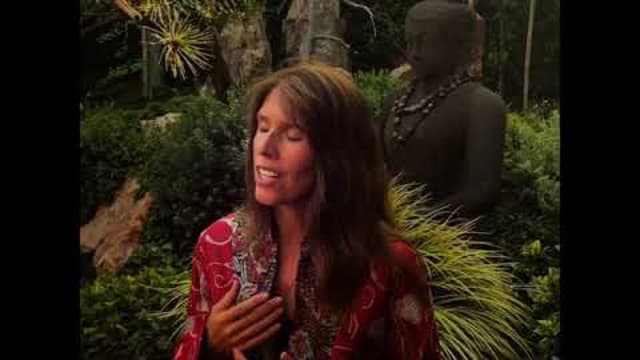
It is early, and the room is quiet in the way rooms get before a teacher has said much of anything. Then a voice, unhurried and plainly settled into its work: "Good morning. We're discussing again the Black Madonna archetype in our meditation this morning." Across a five-minute segment, Matthew Fox returns to a figure he has been circling for decades and makes a case that she is not a devotional curiosity but a necessary presence. The Black Madonna, in his telling, is the dark feminine, a cosmic mother who holds the whole of space and time, and whose depths are the same depths that show up in the ocean, the night sky, and the unlit ground of the soul. He also proposes something more pointed: that she be married to the Green Man, the sacred masculine figure of nature, so that the two together might symbolize the holiness of the living earth.
Fox is careful about where this idea lives. He tells viewers that he refers in his notes to a longer essay on the Black Madonna in his book The Hidden Spirituality of Men. The reason is structural. The body of that book lays out ten archetypes of the Sacred Masculine, and the final two chapters turn to what he calls the sacred marriage of the Divine Feminine and the Sacred Masculine. The video, then, is a short sermon drawn from a bigger argument: the feminine half of that marriage has to be named before it can meet its partner.
He lists the places where she turns up. "You do find her in places such as Turkey, and Africa, and the Soviet Union and Tara in China, and Kali in India, and even Our Lady of Guadalupe in Mexico, the Brown Madonna." The list is less a catalogue than an argument by accumulation. Fox is suggesting that the dark mother is not one regional saint but a recurring human image, showing up across traditions that otherwise have little to do with one another.
Fox turns next to the Celts, who had a name for the dark feminine: Hag. He reads a description attributed to Celtic scholars, and it is worth slowing down on, because it is not a soft image. The Hag, the scholars say, exercises "tough motherly love that challenges her children to stop acting in destructive ways." She is an energy "that will bring death to those dreams and fantasies that are not for the highest good."
"Tough motherly love that challenges her children to stop acting in destructive ways. It is an energy that will bring death to those dreams and fantasies that are not for the highest good."
Celtic scholars, as quoted by Matthew Fox in this video (about 1:22)
This matters for the rest of his argument. If the Black Madonna is only comfort, she is a sentimental figure. The Hag reminds us that the dark feminine also refuses. She takes apart the fantasies that keep a person from the good, and she does it out of love. That combination of severity and care is what Fox is after when he speaks of an archetype that "returns when it is needed."
Fox then cites Lucia Birnbaum, whose book The Dark Goddess he calls "a fine book," written several years before this video. Birnbaum, as Fox relays her, describes the African goddess Isis, the figure she considers foundational to the Black Madonna, as prevailing "through the force of love, pity, compassion, and a personal concern for sorrows." This goddess was empathetic and close to people's grief, and so she was tied to healing as a compassionate mother. Fox notes that she represented not only the earth but water, which he says held especially sacred qualities.
Fox also reports Birnbaum's larger claim, which carries the most charge in the segment. She argued that the next step toward a religious understanding and a just world is to bring the Dark Mother of prehistory and popular history into consciousness and public knowledge. That means recognizing, in her framing, that we all come from the African mother, that we are peoples of many colors, tribes, climates, and diasporas. Fox's summary of her view is that this archetype can carry justice and compassion forward with us. The point is not decorative. It asks a community to remember an origin story it has forgotten.
Fox is direct that the Black Madonna's darkness has an obvious human meaning: "obviously it represents people of color." But he refuses to let that be the whole of it. Darkness, he says, also marks depth. "The depth of things are dark: depth of sky, the cosmos is dark; the depths of the ocean are dark." He pulls in Meister Eckhart, the medieval mystic, and quotes him as saying the depths of the soul are dark: "The ground of the soul is dark."
"The ground of the soul is dark."
Meister Eckhart, as quoted by Matthew Fox in this video (about 3:42)
Read this way, the Black Madonna is an invitation to go deep rather than live on the surface. Fox's word for her is cosmic. She "represents cosmology, a sense of the whole of space and time," and he ties this to a passage from the Book of Wisdom he had shared in an earlier video. He adds the Lakota phrase Mitakuye Oyasin, "All Our Relations," which the Lakota pray whenever they pray. For Fox, the dark mother cannot be only tribal or only individual. "She doesn't represent just tribalism or individuality, but the Whole."
Fox reaches toward physics here, and he is careful to frame it as an analogy and a pointer rather than a proof. He notes that science today is dealing with the dark side of the universe: dark energy and dark matter, which he says make up about 95 to 97 percent of all matter in the universe. The substance is still a great mystery, he says, but it is striking that we named it dark. For him that naming "rings a bell" about the Dark Mother who is returning. The argument is that our most advanced description of the cosmos is leaning into the same unknown that the Black Madonna has always stood for.
It is worth noticing what the video does and does not claim. Fox offers the parallel as something that "tends to ring a bell." He is not asserting a scientific doctrine. He is showing how the old symbol and the new vocabulary rhyme, and letting the rhyme do the work of making the archetype feel current.
The closing argument rests on Carl Jung. "Carl Jung says an archetype returns when it is needed," Fox says, and he concludes that for these reasons "and many more, which we can discuss later, the Black Madonna is back." He does not give the full list here, and that restraint is itself part of the segment's method. He is marking a return and inviting the viewer into a longer conversation.
The Green Man is the other half of the proposal. Fox says "one of the proposals I make is that we should have a marriage of the Green Man and the Black Madonna, two very powerful archetypes, both of which symbolize, and therefore the marriage would symbolize, the sacredness of nature." The logic is that one archetype speaks to the dark feminine depth and the other to the living, growing surface of the world, and that holding them together makes nature itself sacred rather than merely a backdrop for human activity. It is the sacred marriage of the feminine and masculine that the last two chapters of his book are built to explore.
The segment is brief, and it does not try to settle its questions. What it does is give a compact map. The Black Madonna is a figure with many names across many cultures. She is severe as well as merciful, as the Celtic Hag shows. She carries the wisdom of depth, the sense from Eckhart that the soul's ground is dark. She holds the whole, not just a tribe or a self. And she is returning, in Fox's reading, because the culture needs her. Pairing her with the Green Man is his way of insisting that the sacredness of the feminine and the sacredness of the earth are one question, not two.
For a reader coming to this cold, the most useful move is to hold the archetype as a lens rather than a doctrine. Ask where the dark appears in your own life as depth rather than danger. Ask what in your life is being challenged by a love that will not let a destructive fantasy stand. Fox's meditation points there, and it points outward too, toward the earth he wants his Green Man to honor.
If this segment left you wanting the full argument, Fox points to the essay in The Hidden Spirituality of Men, where the Black Madonna is developed at length and the sacred marriage is treated in the book's last two chapters. Birnbaum's The Dark Goddess, which Fox recommends, is the source for much of his account of Isis and the dark mother's role in justice and compassion. Readers who want his daily reflections can sign up for his free meditations at dailymeditationswithmatthewfox.org, and his books and speaking information are at matthewfox.org. Start with the Hag and Eckhart's dark ground, then return to the question Fox leaves open: what would a culture look like if it finally honored both the dark mother and the green earth?