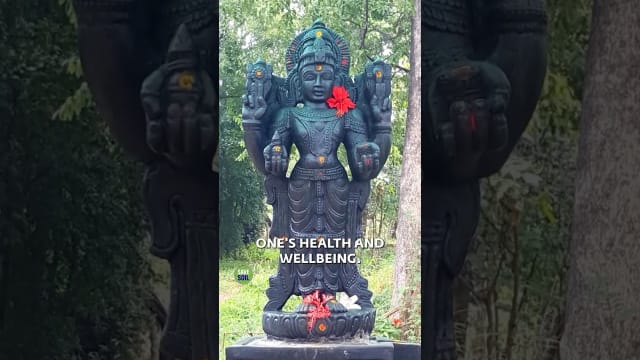
In a video published in November 2026, Sadhguru opens with a question about a three-month-old baby who reportedly caught fire in a Chennai hospital with no external ignition, then answers it with a story from his own life. Years before, he says, he was walking across a busy road in Mysore with his wife Vijji when a bare-chested man in a small cloth asked him for alms. He emptied his wallet into the man's hand, and in the next moment the man was gone. From that single encounter he moves outward to a broader claim: that certain yogis and disembodied beings are drawn toward particular energies, that some yogis have dematerialized their bodies, that pools of water have appeared unexplained beside Bhairavi yantras in people's homes, and that fire is rarer than water because, as he puts it, "only 4% of the system is fire." What follows is a close reading of that argument: what he describes, how he sorts the possibilities, and where the reader is left to decide for themselves.
The scene he builds is deliberately ordinary. He was in Mysore visiting a friend who had recently opened a showroom for a major Indian watch brand. He parked on the opposite side of the road, and he and Vijji were crossing toward the entrance, close enough that the doorway was already in sight. That is the setting for the encounter, and the detail matters. Nothing about it is ceremonial. It happens on a commercial street named Devarajurs Road, which he notes belongs to the royal family of Mysore.
Then the man appears. Sadhguru describes him plainly: a small piece of cloth around the waist, nothing else, and a request for alms. What turns an ordinary request into something else is the speaker's own perception. In his words:
"I looked at him. And I immediately knew this is not a beggar."
— Sadhguru, in a November 2026 YouTube video
He took out his wallet, emptied all the cash into the man's hand, and says he did not even look at what it contained. The man then vanished. Vijji, he says, was left "just looking aghast," and the reaction lasted. He reports that she could not sleep for three days, and was sweating and breathing hard, because she could not make sense of a man standing in front of them one moment and gone the next.
The story has a second, quieter detail that gives it texture. Sadhguru says he regrets keeping the wallet: "I should have just given everything to him," because it held other things besides money. It is a small, human admission, and it sits oddly beside the cosmic framing that follows. He is not describing a man who needed rescue. He is describing a missed exchange.
The Mysore encounter is, for him, one instance of a pattern. He says it has happened to them "many times," and he separates what he calls forces into rough categories. Some are disembodied beings manifesting themselves. Some are yogis who are wandering, looking for an opening. The mechanism he describes is attraction rather than intention: the beings converge when they sense a receptive condition.
"Some of them are yogis who are wandering, always looking for a possibility somewhere. When they see the possibility, they all converge in that direction."
— Sadhguru, in the same video
He ties this to the period around the Dhyanalinga consecration. He says that certain types of yogis came naturally toward him just before it, "because uh we were working in a certain way." He is not offering a method for summoning anyone. He is saying that intense spiritual work creates a kind of field, and that some presences are, in his telling, simply pulled into it. He is also careful to note that not all of them have any stake in a person's life: some "are completely of different dimension" and "have no relevance to your life," but still "get drawn to certain kind of energy if you create" it.
The reader should notice what he is not claiming here. He is not saying every visitor is benevolent or dangerous. He is describing an ecology in which energy draws attention, and in which the nature of the attention varies.
The video's opening question is a useful key to its method. A questioner describes the Chennai case, a baby diagnosed with what was reported as spontaneous human combustion, and asks whether such a thing is possible. Sadhguru answers with three possibilities, and the sequence is worth following because it moves from the mundane to the extraordinary.
- The human explanation. He begins with the darkest reading: that a family member, in this case a mother-in-law, is setting the fire. He notes that you cannot know "what all things relatives can do," but calls it a bad possibility.
- The attention explanation. The second is that the family wants attention and is inventing or exaggerating the event. He warns against underestimating people: "Do not underestimate people."
- The yogic explanation. The third, which he clearly takes most seriously, is that "maybe a great yogi is born," someone with "control over the elements," whose powers are "still a child, something going a little out of control."
What is striking is how he orders them. He does not lead with the miraculous. He leads with the most ordinary, uncomfortable explanations and works toward the one he finds most interesting. This is a discipline a reader can borrow: before accepting an extraordinary account, exhaust the people-based possibilities first.
He then widens the frame again. Fire appearing in a home, he says, can be attributed to black magic or occult forces, and he refers to a Karnataka tradition he assumes his audience knows. Yet he insists that when the relatives have been ruled out, "and it's just happening," then the occult or a yogi with mastery over the elements are the remaining possibilities. The logic is conditional: explain the simple things first, then move up the ladder.
The word he reaches for is dematerialization. He says the English term is the closest fit for a process known in the yogic tradition, and he gives an example from Tamil tradition: a famous sage named Vallalar, who, according to Sadhguru, locked himself in a room, and when the room was opened, he had vanished, leaving only a small pool of water. He is clear that this is not a single case: "Any number of yogis have done this."
The water matters to his argument, and his reasoning about it is the most concrete part of the video. He says that the process of dematerialization is not perfectly efficient. Because "over 72% of the body is water," a yogi who dematerializes the other elements can leave water behind. He puts it this way: "Water, you dematerialize to some extent, but some of it remains."
This is the bridge to his explanation of the pools. In his account the elements are not equal. Water is the element most likely to persist, and fire, by his figure, is the element present least in the system, which is why fire-based events are "rare." Whatever one makes of the framework, it is internally consistent: the residue is water because the body is mostly water, and fire is rare because the body contains little of it.
The Bhairavi yantra is the thread that connects the Mysore story to ordinary households. Sadhguru says there have been many situations in which people with Bhairavi yantras at home noticed a pool of water around the yantra that they "cannot explain in any reasonable sense." He is emphatic that the yantra was not made for this purpose:
"We did not create the Bhairavi Yantra for this purpose. We just created this for people's well-being. But it is by itself, by its own nature."
— Sadhguru, in the same video
The argument here is about intention and nature. The object was made for well-being; the phenomenon, if it occurs, is a byproduct of what the object does on its own terms. He adds that he himself "never thought about it like that" until these reports accumulated. He also says the reports came from people who did not know one another: they "did not even know that it's happening to somebody else." In one case the pool simply appeared overnight: "in the night there was nothing, in the morning there is a pool of water."
This is the point at which a careful reader should slow down. The video offers testimony, not measurement. Unrelated people describing the same thing is a meaningful pattern to notice, but the video does not describe any test that separated the pools from ordinary causes. Sadhguru does not claim to have ruled those out in the segment, and it would be a mistake to write as if he had.
The honest way to read this video is as a worldview presented by a teacher to people who already trust his frame. Its strongest feature is its ordering: it begins with human causes, moves to attention-seeking, and only then arrives at the yogic. Its weakest feature is that most of its evidence is personal memory and secondhand report. The Mysore encounter is vivid, and Vijji's three sleepless days are a human detail that makes it hard to dismiss. But the video does not give a third party a way to verify the man, the wallet, or the vanishing.
Sadhguru's own phrasing offers a reasonable middle path. He describes these events as things he has "personally seen" and as "things like this" that "have happened to us many times," which places them in the register of testimony. A reader can take the testimony seriously as testimony, notice the internal logic, and still keep the question open.
If this video has you thinking about the line between the explicable and the unexplained, the most useful next step is the full video itself, where the segments are tied together more loosely than a summary can capture. Sadhguru frames these accounts as part of a larger body of material. The video's description notes that his encounters are presented in a four-part "Mystical Encounters" series on Sadhguru Exclusive, which would be the place to see how he builds the case across multiple stories rather than one.
For readers interested in the underlying ideas, the most productive questions are the ones the video itself raises: what does it mean to say an element is "present" or "absent" in a body, how would one test whether a pool of water has a source, and why does the three-possibilities method (relatives, attention, the extraordinary) seem so persuasive when it is applied in that order? Those questions do not require accepting the conclusions, and they are a fair way to engage with a teacher whose claims are, by his own account, meant to be taken seriously and examined.