BrightStar

すべてのEventsを見る

意識ある集いに出会う

events

Yoga
Meditation
Breathwork
Qigong
Tai Chi
Sacred Music
World Music
Medicine Music
Sound Healing
Ecstatic Dance
人気の目的地
BaliSedonaLos AngelesCosta RicaNew YorkSan FranciscoAustinMiamiJoshua TreeTulum
すべてのカテゴリを見るすべての目的地を見る

すべての機能を探索

イベントを成長させる強力なツール

プラットフォーム機能

スマートダイナミックプライシング
チケットカテゴリ
座席指定
カート放棄リカバリー
訪問者リカバリー
寄付とスライディングスケール
アフィリエイトシステム
チケットスキャナー
クーポンコード
カスタム質問
チケット共有
アップセルとアドオン
分析とレポート
メールシーケンス
ウェイトリスト / 通知 / リマインダー
人と場所
Artists & TeachersEvent OrganizersVenues & StudiosKnowledge BaseGlossaryInspiration
すべての機能を見る私たちについて
料金ブログ
Language
Saved events
すべてのイベントを見る

events

YogaMeditationBreathworkQigongTai ChiSacred MusicWorld MusicMedicine Music

人気の目的地

BaliSedonaLos AngelesCosta RicaNew YorkSan Francisco

人と場所

Artists & TeachersEvent OrganizersVenues & StudiosKnowledge BaseGlossaryInspiration

プラットフォーム機能

スマートダイナミックプライシングチケットカテゴリ座席指定カート放棄リカバリー訪問者リカバリー寄付とスライディングスケールアフィリエイトシステムチケットスキャナークーポンコードカスタム質問チケット共有アップセルとアドオン分析とレポートメールシーケンスウェイトリスト / 通知 / リマインダー
すべての機能を見る私たちについて
料金ブログ
ログイン探求者クリエイター
  • すべてのイベントを見る
  • 探求者向け
  • ヨガ
  • 瞑想
  • ブレスワーク
  • 気功
  • 太極拳
  • 聖なる音楽
  • ワールドミュージック
  • メディスンミュージック
  • サウンドヒーリング
  • エクスタティックダンス
  • リトリート
  • ワークショップ
  • すべてのカテゴリ →
  • Bali
  • Sedona
  • Los Angeles
  • Costa Rica
  • Tulum
  • Byron Bay
  • San Francisco
  • Austin
  • New York
  • San Diego
  • Denver
  • Seattle
  • Portland
  • Miami
  • すべての都市 →
  • Join the Movement
  • Why we list
  • Sell Globally
  • クリエイター向け
  • チーム向け
  • ライター向け
  • 講師向け
  • キルタンアーティスト向け
  • スタジオ向け
  • フェスティバル向け
  • リトリートセンター向け
  • 非営利団体向け
  • ブランドアンバサダー
  • 無料チケット販売
  • Elevate
  • Amplify
  • 50万人以上のバイヤーネットワーク
  • カート放棄リカバリー
  • スマートダイナミックプライシング
  • チケットカテゴリ
  • 定期イベント
  • 座席指定
  • アフィリエイトシステム
  • ウェイトリスト / 通知
  • チケットスキャナー
  • 埋め込みウィジェット
  • イベント配信
  • メッセージセンター
  • インテグレーション
  • レポート
  • すべての機能 →
  • 概要
  • エコシステム
  • ブログ
  • 用語集
  • インスピレーション
  • ヘルプセンター
  • お問い合わせ
  • APIドキュメント
  • ブランドアセット
  • 採用
  • プレス
  • 利用規約
  • プライバシーポリシー

イベント

  • すべてのイベントを見る
  • 探求者向け
  • ヨガ
  • 瞑想
  • ブレスワーク
  • 気功
  • 太極拳
  • 聖なる音楽
  • ワールドミュージック
  • メディスンミュージック
  • サウンドヒーリング
  • エクスタティックダンス
  • リトリート
  • ワークショップ
  • すべてのカテゴリ →

目的地

  • Bali
  • Sedona
  • Los Angeles
  • Costa Rica
  • Tulum
  • Byron Bay
  • San Francisco
  • Austin
  • New York
  • San Diego
  • Denver
  • Seattle
  • Portland
  • Miami
  • すべての都市 →

クリエイター向け

  • Join the Movement
  • Why we list
  • Sell Globally
  • クリエイター向け
  • チーム向け
  • ライター向け
  • 講師向け
  • キルタンアーティスト向け
  • スタジオ向け
  • フェスティバル向け
  • リトリートセンター向け
  • 非営利団体向け
  • ブランドアンバサダー
  • 無料チケット販売
  • Elevate
  • Amplify

機能

  • 50万人以上のバイヤーネットワーク
  • カート放棄リカバリー
  • スマートダイナミックプライシング
  • チケットカテゴリ
  • 定期イベント
  • 座席指定
  • アフィリエイトシステム
  • ウェイトリスト / 通知
  • チケットスキャナー
  • 埋め込みウィジェット
  • イベント配信
  • メッセージセンター
  • インテグレーション
  • レポート
  • すべての機能 →

会社

  • 概要
  • エコシステム
  • ブログ
  • 用語集
  • インスピレーション
  • ヘルプセンター
  • お問い合わせ
  • APIドキュメント
  • ブランドアセット
  • 採用
  • プレス
  • 利用規約
  • プライバシーポリシー
BrightStar
アプリを入手
App StoreからApp StoreGoogle Playで手に入れようGoogle Play
© 2026 BrightStar. 全著作権所有.
Inspiration

Morning Yoga Flow for Mobility and Control, Explained

YW
Yoga With Tim
Nov 1, 2026
読了 約10分

出典:Yoga With Tim

視聴 · 8

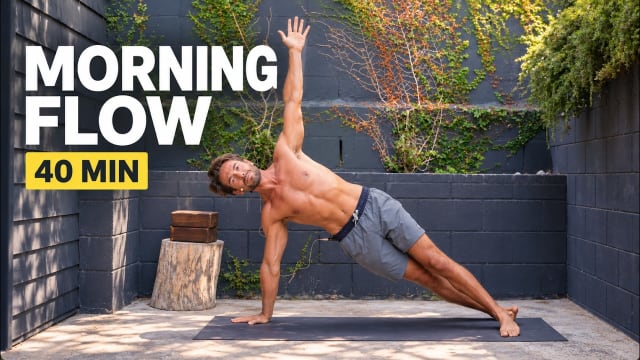
A thirty-minute morning class can be built two ways. One version stacks up impressive shapes and hopes you leave sweaty and loose. The other picks a handful of joints, works them from several angles, and asks you to own every inch of movement on the way in and out. Yoga With Tim's 30-minute "Full Body Mobility, Stretch and Strength" flow, published November 1, 2026, takes the second route. It opens in a seated hip position, circles through the hips on hands and knees, drops onto the side for outer-hip strength, rotates through the shoulders in side plank, and finishes with forearm work that wakes up the upper abdominals. Its central idea is simple and easy to skip past: range of motion only helps you if you can control it, and the fastest way to build that control is to move slowly through ranges you already have before chasing new ones.

読む · 9セクション

Why does a morning flow start in 90/90 instead of a warm-up pose?

The class opens with 90/90, sitting with both shins bent to right angles, one in front and one out to the side. It is a position many people find surprisingly humbling, because it asks the hips to rotate in two directions at once. The instructor's cues are specific. Sit tall, lean out over the front leg, and keep the spine long rather than rounding into the stretch. Then come back up using the leg and the core rather than the hands.

That last instruction is where the class starts to reveal its logic. In the video, the teacher explains the role of the hands: "So, the hands are guiding for stability. You're using more leg and core to control you up and down." (1:09) The hands are scaffolding, not the engine. The stated goal is that over time you might not need them at all, provided the spine stays long and you don't collapse into the position. That is a useful test for any stretch you do in the morning. If the position only holds because your arms are doing the work, the range you are "gaining" is borrowed rather than owned.

The breath pattern is offered as a suggestion, not a rule. "I like to inhale on the way down, and exhale to come up, but you can see what feels best for you," the teacher says. For a practice that depends on slow, controlled lowering and lifting, pairing the descent with an inhale gives the movement something to hang on to, and the exhale on the way up tends to pull the core into work.

What is the point of cat-cow hip circles on hands and knees?

After the seated work, the flow moves to hands and knees for hip circles, one leg at a time. The knee lifts toward the same-side elbow, sweeps out to the side, travels behind, comes down beside the standing knee, and reverses. The cue that matters most is "Biggest circle that you can without letting the lower back sink or twist." The circle is only as large as the pelvis allows while staying stable, so the size of the loop is a result, not a target.

The teacher also offers an image to help the movement stay smooth: "Visualize the femur gliding smooth in the socket. Your strong muscles supporting. Strong and flexible muscles." That phrasing is worth borrowing for any hip work. It reframes a stretch as a question of how a joint glides within a structure of supporting muscle, not a matter of pulling a leg farther in a direction.

The circles are followed by a clear reminder about bodies in general. In the middle of the seated work, the teacher says: "Remember we're asymmetrical, so there's an effort towards balance, but don't be so rigid about trying to force it. Allow for yourself to be asymmetrical." (3:07) Many morning routines quietly punish one side for being tighter. This class treats the difference between hips as information rather than a flaw to fix by force, which is a more sustainable way to approach the same goal.

How does side-lying work build outer-hip strength?

The flow then drops onto one hip and elbow, shoulder stacked over the elbow, for what the teacher calls "a little strengthening mobilization to help with our outer hips." The top leg lifts toward the ceiling, lowers with control, and the bottom leg drives down to lift again. The class asks for several repetitions per side, with a hold at the top. The arm is raised overhead on the way up, which quietly adds a shoulder and oblique challenge to the hip work.

This is the part of the class where the teacher makes the most explicit argument for not reaching only for ab exercises. "Sometimes we think of core isolation exercises only when we want to work on our abs, like a crunch or something, but these types of movements are very beneficial and will elicit in my opinion sometimes a better response." (7:39) The claim is modest and framed as personal opinion, but the underlying idea is one many movement teachers share. The core is a system that has to coordinate with the shoulders and hips, and a side-lying pattern asks all three to cooperate at once.

Why do heel-rocks and the extended child's pose appear so often?

Between the side-lying work and the standing portion, the class returns to a series of grounded positions. Extended child's pose, downward dog, and a heel-rocking sequence on all fours give the hips and calves a chance to lengthen without locking into any one shape. The heel-rocking, performed with both heels lifted and knees bent, rocks back toward the heels and forward again, moving the hips through their range without asking for a deep end-point.

The transitions are part of the structure. The class does not treat rest as separate from work. A position that feels like a break, like child's pose, is still a place to breathe and let the spine relax before the next demand. For anyone who finds morning flows either too static or too frantic, this rhythm is a useful model: a short demand, a short release, a short demand again.

What does side-plank shoulder rotation teach about range?

The most technically interesting section of the flow is the shoulder work in side plank. From a side plank, the arm reaches up, the palm rotates forward, then backward, and the hand hooks behind the back, all while the shoulder rotates inside its socket. The teacher repeatedly directs attention to the rotation happening "from the shoulder deep in the shoulder socket" rather than from the elbow or the wrist. There is an option to lift the bottom leg for a full side plank, and an option to lower the elbow if the wrist is bothering you.

Shoulder rotation of this kind is a good example of why the class emphasises controlled range. The shoulder joint has a great deal of motion, but most of it is only usable if the muscles around the blade can hold position while the arm moves. The cues about keeping the palm turning deliberately, and about reaching "the knuckles away," are about the shoulder staying organized rather than swinging. Practiced slowly, this sequence builds the same kind of joint-level awareness the teacher points toward when he mentions that individual joint movements can be practiced separately.

Why does the forearm section focus on the upper abdominals?

Near the end of the flow, the class comes down to forearms, knees on the ground, elbows under the shoulders. The cues move from subtle to specific. Press into the forearms and push the ground away so the elbows come forward. Keep the collarbones broad and the shoulder blades from creeping up. Lift the knees about an inch, "maintaining that subtle long lever." The teacher notes this is "going to be really on the core, the upper abdominals." Then the hips lift straight up, and the knees are walked in closer, toes curled, before the sequence settles back into child's pose.

The lesson here is about progression by degree rather than by pose. Each step adds a single variable: the knees lift a little, the shoulders move forward, the hips rise. The student who can do the first step with control has a clear, honest sense of where the next one begins. That approach is more useful for building strength than a fixed endpoint, because it tells you exactly what changed when a movement got harder.

What is the mobility challenge course the teacher mentions?

Partway through the standing portion, the teacher pauses to refer viewers to a separate resource. "So, good to practice those individual joint movements like from the mobility challenge course, which is different than the mobility course itself, where we do the individual joint movements. If you haven't explored that, I recommend it." (12:20) The video does not describe that course in detail, so this article will not either. What the reference does reveal is the teacher's underlying philosophy: the flow you do in the morning is one way to practice joint movement, and isolated joint work is another, and the two are meant to complement each other.

At the close of the class, the teacher invites viewers to the Conscious Movement Community, described in the video description as a place for structured courses and classes meant to help build a foundation and improve mobility over time. The video itself makes the pitch briefly near the end, around the 27-minute mark, and the description repeats it. Whether that community suits you is a separate decision. What the class demonstrates on its own is enough to be useful: a morning flow can be short, specific, and demanding without being aggressive.

How do you practice this flow well at home?

The class rewards a few habits. Move at the speed of control, not the speed of the instructor. If your arms are doing the work in 90/90 or in the lowering phases, use them as support and give yourself the option to reduce that assistance as you get stronger. Keep the spine long in any forward lean. Accept that one hip or shoulder will feel different from the other and do not force them to match. Use the breath as a guide rather than a requirement, and choose the variation that keeps your joints comfortable, as the teacher does in the side plank and forearm sections.

Above all, treat the thirty minutes as a conversation with your body. The teacher closes the loop on that idea in the descriptions and comments, asking viewers to report how they feel after the practice. That question is worth asking seriously. A morning routine is only useful if it leaves you more able to move, not just more tired.

Where to go from here

If you want to try this flow, start with the first ten minutes and repeat them until the 90/90 lean and the hip circles feel steady without the hands. Then add the side-lying work, which is the most underrated section for building outer-hip and oblique strength. Keep a note of which side feels tighter, and check whether it changes over a few weeks rather than assuming it will match the other side on schedule. When the shoulder rotation starts to feel controlled, you can explore the individual joint work the teacher recommends in the mobility challenge course he mentions. For more structured progression, the Conscious Movement Community is the next step the video itself points to, and the full class is available on the Yoga With Tim channel.
Comments

Loading the conversation…

Transcript

[0:02] Hi, and welcome to class.

[0:04] I'm excited for today's class cuz we're

[0:06] going to do some mobility, some

[0:09] strengthening, and some deep stretching.

[0:11] We're going to do some targeted areas

[0:14] that I have found helpful in my own

[0:16] practice to help to open up and

[0:19] improve my control and range of motion.

[0:23] So, I hope you find this class helpful

[0:25] as well.

[0:27] From here, we're going to come into

[0:28] 90/90. Left shin at a 90° angle, right

[0:32] shin at a 90° angle off to the side. Sit

[0:35] tall, and then start to lean out over

[0:39] the right leg.

[0:42] Left leg.

[0:44] Come back up.

[0:47] We're just going to lean forward into a

[0:49] stretch position keeping a long spine,

[0:51] so we're not just rounding into it.

[0:56] And back up.

[0:59] Using your hands to help you,

[1:02] but also when you come back up, press

[1:04] down to the leg and use your strong core

[1:06] to help you come back up.

[1:09] So, the hands are

[1:12] guiding for stability. You're using more

[1:14] leg

[1:15] and core to control you up and down.

[1:21] Over time, you might not even need

[1:24] the assistance of the hands.

[1:27] As long as you keep that good long spine

[1:30] and don't just

[1:31] collapse into the position.

[1:46] I like to inhale on the way down,

[1:50] and exhale to come up,

[1:52] but you can see what feels best for you

[1:55] as we finish these last two.

[2:12] >> Let's do the second side now.

[3:05] And just observing

[3:07] how one hip feels compared to the other.

[3:11] Remember we're asymmetrical, so

[3:13] there's an effort towards balance,

[3:17] but don't be so rigid about trying to

[3:19] force it.

[3:23] Allow for yourself to be asymmetrical.

[3:42] Now, let's come on to hands and knees

[3:48] for cat cow.

[4:39] >> Okay, come to neutral now lean over to

[4:41] the right knee and let's bring the left

[4:43] knee up by the left elbow.

[4:46] Out to the side.

[4:48] Back around behind you.

[4:50] Lower it down next to the right.

[4:53] Then lift up in reverse back behind.

[4:56] Out to the side up and around.

[5:00] Back to starting position. Again.

[5:04] Up [clears throat] and out to the side.

[5:06] Biggest circle that you can without

[5:08] letting the

[5:09] lower back sink or twist.

[5:14] And reverse.

[5:18] Nice job. Let's try on the right knee

[5:20] now lean into the left knee bring the

[5:22] right knee up to the elbow.

[5:25] Out to the side.

[5:27] Up and around.

[5:31] Starting position and in reverse.

[5:34] Feeling freedom here in the hip socket

[5:37] to move your

[5:40] leg around nice and smooth.

[5:44] Visualize the femur gliding smooth in

[5:47] the socket.

[5:49] Your strong muscles supporting.

[5:52] Strong [snorts] and flexible muscles.

[6:02] Good job.

[6:04] Now drop the right elbow down onto the

[6:06] ground. We're going to come to lie

[6:09] onto the right hip and elbow for a

[6:12] little strengthening mobilization to

[6:14] help with our outer hips.

[6:18] From [clears throat] here as you lean

[6:19] into your right elbow with the shoulder

[6:20] stacked, press your right knee down,

[6:23] lift your left knee up into the sky.

[6:27] Lower with control.

[6:29] Set the right hip down

[6:31] and drive down through the right knee,

[6:33] come back up.

[6:36] Good. We're going four more times.

[7:00] Hold at the top.

[7:02] Left arm up.

[7:05] And slowly lower down.

[7:08] Let's change sides now.

[7:10] Left elbow down.

[7:13] Left hip knee down. Lean and stack up.

[7:17] Drive the left knee down as the right

[7:18] knee comes up.

[7:21] And lower with control the hip down.

[7:24] Press down.

[7:26] Squeeze the

[7:28] right hip to lift the knee

[7:30] and lower.

[7:31] Four more times.

[7:36] So good also for our shoulder and our

[7:39] core muscles, the obliques here, to be

[7:41] able to coordinate the shoulders,

[7:45] obliques, and hips all at once.

[7:53] Sometimes we think of core isolation

[7:56] exercises

[7:58] only when we want to

[8:00] work on our abs,

[8:02] like a crunch or something, but

[8:05] these types of movements are very

[8:07] beneficial

[8:08] and will elicit

[8:11] in my opinion sometimes a better

[8:13] response.

[8:15] Good.

[8:16] Release that.

[8:19] Come into your extended child's pose.

[8:47] Adho Mukha Svanasana

[8:50] or downward dog, your choice.

[8:54] Bend the right knee and stretch the left

[8:56] heel bone down.

[9:00] Change. Bend the left knee in reach the

[9:02] right heel bone towards the ground.

[9:09] One more round.

[9:23] Both heels up high.

[9:25] Bend the knees. Lower the knees towards

[9:28] the ground.

[9:30] Rock the hips back towards the heels.

[9:33] Come forward.

[9:35] Lift hips. Lift knees up.

[9:39] Reach heels down.

[9:41] Heels up.

[9:43] Knees bend.

[9:45] Rock back.

[9:47] Rock forward.

[9:51] Lift knees, heels up.

[9:54] Reach heels down.

[9:56] Last one. Up.

[9:59] Knees down.

[10:01] Stretch back.

[10:04] Rock forward.

[10:07] Up with the heels and knees.

[10:10] down to the ground.

[10:13] >> [snorts]

[10:13] >> Drop the right knee down. Of course, you

[10:16] could use your cushion

[10:18] if [snorts] you were before. Left arm

[10:19] up.

[10:22] Spin

[10:24] the left palm to face forward, but see

[10:27] if you can rotate it from the shoulder

[10:29] deep in the shoulder socket as you reach

[10:31] the arm over.

[10:32] Of course, if you want to make this more

[10:34] challenging,

[10:35] lift the bottom leg so you're in a full

[10:37] side plank.

[10:40] Take the arm back up and let's turn the

[10:43] palm to face

[10:44] all the way back.

[10:46] Maybe even all the way up.

[10:48] The other way towards the sky.

[10:51] And then hook the arm behind your back

[10:52] as you look down.

[10:57] Reach the arm back.

[10:59] Rotate palm

[11:01] forward as you reach overhead.

[11:04] Last one.

[11:05] Back up.

[11:07] Rotate it to face back.

[11:10] Hook arm behind.

[11:14] Back up.

[11:17] Other side.

[11:23] Arm up. Rotate shoulder in the socket as

[11:26] you take the arm over.

[11:30] Back up.

[11:31] Turn palm to face the other way. Maybe

[11:34] even all the way back.

[11:37] As you hook the arm.

[11:43] Reach the knuckles away.

[11:45] Turn the palm to face open and reach

[11:49] over.

[11:53] Back up.

[11:55] Internally rotate so the palm faces

[11:57] back. Maybe even all the way

[12:01] so it faces up from the other direction

[12:05] as you hook.

[12:08] Back up.

[12:11] Hand over.

[12:16] So, good to practice those individual

[12:18] joint movements

[12:20] like from the mobility challenge course,

[12:22] which is different than the mobility

[12:24] course itself, where we do the

[12:25] individual joint movements.

[12:28] If you haven't explored that, I

[12:29] recommend it.

[12:32] Step your feet forward

[12:36] and fold.

[12:40] Let the head drop.

[12:42] Let go of the neck tension.

[12:48] Roll yourself up to stand.

[12:54] Spread arms and reach up.

[12:59] Then, hook your hands behind your back.

[13:02] Roll your shoulders back, heart open.

[13:10] Release. Reach back up.

[13:13] And fold forward.

[13:18] Hands come to shins.

[13:20] Elongate.

[13:25] Step your left leg back.

[13:27] Drop knee down.

[13:29] Inhale, come up.

[13:32] Exhale, cactus arms.

[13:36] Inhale, reach up.

[13:38] Touch palms.

[13:40] Left hand down, right arm up. Lift the

[13:43] back knee as you twist.

[13:49] Right hand down, walk around to the

[13:51] middle. Parallel your feet.

[13:54] Up on fingertips, get long.

[13:58] Turn around to the back. Drop back knee.

[14:03] Lift up.

[14:05] Cactus, bend the elbows, lift your

[14:07] heart.

[14:10] Inhale up. Touch palms.

[14:14] Hands come down, right hand down, lift

[14:17] back knee and twist.

[14:24] Watch out for the bush as you bring your

[14:25] left hand down, walk around to the

[14:27] middle.

[14:28] Come up on fingertips.

[14:32] Walk back around to the front, step to

[14:34] plank.

[14:51] Drop knees down, stretch back, extended

[14:53] child's pose.

[15:05] Look between your hands.

[15:08] Bring your heart there, knees, chest,

[15:09] chin.

[15:11] Slide into cobra pose.

[15:20] Lower heart down and press up.

[15:25] Downward facing dog.

[15:31] Okay, and then set the right knee down.

[15:36] Left arm up.

[15:38] Hold here or take a full side plank or

[15:41] you could drop your elbow down

[15:43] if it bothers your wrist.

[16:02] Change sides.

[16:17] Good, and then pull both elbows tap the

[16:19] knees down.

[16:21] As you reach down to your forearms,

[16:23] reach

[16:25] from the shoulder blades into the

[16:26] elbows.

[16:28] >> [snorts]

[16:28] >> Screw your knees up close. And now, just

[16:30] practice pressing into your forearms and

[16:33] pressing the ground away so the elbows

[16:35] start to come forward.

[16:37] Still keeping the collar bones broad and

[16:39] the blades broad on the back.

[16:42] Now, see if you can lift your knees up

[16:44] an inch, maintaining that subtle long

[16:46] lever. It's going to be really on the

[16:47] core, the upper abdominals.

[16:53] Tap the knees back down. Good job.

[16:56] Now, shoulders more over the elbows,

[16:57] still reaching into the forearms, still

[16:59] working the blades so they're not

[17:01] creeping up.

[17:02] And see if you can lift the hips

[17:04] straight up.

[17:17] Good. Knees down.

[17:19] See if you can walk the knees in a

[17:20] little bit closer.

[17:22] Press into the forearms.

[17:25] Curl the toes. Lift the knees.

[17:28] And then, lift straight up.

[17:45] Good job. Sit the knees down. Stretch

[17:47] back into a child's pose.

[17:51] >> [snorts]

[18:28] [snorts]

[18:32] >> Right hand, right knee down.

[18:36] Modified side plank.

[18:39] See if you could bend the left knee and

[18:41] reach back to take a hold of the foot.

[18:45] If this one isn't available to you, you

[18:47] could do low lunge instead or you

[18:49] have the knee down on the ground, you

[18:51] reach back with the hand for the foot

[18:53] that way.

[18:54] So one way or another, we're getting a

[18:55] little

[18:57] stretch and opening in the front.

[19:07] Good. And release that.

[19:09] Change sides.

[19:43] Good. Release that. Let's come into

[19:45] downward facing dog.

[20:22] From down dog, bring your left leg up

[20:25] for a pigeon pose.

[21:37] Back to down dog.

[21:40] Change sides.

[23:07] >> Back to down dog.

[23:16] Make your way to seated.

[23:24] Sit up straight and tall.

[23:28] Hug your left knee and then cross your

[23:29] left ankle to the outside of your right

[23:31] knee.

[23:36] Wrap your right elbow around your knee

[23:38] and twist.

[24:02] Release.

[24:04] Change sides.

[24:38] >> Come back to center.

[24:40] Both legs forward, sit up tall.

[24:43] And fold forward.

[24:59] Then lie down on your back for Savasana,

[25:01] corpse pose.

[26:37] >> Roll onto your side

[26:40] and [clears throat] press up.

[26:50] Bring your palms together.

[26:54] Thank you. Namaste.

[26:59] Thanks for joining. I'll see you next

[27:01] time.

[27:04] Thanks, bear.

[27:07] Thanks for joining me for this class.

[27:09] If you haven't already, click the link

[27:12] below in the description or in the first

[27:14] comment to join me for the transform

[27:16] course.

[27:17] The transform course is a course that I

[27:19] made that takes you step-by-step from

[27:21] wherever you're at in your practice will

[27:23] help you to advance.

[27:25] The most common feedback that I get from

[27:27] people who've been practicing with me on

[27:29] YouTube is that they're amazed that even

[27:32] after years of yoga practice, just after

[27:35] a few months of practicing the transform

[27:37] course, they're able to do things that

[27:39] they never thought they'd be able to do

[27:41] and open up their body in ways they

[27:42] never thought it would.

[27:44] So, check that course out. You can try

[27:46] it for a month free right now if you

[27:48] click that link.

[27:49] Have a great day. I'll see you next

[27:50] time.

YW
Artist
Yoga With Tim

Watch more from Yoga With Tim on YouTube.

ウェブサイト
トピックを見る
Morning-yoga-flowMobility-trainingHip-mobilityControlled-range-of-motionYoga-sequencing

ご質問はありますか?

よくある質問

In this flow, 90/90 means sitting with both shins bent to right angles, one in front and one to the side, then leaning over the front leg while keeping the spine long. The teacher uses it to work hip rotation, and cues you to come back up with leg and core strength rather than your hands.
The teacher says the hands are there for stability at first, and that over time you might not need them at all. The key condition is keeping a long spine and not collapsing into the position.
Lift one knee toward the same-side elbow, sweep it out to the side and around behind you, then reverse. The teacher's main cue is to make the circle as big as you can without letting the lower back sink or twist.
The teacher says yes, noting that we are asymmetrical and that there is an effort toward balance but no need to force it. The suggestion is to observe the difference and allow for it rather than trying to make both sides identical.
In this flow, the arm reaches up, rotates forward and back, and hooks behind the body while the rotation happens inside the shoulder socket. Options include a full side plank or lowering the elbow if the wrist is uncomfortable.
The teacher argues that side-lying and coordinated movements that engage shoulders, obliques, and hips together can sometimes produce a better core response than isolated ab exercises. He frames this as his opinion, and the flow also includes forearm work that targets the upper abdominals.

読みつづける

More from Yoga With Tim

すべて表示
Full-Body Morning Yoga Flow: Breath, Balance, Modifications
Inspire

Full-Body Morning Yoga Flow: Breath, Balance, Modifications

A walkthrough of a morning yoga flow from Yoga With Tim: breath-first opening, thread-the-needle, tree pose, side plank, warrior three, and …

8 min read
15-Minute Bedtime Yoga: How the Breath-to-Spine Sequence Works
Inspire

15-Minute Bedtime Yoga: How the Breath-to-Spine Sequence Works

A 15-minute floor sequence built on breath awareness, a seaweed-like spinal wave, and slow twists. Here is how each step works and why the p…

8 min read
Kirtan Camp in Costa Rica: Bhakti, Chant and the Blue Zone
Inspire

Kirtan Camp in Costa Rica: Bhakti, Chant and the Blue Zone

A week of kirtan, yoga and ocean swims at a Costa Rica retreat set for July 2027. This clip shows what Jai Uttal's camp is built to do: gath…

6 min read
Sita's Sacrifice: Why the Ramayana Story Changes Women's Place
Inspire

Sita's Sacrifice: Why the Ramayana Story Changes Women's Place

In a two-minute clip, Nina Rao argues that Sita's sacrifice in the Ramayana was a deliberate teaching about women's place in humanity, and a…

6 min read

探索を続ける

旅をつづける

BrightStarのディレクトリから、さらなる智慧と集いを。

もっと記事を読む

教え、インタビュー、ガイドのライブラリ全体をご覧ください。

すべての記事に戻る →

講師とアーティスト

コンシャスな世界の系譜、音楽家、導き手を探しましょう。

アーティストを探す →

イベントを見つける

キルタン、リトリート、サウンドバス、ブレスワーク、フェスティバル — まもなく開かれます。

イベントを見る →