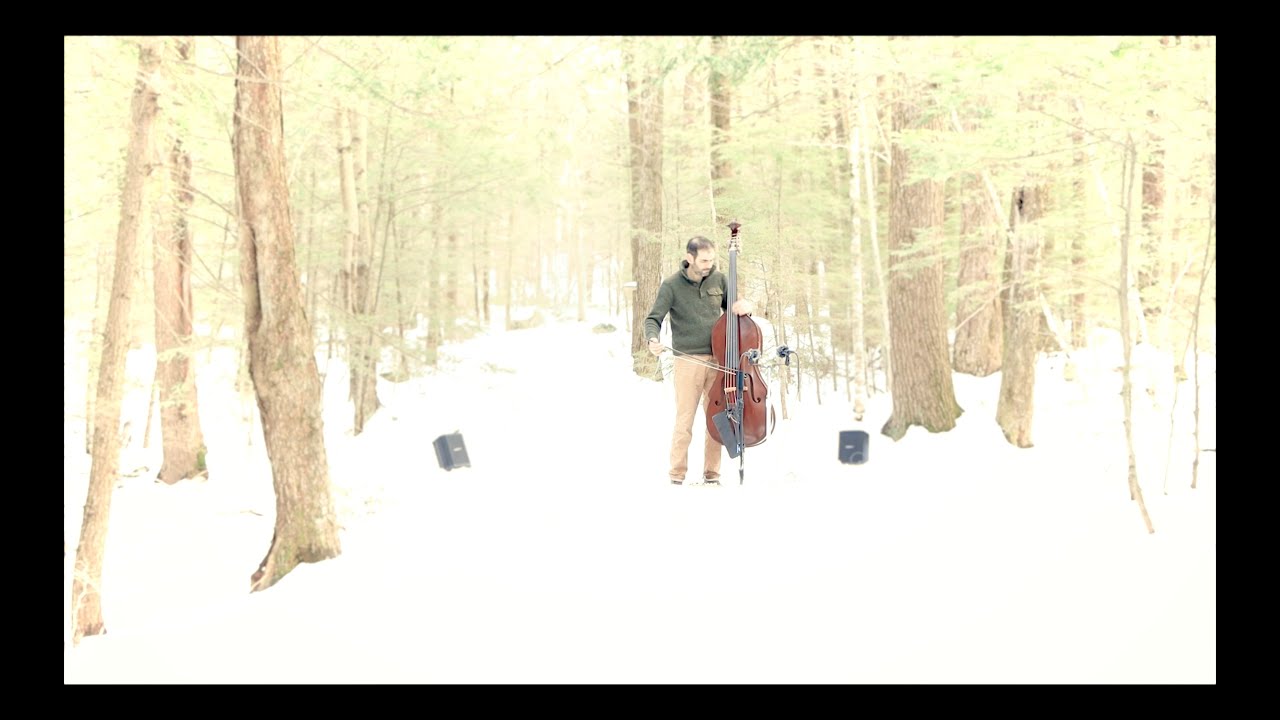
Each morning at the Wanderlust Festival of Music and Yoga, more than forty people rode a cable car to the top of Squaw Valley ski resort, stepped off into thin mountain air, and followed a musician up a mile-long trail with a double bass strapped to his back. At the end of the climb, next to a steep slope of wild alpine flowers and a stream fed by melting glacial ice, Garth Stevenson set his bass to sound. He wove bowed tones into the ambient sounds of the mountain for forty-five minutes, then stopped and let twenty minutes of silence finish the sitting. The video published under his name is an eight-minute edit of that seventy-five-minute experience, and it captures a practice that treats the climb, the instrument, and the quiet as one continuous meditation.
This account draws on the video's published description, which is the only documentation available for the morning itself. The sound lives in the edit. What follows is an attempt to explain the ideas the practice raises, and why a hike with a bass might be worth more than a novelty.
The logistics are the first thing the description lays out, and they are not incidental. Participants did not walk from a trailhead at the bottom of the valley. They rode the cable car to the summit first, so the ascent that followed was a deliberate climb rather than a warm-up. Stevenson went ahead on foot with his double bass strapped to his back, and the group followed him.
The instrument itself is a large, awkward thing to haul over uneven ground. A double bass is roughly the height of the person carrying it and is built to be played seated or standing in one place, not walked with. Choosing to bring it up a mountain changes its meaning. It stops being a stage object that arrives by van and becomes something that has to be earned by the body. The bass becomes a kind of pilgrim's staff, and the climb becomes part of the sound, because the player arrives at the performance area already breathing hard and already quiet from the effort.
The support crew matters too. The description notes that each day a volunteer carried the battery-powered speaker, and that the backpack held video gear and the looping and reverb pedal. Those are the tools of a one-person ensemble, and the volunteer's role hints at how the morning was built: a shared effort, with the music as the group's collective responsibility rather than a single performer's show.
The gear list names a looping and reverb pedal, and it is worth understanding what those tools do in this context. A looper records a phrase played by the musician, then replays it continuously while the player adds new layers on top. One instrument can, in effect, become several: a drone underneath, a melody above it, and a rhythmic pulse in the middle, all generated by one person with one bow. Reverb extends the decay of each note so that tones linger in the air rather than stopping cleanly. Together, the two effects let a sustained bowed line bloom into open space.
Out on a mountain, that bloom has somewhere to go. Indoors, a reverb pedal fills a room with its own reflections. Outdoors, the reverb mixes with the stream, the wind, and the open distance, so the processed tone and the natural sound begin to blur. That is the detail the description points toward when it says Stevenson was weaving the tone of his bowed bass amongst the ambient nature sounds. The aim is not to overpower the setting with a louder instrument. It is to make the instrument a thread inside the setting, so that a listener cannot always say where the mountain stops and the music begins.
The location was not a backdrop chosen for photography. The description specifies a steep slope covered in wild alpine flowers, with a stream running from the melting glacial ice above. Those details matter for the practice. Moving water provides a constant, low, textured sound that never repeats exactly, and it is one of the oldest drones in nature. Placing a bowed instrument beside a stream asks the musician to join a sound that was already going on, rather than starting one from nothing.
The steepness and the flowers add a second layer. Standing on a slope, the body has to stay engaged just to remain upright, and a listener sitting on it is not in a relaxed concert seat. Attention has to be held by the ground and the air as much as by the music. The alpine setting also places the group in a landscape that is changing as the ice melts, which gives the morning a sense of time and impermanence that no studio can supply. A meditation in this setting is not about escaping the world. It is about sitting inside one of its most vivid parts.
The structure is the most instructive part of the description. Forty-five minutes of music were followed by twenty minutes of silence. That ratio suggests the silence was not an afterthought. It was roughly a third of the total sitting, and it was the part that asked the most of the audience. Music gives the mind something to follow. Silence takes that support away and leaves attention to rest on whatever is left: breath, wind, water, the small noises of people shifting on the slope.
Many contemplative traditions use this kind of contrast. Sound is brought forward and then allowed to fall away, so that the stillness after it is noticed rather than assumed. A performer who can hold a silence of twenty minutes in an open outdoor space, with forty people present, is making a decision about trust. The music has to be strong enough to be missed, and the audience has to be willing to remain without it.
There is also a practical irony in the edit. The full morning ran seventy-five minutes, and the video compresses it to eight. A viewer watching at home experiences the music in fragments and can skip the silence entirely. The silence is the part that resists compression, which is why the experience is best understood as something that happened in one place, over one morning, rather than as a clip.
The festival that hosted the hike was built around music and yoga, and the morning sits comfortably at the intersection of the two. Yoga practice often begins with the body: walking, breathing, moving into a position that needs attention. Music practice often begins with the ear and the instrument. A hike followed by a listening meditation puts both into one sequence. The body is exerted, then the senses are opened, then the mind is invited to rest. The order is the practice.
The video's reach also says something about how such work circulates. The description was posted in August 2010, and at the time of the snapshot this article draws on, the video had 49,702 views. That number suggests people kept returning to a morning they did not attend in person, perhaps looking for the same thing the participants climbed for: a way to sit with sound and silence without a stage between them and the world.
If the eight-minute edit has made you curious, start with the sound itself. Watch the video at the highest quality your connection allows, and pay attention to the moments when the bass recedes into the stream and the wind. Then listen to the silence that follows the music, even if the edit cannot give you all twenty minutes of it.
For a version you can try yourself, pair a short walk with a listening sit. Choose a spot near running water or open air, carry something you can hold without strain, and play or listen to a single sustained tone for a set period. When the tone ends, sit in silence for a period roughly half as long, and notice what changes. You do not need a double bass or a glacier to test the idea. You need a place where sound and silence can both be heard clearly.
To learn more about Garth Stevenson's work, the description points to his website, www.garthstevenson.com. The video description does not say whether a full-length recording of the seventy-five-minute morning is available, so the eight-minute edit is the public record of that experience for now.