BrightStar

すべてのEventsを見る

意識ある集いに出会う

events

Yoga
Meditation
Breathwork
Qigong
Tai Chi
Sacred Music
World Music
Medicine Music
Sound Healing
Ecstatic Dance
人気の目的地
BaliSedonaLos AngelesCosta RicaNew YorkSan FranciscoAustinMiamiJoshua TreeTulum
すべてのカテゴリを見るすべての目的地を見る

すべての機能を探索

イベントを成長させる強力なツール

プラットフォーム機能

スマートダイナミックプライシング
チケットカテゴリ
座席指定
カート放棄リカバリー
訪問者リカバリー
寄付とスライディングスケール
アフィリエイトシステム
チケットスキャナー
クーポンコード
カスタム質問
チケット共有
アップセルとアドオン
分析とレポート
メールシーケンス
ウェイトリスト / 通知 / リマインダー
人と場所
Artists & TeachersEvent OrganizersVenues & StudiosKnowledge BaseGlossaryInspiration
すべての機能を見る私たちについて
料金ブログ
Language
Saved events
すべてのイベントを見る

events

YogaMeditationBreathworkQigongTai ChiSacred MusicWorld MusicMedicine Music

人気の目的地

BaliSedonaLos AngelesCosta RicaNew YorkSan Francisco

人と場所

Artists & TeachersEvent OrganizersVenues & StudiosKnowledge BaseGlossaryInspiration

プラットフォーム機能

スマートダイナミックプライシングチケットカテゴリ座席指定カート放棄リカバリー訪問者リカバリー寄付とスライディングスケールアフィリエイトシステムチケットスキャナークーポンコードカスタム質問チケット共有アップセルとアドオン分析とレポートメールシーケンスウェイトリスト / 通知 / リマインダー
すべての機能を見る私たちについて
料金ブログ
ログイン探求者クリエイター
  • すべてのイベントを見る
  • 探求者向け
  • ヨガ
  • 瞑想
  • ブレスワーク
  • 気功
  • 太極拳
  • 聖なる音楽
  • ワールドミュージック
  • メディスンミュージック
  • サウンドヒーリング
  • エクスタティックダンス
  • リトリート
  • ワークショップ
  • すべてのカテゴリ →
  • Bali
  • Sedona
  • Los Angeles
  • Costa Rica
  • Tulum
  • Byron Bay
  • San Francisco
  • Austin
  • New York
  • San Diego
  • Denver
  • Seattle
  • Portland
  • Miami
  • すべての都市 →
  • Join the Movement
  • Why we list
  • Sell Globally
  • クリエイター向け
  • チーム向け
  • ライター向け
  • 講師向け
  • キルタンアーティスト向け
  • スタジオ向け
  • フェスティバル向け
  • リトリートセンター向け
  • 非営利団体向け
  • ブランドアンバサダー
  • 無料チケット販売
  • Elevate
  • Amplify
  • 50万人以上のバイヤーネットワーク
  • カート放棄リカバリー
  • スマートダイナミックプライシング
  • チケットカテゴリ
  • 定期イベント
  • 座席指定
  • アフィリエイトシステム
  • ウェイトリスト / 通知
  • チケットスキャナー
  • 埋め込みウィジェット
  • イベント配信
  • メッセージセンター
  • インテグレーション
  • レポート
  • すべての機能 →
  • 概要
  • エコシステム
  • ブログ
  • 用語集
  • インスピレーション
  • ヘルプセンター
  • お問い合わせ
  • APIドキュメント
  • ブランドアセット
  • 採用
  • プレス
  • 利用規約
  • プライバシーポリシー

イベント

  • すべてのイベントを見る
  • 探求者向け
  • ヨガ
  • 瞑想
  • ブレスワーク
  • 気功
  • 太極拳
  • 聖なる音楽
  • ワールドミュージック
  • メディスンミュージック
  • サウンドヒーリング
  • エクスタティックダンス
  • リトリート
  • ワークショップ
  • すべてのカテゴリ →

目的地

  • Bali
  • Sedona
  • Los Angeles
  • Costa Rica
  • Tulum
  • Byron Bay
  • San Francisco
  • Austin
  • New York
  • San Diego
  • Denver
  • Seattle
  • Portland
  • Miami
  • すべての都市 →

クリエイター向け

  • Join the Movement
  • Why we list
  • Sell Globally
  • クリエイター向け
  • チーム向け
  • ライター向け
  • 講師向け
  • キルタンアーティスト向け
  • スタジオ向け
  • フェスティバル向け
  • リトリートセンター向け
  • 非営利団体向け
  • ブランドアンバサダー
  • 無料チケット販売
  • Elevate
  • Amplify

機能

  • 50万人以上のバイヤーネットワーク
  • カート放棄リカバリー
  • スマートダイナミックプライシング
  • チケットカテゴリ
  • 定期イベント
  • 座席指定
  • アフィリエイトシステム
  • ウェイトリスト / 通知
  • チケットスキャナー
  • 埋め込みウィジェット
  • イベント配信
  • メッセージセンター
  • インテグレーション
  • レポート
  • すべての機能 →

会社

  • 概要
  • エコシステム
  • ブログ
  • 用語集
  • インスピレーション
  • ヘルプセンター
  • お問い合わせ
  • APIドキュメント
  • ブランドアセット
  • 採用
  • プレス
  • 利用規約
  • プライバシーポリシー
BrightStar
アプリを入手
App StoreからApp StoreGoogle Playで手に入れようGoogle Play
© 2026 BrightStar. 全著作権所有.
Inspiration

Embracing Anger Like a Baby: A Mindfulness Practice Guide

PV
Plum Village App
Nov 2, 2026
読了 約8分

出典:Plum Village App

視聴 · 6

For thirty-three minutes, one voice leads the viewer through a practice most of us would rather skip: sitting with anger without trying to make it go away. The voice belongs to Thich Nhat Hanh, drawn from a Dharma talk originally recorded on March 25, 2004, and assembled into a short film by the Plum Village App. The film, directed and edited by Miguel Sánchez with cinematography by Manuel Wenger and a soundscape of nature recordings and cinematic sound design, follows a deliberate arc. It begins with the breath, moves into the body, and only then arrives at the anger itself, which is met not with a fight but with a smile and the image of a mother holding a crying baby. The reason this is worth a close reading is the reversal at its center. Anger here is not an enemy to be defeated. It is a child in pain, and the first duty toward it is tenderness.

読む · 7セクション

What does it sound like when you start with the breath?

The film opens on a count of breath, and the rhythm is the first thing to notice. "Breathing in. I know I am breathing in. I enjoy." Thich Nhat Hanh's phrasing is simple enough to repeat under your breath, and that repetition is the point. Each line names an action and then names the awareness of that action, so that the mind has two steps to follow rather than one.

Early on (at 0:11), the teaching gives its definition: "When you bring your attention to your in breath, that's called mindful breathing. And your in breath become the only object of your mind." The idea is concentration in its most practical form. The breath is not a technique to be perfected. It is a single object that the mind can return to, and in returning, it lets go of everything else.

The film is specific about what gets released. At 0:37, the teacher lists the material the mind usually carries: "worries, projects, regret." The claim is modest but important. Before anger can be touched, the mind has to be briefly cleared of the running commentary that feeds it. Mindful breathing is not an escape from the feeling. It is a way of arriving with enough space to meet it.

Why does the practice begin with the body instead of the anger?

This is the part of the film that surprises first-time viewers. A meditation on anger spends several minutes on the body before anger is mentioned at all. At 4:43, the instruction shifts: "Breathing in, I'm aware of my body. Breathing out, I smile my body. I want to reconcile with my body. Hello there, my body. I'm home to you."

The word that carries weight is reconcile. Anger usually lives in the body as tension, heat, a clenched jaw, a held breath. A practitioner who has been at odds with their own physical state, and who keeps fighting it, will find that anger has somewhere to hide. By greeting the body first, the teaching makes the ground safe before the harder feeling arrives.

Thich Nhat Hanh describes the mechanism directly: "And you use the energy of mindfulness of your capacity of being fully present in order to recognize your body as being there. Embrace it tenderly. That is already the practice of love." The sequence is recognition, then embrace, and the film names the embrace as love. This is a different model from the one many people carry, where meditation is a method for fixing a body that is wrong. Here the body is simply present, and presence is enough to begin.

"Darling, I am home for you. I'll take care of you."

Thich Nhat Hanh, Dharma talk recorded March 25, 2004, as excerpted in the Plum Village App short film (approx. 4:43–5:31)

What does it mean to let the body relax and surrender?

The third movement is quieter. At 10:11, the instruction is to breathe out and "allow my body to relax." The film then gives a short description of what that release looks like from the inside: "You feel relaxed. The fighting is no longer there. You surrender yourself to the present moment."

The word surrender appears twice in this passage, and it is worth noticing how it is used. Surrender here does not mean giving up or letting the anger win. It means ceasing to add a second layer of struggle on top of the first. The teaching continues: "You surrender yourself to the power of healing of your body and of your consciousness." Healing is framed as something the body and consciousness already have the capacity for. The practitioner's job is to stop obstructing it.

For anyone who has tried to meditate through a flare of irritation, this is the crux. The instinct is to push the feeling out. The film suggests that pushing is itself a form of fighting, and that the fighting is what keeps the body braced.

How do you name anger without feeding it?

Only after the body has been greeted and released does the film turn to the emotion. At 15:12, the instruction is precise: "Breathing in, I'm aware of the anger in me. Breathing out, I smile to the anger in me." The smile is not a mask. It is an act of acknowledgment, a way of saying the feeling is seen without being given authority over the mind.

Then comes the line that gives the practice its name: "Painful feeling. I know you are there. I will take good care of you." Notice what is absent. There is no command to stop, no judgment about whether the anger is justified, no analysis of its cause. The anger is addressed as a "you," and that second-person address changes the relationship. A feeling you are talking to is not quite the same as a feeling you are trapped inside.

Why compare anger to a baby, and what does the mother do?

The image at the heart of the film arrives at 15:34: "It's like a mother holding her baby. Baby anger, baby pain. The mother is not trying to punish. The mother is there for the baby because the baby need her care."

The comparison does a lot of work in a few words. A baby who cries is not being bad. A baby is in need, and the crying is a signal of that need. By calling anger "baby anger," the teaching removes the moral charge that most people attach to their own rage. The anger is not a character flaw or a sin. It is an immature, overwhelmed part of experience asking for care.

The phrase "The mother is not trying to punish" addresses the most common mistake in working with difficult emotion. Many of us meet our anger the way a harsh parent meets a crying child, with scolding, shame, or a demand to be quiet. The film offers a different parent. The mother holds, stays, and tends. The practice is to become that mother for the feeling inside you, and the film is clear that this is a daily discipline rather than a single breakthrough.

"Baby anger, baby pain. The mother is not trying to punish."

Thich Nhat Hanh, Dharma talk recorded March 25, 2004, as excerpted in the Plum Village App short film (approx. 15:34–15:45)

What is it like to watch a 33-minute meditation film?

The film's length is part of the teaching. Thirty-three minutes is long enough that the viewer cannot simply absorb the words and move on. The instructions repeat, the breath returns, and the body is greeted more than once before the anger appears. The soundscape, credited to Mat Eric Hart, Cinematic Sound Design, and Angel Perez Grandi, works as a second voice, which means the viewer is listening to two kinds of attention at once: the human voice guiding and the natural and ambient sound that holds the room open.

Watching it the way one might listen to a slow record, rather than as a lecture to be taken in quickly, lets the structure reveal itself. Breath, then body, then feeling. Each stage prepares the one after it. The practice cannot be shortened without losing the sequence that makes it work.

Where to go from here

The film is an excerpt. The words come from a Dharma talk recorded on March 25, 2004, and the full talk is available on YouTube at https://www.youtube.com/watch?v=EhC9spSh5J4. Hearing the teaching in its longer form gives context for the short excerpts, including the surrounding explanation of what mindful breathing is for.

To practice the film's sequence on your own, begin with three to five minutes of breathing in with the phrase "I know I am breathing in," then move to the body. Greet it. Let the breath out with a sense of release. Only then, if anger is present, name it gently, smile to it, and speak to it as a baby in need. Do not force the sequence or rush it. The film's own pacing is the best guide.

The full short film collection is available through the Plum Village App, which describes its library as free. This piece is a companion to the film, not a replacement for it. Watch it once through, then return to the breath.

Comments

Loading the conversation…

Transcript

[0:11] Breathing in. I know

[0:14] I am breathing in.

[0:17] I enjoy.

[0:21] When you bring your attention to your

[0:23] inb breath,

[0:27] that's called mindful breathing.

[0:31] And your inb breath become the only

[0:33] object of your mind.

[0:37] You release everything

[0:41] worries, projects,

[0:45] regret.

[0:48] So just breathe in mindfully

[0:52] and you become a free person.

[4:43] Breathing in, I'm aware of my body.

[4:48] Breathing out, I smile my body.

[4:53] I want to reconcile with my body.

[4:58] Hello there, my body. I'm home to you.

[5:03] And you use the energy of mindfulness

[5:07] of your capacity of being fully present

[5:10] in order to recognize your body as being

[5:13] there.

[5:15] Embrace it

[5:17] tenderly.

[5:20] That is already the practice of love.

[5:24] Darling, I am home

[5:28] for you.

[5:31] I'll take care of you.

[10:11] Breathing in, I'm aware of my body.

[10:16] Breathing out, I allow my body to relax.

[10:23] You feel relaxed.

[10:28] The fighting is no longer there.

[10:31] You surrender yourself to the present

[10:34] moment.

[10:37] You surrender yourself to the power of

[10:40] healing of your body and of your

[10:43] consciousness.

[15:12] Breathing in, I'm aware

[15:15] of the anger in me.

[15:19] Breathing out, I smile to the anger in

[15:22] me.

[15:25] Painful feeling. I know you are there.

[15:30] I will take good care of you.

[15:34] It's like a mother holding her baby.

[15:41] Baby anger, baby pain.

[15:45] The mother is not trying to punish.

[15:50] The mother is there for the baby because

[15:52] the baby need

[15:55] her care.

PV
Artist
Plum Village App

Watch more from Plum Village App on YouTube.

ウェブサイト
トピックを見る
Embracing-angerMindful-breathingThich-nhat-hanhPlum-villageAnger-practice

ご質問はありますか?

よくある質問

The film suggests starting with mindful breathing, then greeting the body, letting it relax, and only then naming the anger. Each breath is paired with a sentence, such as 'Breathing in, I'm aware of the anger in me,' and 'Breathing out, I smile to the anger in me.'
In the excerpt, he describes mindful breathing as bringing attention to the in-breath so that it becomes the only object of the mind. The practice releases worries, projects, and regret, leaving the mind free and present.
He says 'Baby anger, baby pain,' and describes a mother who holds her baby without trying to punish it, because the baby needs care. The image reframes anger as a vulnerable part of experience asking for tenderness rather than a moral failing.
In this teaching, the smile is an act of acknowledgment rather than a mask. The instruction is to breathe out and smile to the anger, then address it directly as a painful feeling that you know is there and will take good care of.
No. The film is an excerpt from a talk Thich Nhat Hanh gave, originally recorded on March 25, 2004. The full talk is available on YouTube, and the short film is one of several videos in the Plum Village App's free collection.
The film spends several minutes greeting the body and saying 'I want to reconcile with my body' before anger is mentioned. The reasoning implied is that a body that is already at peace with itself gives the painful feeling less to fight against.

読みつづける

More from Plum Village App

すべて表示
Vietnamese Identity Beyond Vietnam: A Plum Village Conversation
Inspire

Vietnamese Identity Beyond Vietnam: A Plum Village Conversation

A two-hour Plum Village conversation on Vietnamese identity in the diaspora, with Brother Phap Huu, Nho Tran and Ocean Vuong. It rejects bin…

10 min read
Only an Emotion: The Second Arrow and Handling Painful Feelings
Inspire

Only an Emotion: The Second Arrow and Handling Painful Feelings

A five-minute teaching from Thich Nhat Hanh on why pain doubles when we exaggerate it, and how seeing a strong emotion as only an emotion ca…

8 min read
Liberation Through Grief and Self-Worth in Buddhist Practice
Inspire

Liberation Through Grief and Self-Worth in Buddhist Practice

Br. Phap Huu explores how recognizing our inherent goodness and learning to grieve openly within community liberates us from suffering and s…

11 min read
Living Gems Archive: Preserving Thích Nhất Hạnh's Dharma for the World
Inspire

Living Gems Archive: Preserving Thích Nhất Hạnh's Dharma for the World

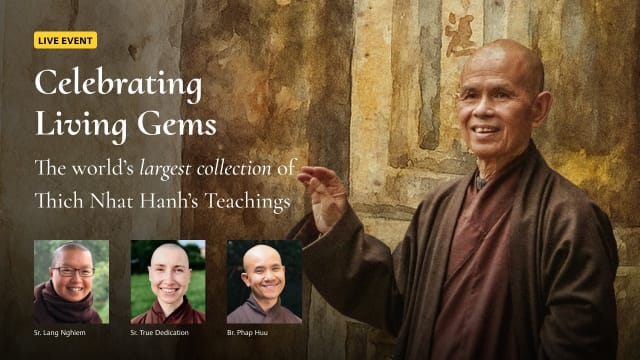
Living Gems is a searchable digital archive of Thích Nhất Hạnh's teachings, built by Plum Village to preserve and share the dharma globally …

10 min read

探索を続ける

旅をつづける

BrightStarのディレクトリから、さらなる智慧と集いを。

もっと記事を読む

教え、インタビュー、ガイドのライブラリ全体をご覧ください。

すべての記事に戻る →

講師とアーティスト

コンシャスな世界の系譜、音楽家、導き手を探しましょう。

アーティストを探す →

イベントを見つける

キルタン、リトリート、サウンドバス、ブレスワーク、フェスティバル — まもなく開かれます。

イベントを見る →