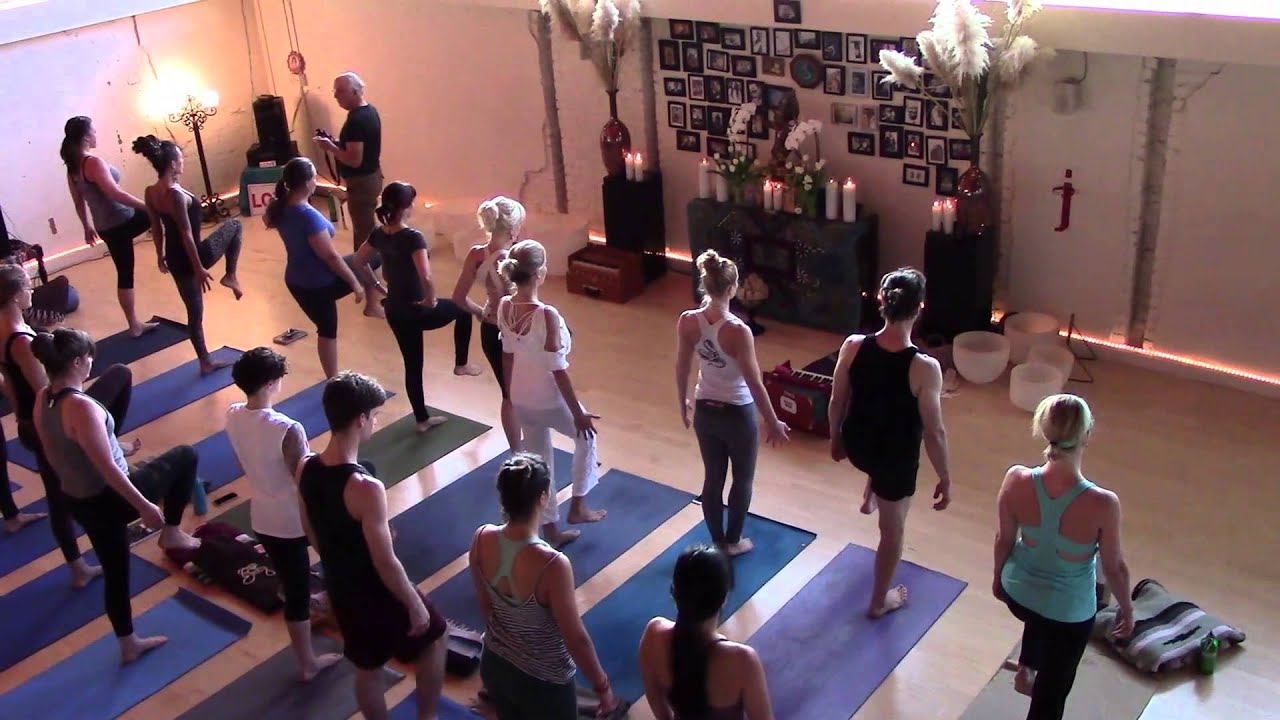
In this 1994 performance at the Jivamukti Yoga Center, Sharon Gannon choreographs a sequence of yoga asanas synchronized with Bhagavan Das's kirtan singing and Ray Spiegel's tabla accompaniment. The work demonstrates how physical yoga postures can function as devotional expression when integrated with sacred chanting and percussion, creating a unified art form that honors both the body's capacity for precise alignment and the heart's capacity for emotional and spiritual resonance.
Asana dance represents a deliberate fusion of yoga posture work with choreographic intent and musical accompaniment. Rather than moving through poses as isolated techniques for flexibility or strength, asana dance treats each posture as an expressive element within a larger artistic and devotional arc. Sharon Gannon's approach, demonstrated in this performance, integrates classical yoga asanas—the physical shapes and sequences taught in traditional hatha yoga—with the emotional and sonic qualities of kirtan, the call-and-response chanting of sacred Sanskrit mantras.
This format differs fundamentally from most yoga instruction in that the body becomes a vehicle for artistic and spiritual communication rather than merely a laboratory for the student's personal development. The choreography creates a shared experience where the dancer embodies the devotional sentiment that the singer voices, and the rhythm of the tabla provides a temporal container that unifies both elements.
Bhagavan Das's kirtan singing provides the emotional and spiritual soundtrack that gives meaning and texture to the physical movement. In traditional kirtan, a chant leader calls out a mantra or sacred verse, and the community responds, creating a call-and-response structure that builds energy and invites collective participation. When paired with asana choreography, the kirtan does several things simultaneously:
- It establishes a rhythmic foundation that organizes the timing and pacing of the movement sequences
- It anchors the physical practice in devotional intention, transforming exercise into worship
- It creates emotional resonance that allows practitioners and observers to feel the deeper meaning of the postures beyond their biomechanical function
- It invokes the sacred through sound and language, deepening the spiritual dimension of the work
The pairing of asana and kirtan acknowledges a fundamental principle in classical yoga philosophy: that the body and the heart, or soma and psyche, operate together. The postures prepare and sensitize the nervous system, while the chanting cultivates devotion, gratitude, and connection to something larger than the individual self.
Ray Spiegel's tabla—a pair of hand drums central to Indian classical music—functions as the temporal anchor and rhythmic intelligence of the entire performance. The tabla establishes the tala, or rhythmic cycle, that both the singer and the dancer follow. In this way, the tabla becomes the connective tissue between kirtan and asana, creating a shared metric structure that allows three different forms of expression to move coherently together.
The tabla's presence also honors the Indian classical music tradition from which both yoga and kirtan emerge. By including authentic tabla accompaniment, the performance situates itself within a lineage of sacred arts rather than treating asana as a standalone Western fitness practice. The tabla rhythm invites a precision and attention from the dancer—the asanas must align not only with the breath and the body's capacity, but with the musical pulse that surrounds them.
This performance took place at the Jivamukti Yoga Center, the studio co-founded by Sharon Gannon and David Life in 1984. Jivamukti yoga integrates asana practice with chanting, meditation, music, and philosophical study, explicitly rejecting the notion that yoga is merely a physical fitness system. The term "Jivamukti" itself means "liberation while living"—the idea that enlightenment and spiritual awakening are possible within daily life, not only in monasteries or retreat settings.
By performing asana dance as an artistic work, Gannon demonstrates a core Jivamukti principle: that the body and the arts are vehicles for awakening and devotion. The choreography is not separate from spirituality but is a direct expression of it. Similarly, the inclusion of kirtan and tabla reflects Jivamukti's emphasis on bhakti yoga—the yoga of devotion and emotional opening—as a valid path to liberation alongside physical practice.
The title "Wings of a Dove" suggests a movement quality that is light, graceful, and associated with transcendence or spiritual ascent. In many spiritual traditions, the dove symbolizes peace, purity, and the capacity to rise above earthly concerns. By naming this asana dance after the dove's wings, Gannon indicates that the movement practice aims not for muscular strength or visible flexibility, but for a quality of ease, uplift, and spiritual lightness. The dove's wings carry the body effortlessly—much as good asana practice should feel like a release rather than a struggle.
This title also reflects the bhakti yoga tradition's use of animal and natural imagery to evoke inner states. Just as the devotee wishes to feel the lightness and freedom associated with a dove in flight, the asana practice aims to cultivate those qualities in the body and mind.
For Sharon Gannon, creating asana dance serves several purposes beyond the conventional yoga classroom. First, it demonstrates that yoga practice can be aesthetically beautiful and artistically rigorous—that precision in asana aligns with precision in choreography, and that both require attention, intention, and refinement. Second, it brings yoga into dialogue with other art forms (dance, music) and makes it visible and tangible to audiences who may not practice yoga themselves. Third, it models a way of relating to the body that is neither narcissistic nor punitive, but genuinely playful and devotional.
By performing asana dance, Gannon also challenges the Western association of yoga with solitary, inward-focused practice. She creates yoga as a shared, witnessed, and celebrated human endeavor—something performed and offered, not merely practiced in private.
Although recorded nearly three decades ago, this performance addresses persistent questions in modern yoga: How do we practice asana with genuine spiritual intention rather than purely aesthetic or fitness goals? How do we integrate sound and music into embodied practice? How do we honor yoga's roots in Indian classical arts and philosophy rather than treating it as a decontextualized gym technique?
Contemporary yoga classes often bracket music, chanting, and philosophy as "optional" or "complementary" to the "real" work of asanas. This performance argues implicitly that such separation is artificial. When asana, kirtan, and tabla work together, they amplify each other—the practice becomes more coherent, more meaningful, and more likely to catalyze the internal shifts that yoga is meant to facilitate.
If you are interested in exploring asana dance further, you might seek out classes or workshops that explicitly integrate chanting, music, and choreography into yoga practice. Many Jivamukti-trained teachers maintain this integrated approach. You might also listen to recordings of kirtan by artists like Bhagavan Das and others to understand the emotional and devotional qualities that underpin this music. If you have asana experience, you might experiment with moving through familiar sequences while listening to kirtan, paying attention to how the music changes your relationship to the poses. Finally, studying the philosophical underpinnings of bhakti yoga—devotion through emotion, music, and relationship—will deepen your understanding of why Sharon Gannon and others believe that asana and kirtan are not separate practices but aspects of a single integrated path.