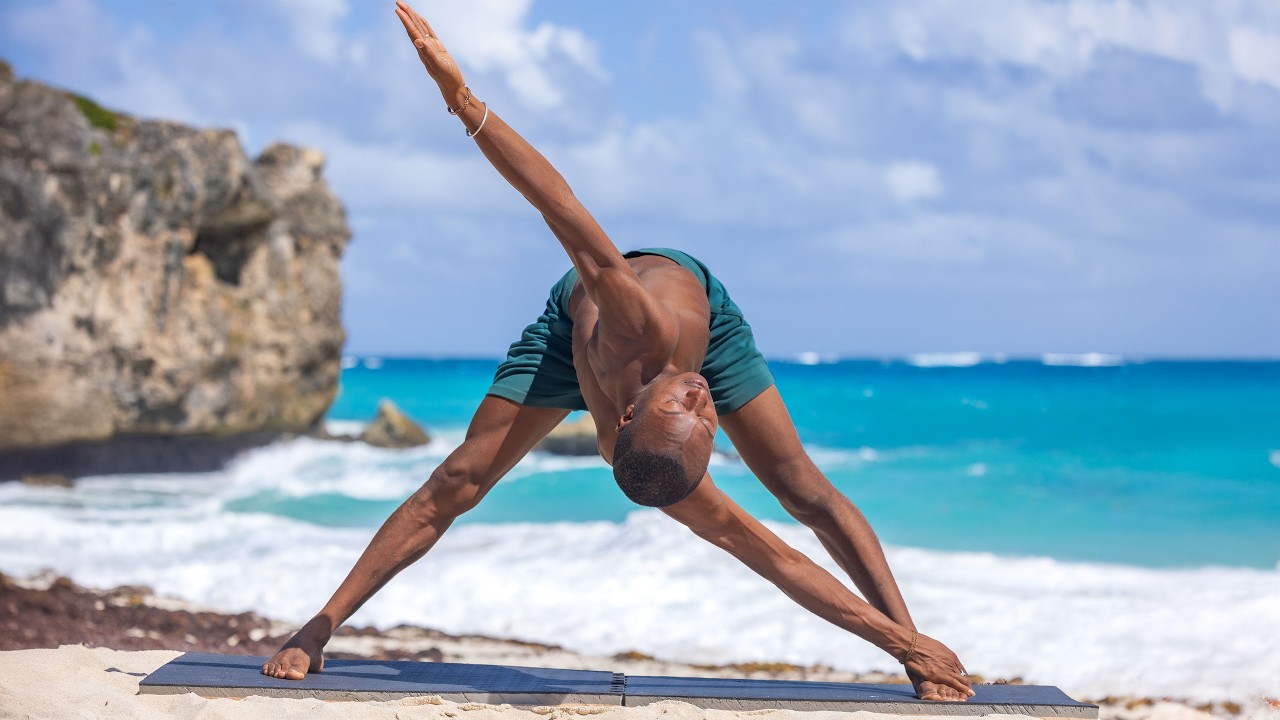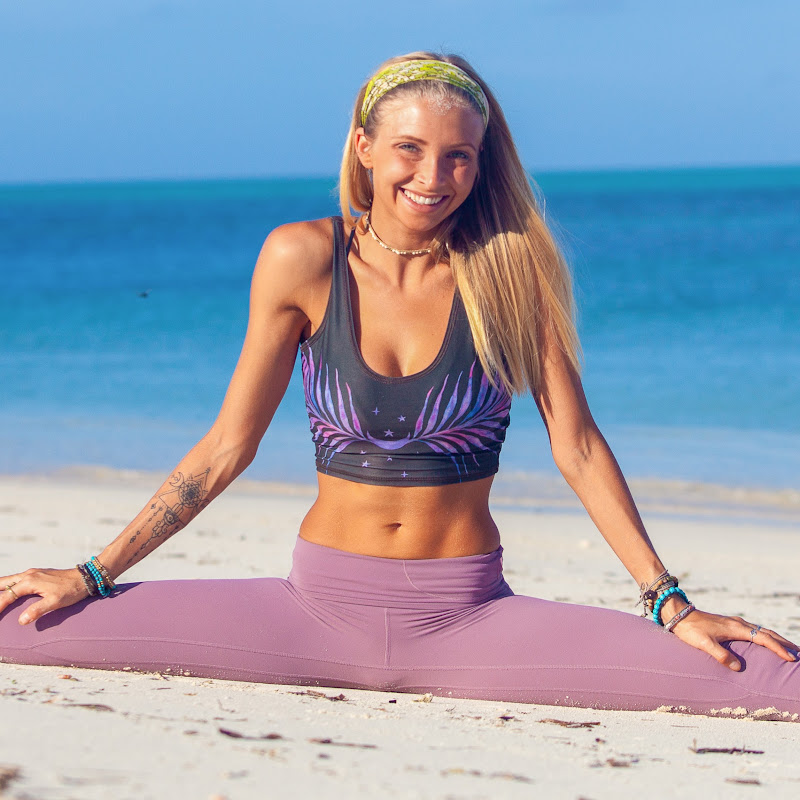
A bright sunny morning on the beach in Mexico becomes the perfect backdrop for a deliberate awakening. This 15-minute morning yoga flow is built on a simple but transformative idea: that the first 15 minutes of your day can reshape how you move through it. The practice weaves together mindful breath work, shoulder openers, core strengthening, and foundational preparation for more advanced inversions like forearm stand—all in a sequence designed to meet you exactly where you are, whether you're a beginner rolling out a mat for the first time or an experienced practitioner refining your craft.
How Morning Yoga Wakes Up the Body
The class opens in child's pose, a grounding position that immediately invites you to settle the breath and signal to your nervous system that this is intentional time. From there, the sequence progresses with threading movements—where the arms weave underneath the torso, creating gentle spinal twists and shoulder releases. These aren't flashy poses; they're the body's way of saying "good morning" to itself. By the time you reach hands and knees, your shoulders have already begun to open and your spine has mobilized through its natural ranges of motion.
The practice then introduces puppy pose, which the instructor describes as a "big opener for the shoulders." Rather than forcing deep stretches early, this pose allows the chest to lower while the hips stay grounded, creating space across the shoulders and upper back. For those with additional flexibility, the variation of placing the chin on the ground deepens the stretch further—a reminder that every version of the pose is valid. This builds the accessibility principle that runs through the entire flow: there is no one "correct" version, only the version that serves your body on this particular morning.
Building Strength Through Dolphin Pose
The heart of the practice centers on dolphin pose, a foundational position that bridges accessible yoga and preparation for inversions like forearm stand (Pincha Mayurasana). By lowering the elbows to the floor while keeping the hips lifted, you create stability through the shoulders and engage the core in a way that ground-based arm balances demand. The sequence moves fluidly between dolphin pose and high plank, creating a wave of strengthening work that activates both the upper body and the stabilizing muscles of the trunk.
What makes this progression effective is its rhythm. Rather than holding static poses for long counts, the flow asks you to move with intention between forms: forward into low plank, back into dolphin, up to high plank, and back again. This dynamic approach builds functional strength and teaches the body how to distribute weight and energy—skills that become essential when you eventually approach forearm stand. The breath anchors each transition, creating a meditation in motion rather than a grinding strength workout.
Balancing Challenge with Accessibility
Side plank variations and three-legged dog pose introduce balance challenges midway through the class. Here, the instructor makes clear that lifting the top leg is an option, not a requirement. This differentiation—between a foundational version and an advanced variation—appears throughout the practice and reflects a philosophy that strength isn't about how far you can go, but about how intelligently you can meet your body's actual capacity on any given day.
The fallen triangle position (also called thread the needle in a reclined position) offers another moment of openness. By lowering the right hip while the left leg stretches overhead, you're simultaneously opening the hip flexors, opening the chest, and discovering stability in an asymmetrical shape. These moments of asymmetry are where real balance and proprioception develop—they're the poses that teach your nervous system, not just your muscles.
Pigeon Pose and Deep Hip Release
Pigeon pose arrives midway and toward the end of the sequence, offering a profound hip opener that complements the shoulder and core work. The first repetition is treated as an exploratory moment: slide the leg back, open the chest, then fold forward slowly, inviting the breath to do the work rather than forcing depth. The instructor explicitly invites you to "notice the sensations you have in your body right now"—a cue to move from mechanical execution toward embodied awareness.
The second pigeon pose comes after an intense sequence of three-legged work, side plank, and high-to-low plank transitions. By this point in the practice, the hips are already warm and the nervous system has been engaged. The fold becomes richer, informed by all the movement that came before it. This is how a well-structured yoga sequence works: each pose prepares you for what comes next, and repetition at different stages of the practice creates different depths of sensation and understanding.
The Final Transition to Rest
In the final minutes, the practice returns to child's pose and offers the option to move into shavasana (final rest). The instructor acknowledges that some practitioners may want to continue resting in child's pose for as long as they need, while others may prefer to lie flat. This honoring of choice—whether active or receptive—reinforces that the practice is designed around listening to yourself rather than performing the "right" way.
As you lie in final rest, the cue comes to "allow the body to settle here." After 15 minutes of intentional movement, breath work, and activation, this settling is earned. The practice has literally woken up your body—engaged your nervous system, warmed your muscles, opened your joints—and now the invitation is to rest inside that awakeness, carrying the sense of aliveness and intention into whatever comes next in your day.
What This Practice Is Really Teaching
On the surface, this is a 15-minute morning yoga flow. But the deeper architecture is teaching you how to move with awareness, how to build strength without force, and how to honor your body's actual capacity in the present moment. Every time you return to this practice—and the best way to understand morning yoga is to treat it as a daily ritual, not a one-time event—your nervous system will recognize the sequence and begin to settle more quickly into that state of aware presence.
The emphasis on forearm stand preparation isn't incidental; it signals that this practice respects your potential. You're not being asked to simply stretch or relax. You're being invited into a sequence that both grounds you in the present and scaffolds toward deeper work. For complete beginners, the foundational poses and accessible variations make the practice genuinely available. For experienced practitioners, the opportunity to play with balance work in dolphin pose and refine the alignment patterns that lead to inversions makes the sequence meaningful.
Starting your day with this kind of movement—intentional, intelligent, and rooted in the actual sensations of your body—creates a different relationship with your day. The instruction to "give yourself these 15 minutes to awaken your body, embrace your strength, and start your day feeling amazing" isn't motivational rhetoric. It's an invitation to reclaim the morning as time that belongs entirely to you, shaped by your breath and your choice to show up on your mat.
Where to go from here
If this morning flow resonates with you, the practice deepens with repetition. The most powerful way forward is to commit to rolling out your mat for these 15 minutes regularly—not as a box to check, but as a way of honoring yourself at the start of each day. As your body becomes familiar with the sequence, you'll notice subtleties you missed on the first attempt: the precise angle your shoulders need to find true dolphin strength, the specific breath pattern that lets you fold deeper in pigeon, the moment when balance feels effortless in three-legged dog. That refinement is where the real transformation lives. You might also explore longer flows that extend this work, or dedicate focused practice to forearm stand with a qualified teacher, building on the shoulder and core foundations this sequence establishes.