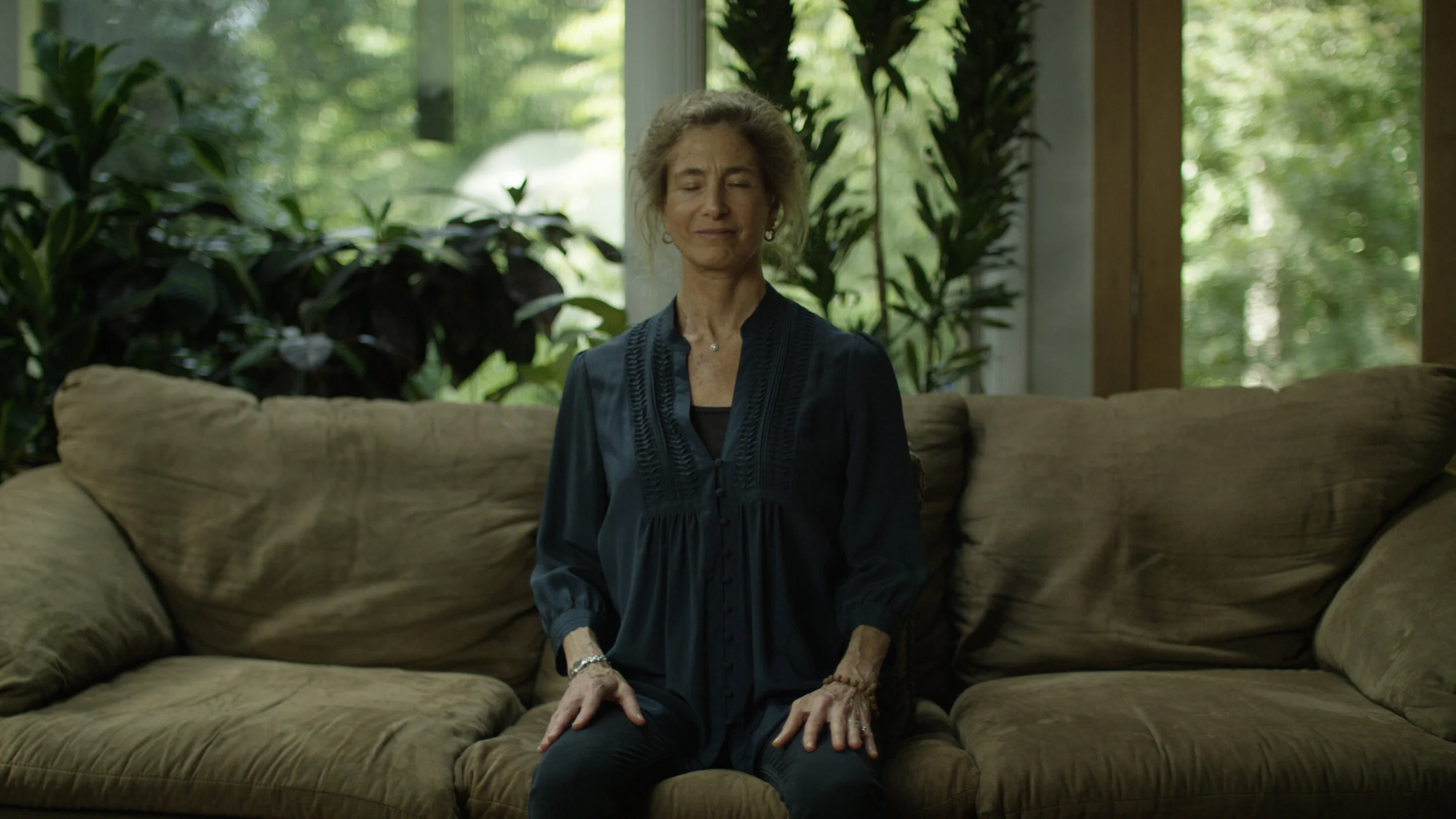

A typical Tara Brach session unfolds in layers. The opening meditation might be fifteen or twenty minutes of guided body awareness, her voice steady and unhurried, directing attention to breath and sensation with the precision of someone who has logged thousands of hours on the cushion. Then comes the dharma talk proper—structured around a theme, illustrated with case studies from her clinical practice, woven through with poetry from Mary Oliver or Rumi, and punctuated by personal anecdotes that reveal struggle without seeking sympathy. She often returns to a second meditation toward the end, integrating the conceptual teaching into direct practice. The overall architecture is reliable: you know what you're getting, and that predictability itself becomes a kind of container.
Her retreats extend this structure across days, though the intensity remains moderate compared to more austere Vipassana traditions. Brach doesn't emphasize the boot-camp aspect of meditation. There's space for rest, for walking, for gentleness. The schedule accommodates rather than confronts the Western nervous system. This isn't a criticism—it's a deliberate pedagogical choice rooted in her conviction that self-compassion must precede and accompany insight. You won't find the rigorous silence of a Goenka retreat, but you will find room to actually metabolize what arises.
Two concepts form the gravitational center of Brach's teaching: Radical Acceptance and the "trance of unworthiness." The first is both book title and mantra—the practice of turning toward rather than away from difficult experience, meeting what is with an unconditional yes. The second is her diagnostic frame for contemporary suffering. She returns again and again to the ways we construct an identity around inadequacy, how the inner critic functions, how we exile parts of ourselves in search of belonging or achievement.
The RAIN meditation—Recognize, Allow, Investigate, Nurture—is her signature practice, a four-step process that essentially systematizes what acceptance looks like moment to moment. It's therapeutic in flavor, psychological in vocabulary, Buddhist in underlying assumptions about suffering and impermanence. This hybrid nature is not incidental. Brach consistently translates Buddhist concepts into the language of Western psychology, making dharma accessible to those who might recoil from explicitly religious framing.
Brach doesn't traffic much in koans or paradoxes. Her questions are therapeutic inquiries: What are you believing right now? What does this feeling want from you? Can you meet this with kindness? What would it be like to offer yourself compassion? These aren't riddles to break the conceptual mind; they're invitations to relationship with one's inner experience. The assumption is that awareness plus compassion equals transformation. She asks students to get curious about their resistance, to notice the stories they tell about why they can't be present, to investigate the somatic dimension of emotional patterns.
The questions assume a self that can observe itself—a fundamentally psychological stance. There's less emphasis on the questions that deconstruct selfhood entirely, though the Buddhist framework is present in the background. She's more interested in healing the self than dissolving it, at least as a first-order practice.
Brach's voice is her primary instrument—warm, intimate, slightly breathy, calibrated for headphones. There's minimal humor, though occasional lightness. She uses silence strategically but doesn't let it become uncomfortable. Stories anchor the teachings: clients from her practice (anonymized), moments from her own life (her struggles with bulimia, her relationship with her mother), narratives that make abstract principles concrete.
Scripture appears, but filtered through accessibility. She'll reference the Buddha's teachings or Pema Chödrön's interpretations more than suttas directly. Poetry serves as emotional punctuation. The overall aesthetic is therapeutic-spiritual rather than ascetic-spiritual: invitational, reassuring, carefully boundaried.
Brach's teaching lands powerfully for those already in therapy or therapy-adjacent culture, people familiar with concepts like "parts work" or "reparenting," those suffering from shame, perfectionism, or chronic self-judgment. Her audience skews educated, secular, progressive—people who want meditation's benefits without Buddhism's devotional elements.
Those seeking more traditional rigor may find it too accommodating. Students drawn to Zen's austerity or Mahasi Sayadaw's precision might experience her approach as insufficiently challenging. The therapeutic frame, while accessible, can also feel limiting to practitioners ready to move beyond the healing paradigm into more destabilizing territory.
She belongs to the Insight Meditation lineage through Kornfield and Goldstein, but represents its therapeutic evolution—where mindfulness becomes a tool for psychological flourishing rather than liberation from all becoming. It's Buddhism for healing, clearly and skillfully taught.