
The Scholarly Foundation
Shiva Rea came to yoga in the 1990s through a path less common among Western teachers: she approached the practice with both physical devotion and academic rigor. Holding a master's degree from UCLA, her early scholarly work explored the intersection of yoga philosophy and embodied practice—a foundation that would inform everything she built afterward. While many Western practitioners were drawn to yoga's physical benefits or spiritual escape, Rea was investigating how ancient philosophy could manifest through the body's intelligence.
Her formation included studying Ashtanga with Pattabhi Jois in Mysore, but she didn't stop there. She sought out Tantric scholars and somatic movement educators, weaving together lineages that don't always sit comfortably beside one another. That eclecticism—rooted in research rather than casual borrowing—became the signature of her approach.
Finding Flow
The turning point in Rea's work came as she moved away from the rigidity of set sequences and alignment-based systems toward something more fluid and responsive. She developed a practice centered on vinyasa krama, the sequential flow methodology rooted in classical Indian yoga traditions. Unlike the set-series structure of Ashtanga or the alignment-focused precision of Iyengar, her interpretation emphasized rhythm, breath layering, and transitions that follow the body's natural movement patterns rather than imposed geometries.
This wasn't simply about creating prettier sequences. Rea was interested in how practice could sync with circadian and lunar rhythms, how breath (pranayama), energetic seals (mudra), and the Tantric philosophy of Shakti—the divine feminine creative force—could combine into something both traditional and alive. Her approach draws from the Krishnamacharya lineage, but filters it through somatic principles that account for individual variation and natural impulse.
What emerged was a teaching style that distinguished itself in a crowded field: less athletic than power vinyasa, more improvisational than classical forms, and philosophically grounded without being dogmatic.
Building Samudra
Rea founded Samudra Global School for Living Yoga to formalize and spread her methodology. The organization offers 200-hour and 500-hour teacher certifications and has trained instructors across North America, Europe, and Asia. The name itself is revealing—samudra means ocean in Sanskrit, suggesting depth, fluidity, and constant motion.
Her tagline, "Embodying the Flow for All," reflects a genuine commitment to accessibility. In a yoga culture often criticized for catering to young, flexible, affluent bodies, Rea has consistently emphasized that her approach works across experience levels and body types. This isn't just marketing language; it's embedded in her technical emphasis on breath and internal awareness rather than external form.
Through Samudra, she's created a network of teachers who carry forward this particular interpretation of vinyasa—one that values spontaneity within structure, feminine energy alongside classical rigor, and scholarly depth beneath physical practice.
Instructional Work and Reach
Rea has released multiple instructional programs distributed through Sounds True and other wellness platforms, translating her in-person teaching into guided audio and video formats. This work has helped build her following well beyond those who can attend her trainings; she currently has nearly 80,000 followers on Spotify, an unusual metric for a yoga teacher but indicative of how widely her recorded practices circulate.
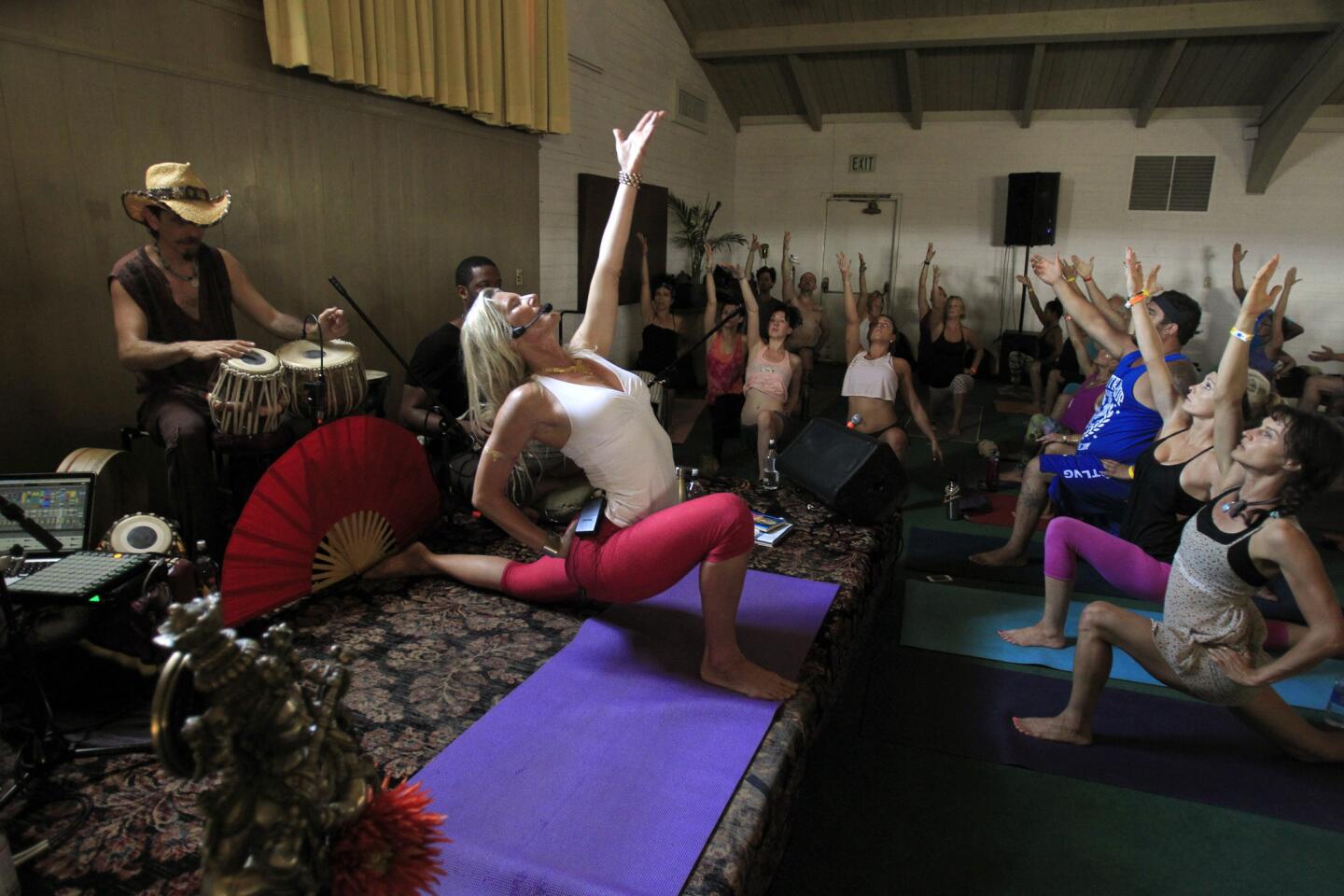
Her teaching has been featured in Yoga Journal, and she's become a familiar presence at major festivals including Wanderlust and Bhakti Fest, where her workshops draw practitioners looking for something beyond the standard festival fare. These appearances have positioned her as a bridge figure—accessible enough for mainstream wellness culture, substantive enough for serious practitioners.
The Current Chapter
Today, Rea continues to teach internationally while stewarding Samudra's growth as an educational institution. She remains committed to the integration that defined her early work: balancing rigorous technique with improvisational flow, honoring tradition while adapting to contemporary understanding of movement and somatics.
Her current work reflects a maturation of her core ideas rather than a departure. She continues layering breath, bandha (energy locks), and fluid transitions in ways that distinguish her methodology from both athletic vinyasa and strictly traditional forms. The practice she's developed over decades has enough internal coherence to be teachable, enough flexibility to remain alive.
Why She Matters
In the landscape of Western yoga, Rea occupies important territory. She brings scholarly credibility to a field often criticized for historical shallowness. She offers a feminine-centered practice in a tradition whose Western popularization often emphasized masculine force. And she's built a reproducible methodology that honors classical roots while acknowledging that bodies move in varied, personal ways.
Her influence extends through the teachers she's certified, the recordings that guide home practitioners, and the gradual shift she represents—away from yoga as athletic achievement or rigid tradition, toward something more breathing, more rhythmic, more integrated. For students seeking a practice that respects both scholarship and sensation, both lineage and living inquiry, Shiva Rea has created a substantial body of work worth encountering.