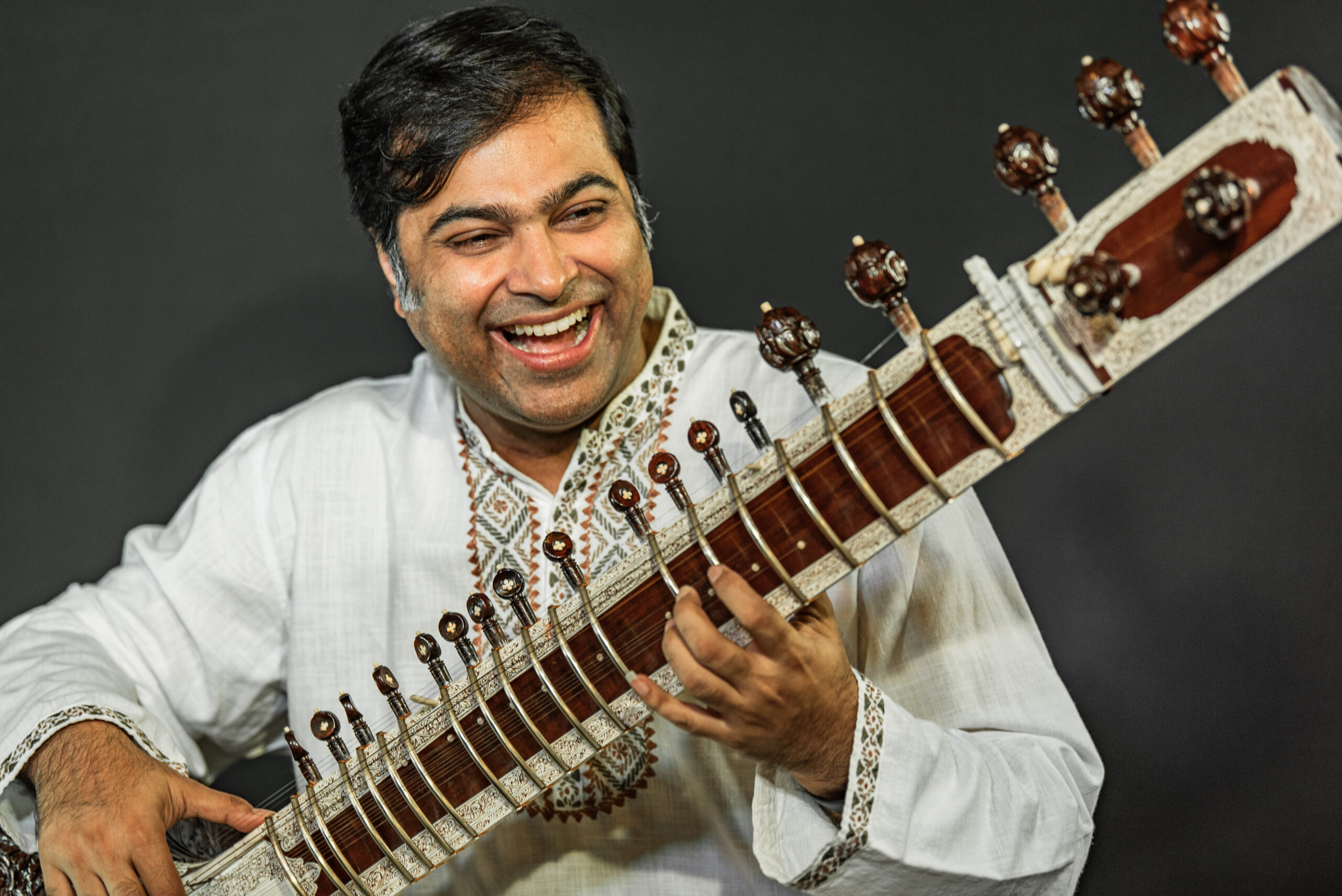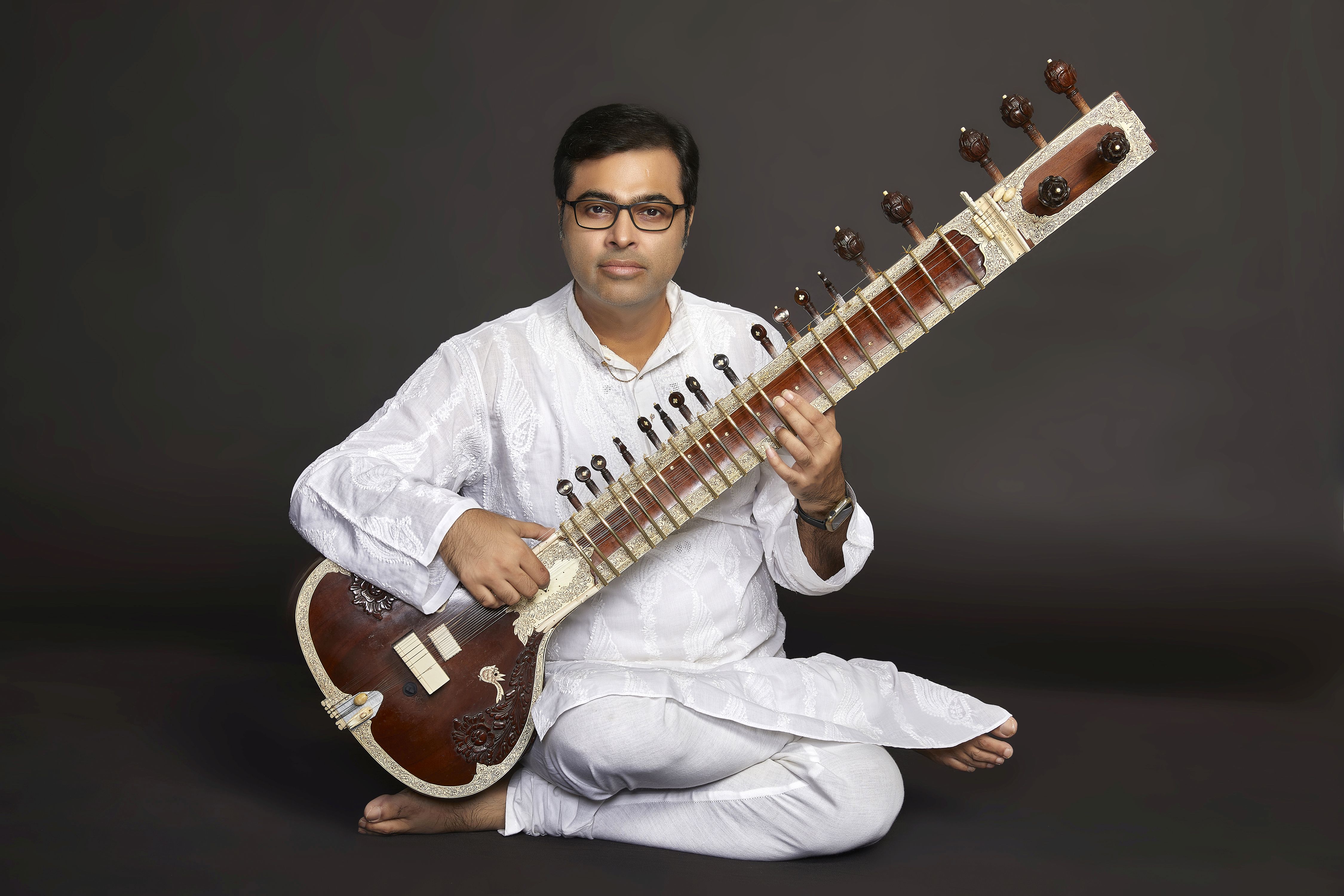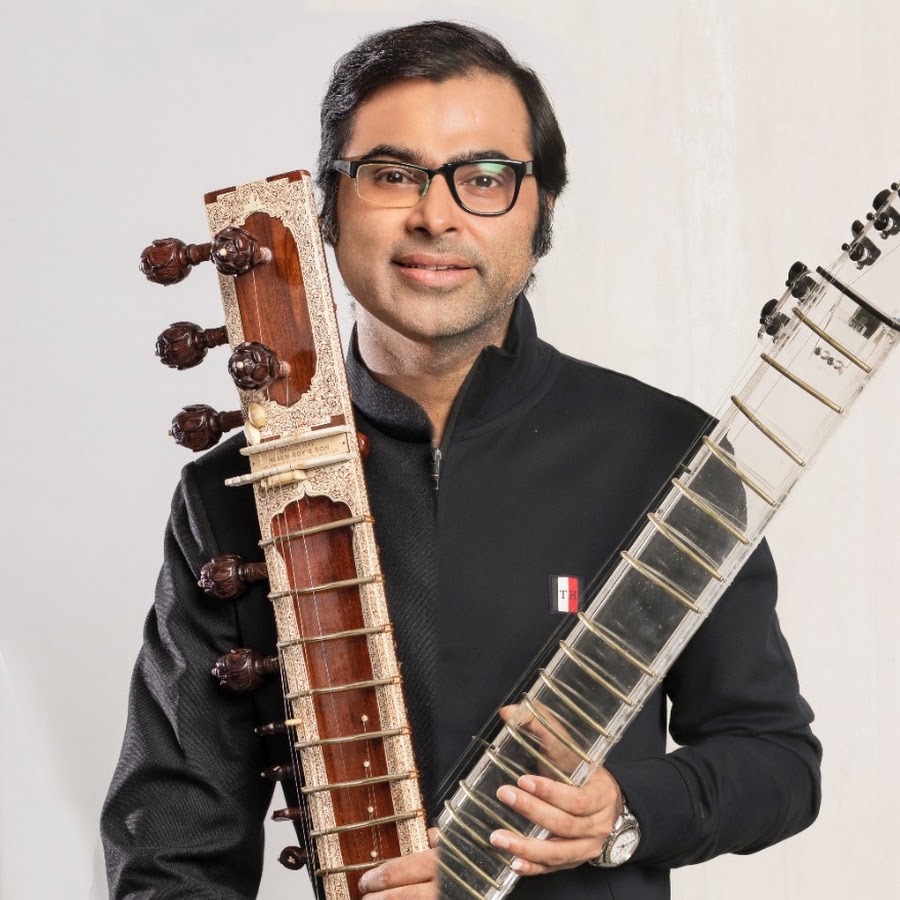

When Purbayan Chatterjee's sitar enters a recording, you hear it before you intellectually register it—a metallic shimmer that seems to hover in the stereo field, then a curved phrase that bends upward like smoke. His instrument doesn't announce itself with aggressive attack or percussive plucking. Instead, the sound is liquid: sympathetic strings create a halo of resonance beneath the melody, the gourd-bodied tambura-like drone hums steadily in the low register, and the main melodic line slides between microtones with a vocal suppleness. This is Hindustani classical sitar, but Chatterjee's touch leans toward clarity rather than density. Even in fast taan passages—those cascading runs of notes that demonstrate virtuosity—his articulation remains crisp, each note momentarily distinct before dissolving into the next.
The textures he favors tend toward the conversational. In traditional raga performance, the alap—the slow, unmetered opening section—establishes the tonal universe of the raga note by note, phrase by breath-like phrase. Chatterjee's alaps unfold patiently but not ritualistically; there's an improvisational ease that suggests he's discovering the raga's contours in real time rather than reciting a fixed devotional script. When the tabla enters and tempo locks in during the gat section, his rhythmic playing is precise without being mechanical, weaving syncopations that dance around the tala cycle.
Chatterjee's music emerges from the guru-shishya parampara, the ancient teacher-disciple transmission system that has preserved Hindustani classical music for centuries. This is not the devotional bhakti or kirtan tradition—there are no lyrics, no invocations to Krishna or Shiva, no call-and-response with a community of singers. Instead, the devotional quality resides in the discipline itself: thousands of hours internalizing the grammar of ragas, each one a modal framework with specific phrases, ornaments, and emotional contours. Raag Mishr Kafi carries a twilight wistfulness; Raag Shyam Kalyan evokes evening introspection; Raga Bhairavi is associated with dawn and parting.
This lineage is not monastic. Chatterjee performs at India's most traditional venues—the Sawai Gandharva Bhimsen Mahotsav in Pune, a festival named after a legendary vocalist, and the Narad Gana Sabha in Chennai, a century-old institution. These are spaces where audiences know the ragas intimately, where a slight variation in phrasing can draw murmurs of appreciation or quiet disapproval. Yet Chatterjee has also pushed the sitar into studios and collaborative contexts where the rules are negotiable.
Where Chatterjee distinguishes himself is in treating the sitar not as a relic to be preserved under glass but as a living instrument capable of multiple conversations. Many classical sitarists view fusion work with suspicion, fearing dilution of the tradition. Chatterjee navigates this tension by maintaining technical rigor—his command of raga exposition is unimpeachable—while exploring timbral and rhythmic possibilities beyond the classical canon. He has placed the sitar in dialogue with electric guitar, synthesizers, and jazz harmonic structures without forcing the instrument into alien idioms. The sitar retains its microtonal bends and sympathetic string shimmer, but it might linger in a harmonic space inflected by Western chord progressions or lock into a groove with unexpected syncopation.
His collaborators have included tabla virtuosos in traditional jugalbandi (duet) settings, but also musicians from rock and world music backgrounds. These partnerships shape his sound not through compromise but through call-and-response: the sitar offers a melodic idea rooted in raga vocabulary, another instrument responds with a harmonic or rhythmic variation, and Chatterjee adapts in real time.
If you're new to Chatterjee's work, start with a traditional raga performance to understand his classical foundation—perhaps a recording of Raga Bageshree, often performed late at night, which will give you the full arc from meditative alap through rhythmic interplay with tabla. Notice how the sitar's timbre changes: metallic and almost nasal in the high register, woody and resonant in the lower octaves.
Then explore his fusion work. You may be surprised by how seamlessly the sitar coexists with electronic textures or rock instrumentation. The surprise isn't that it works—it's that the sitar never sounds like it's trying to be something else. It remains a sitar, but the context shifts.
Chatterjee occupies a distinctive position: too experimental for purists, too rooted in classical grammar for casual world-music consumption. He exists in conversation with artists who honor lineage while refusing to be limited by it—sitarist Anoushka Shankar's electronica-inflected work, or tabla player Zakir Hussain's collaborations across genres. His music offers a secular but focused listening experience, demanding attention without requiring devotional context. It's music for deep listening, whether in a concert hall or late at night through headphones.