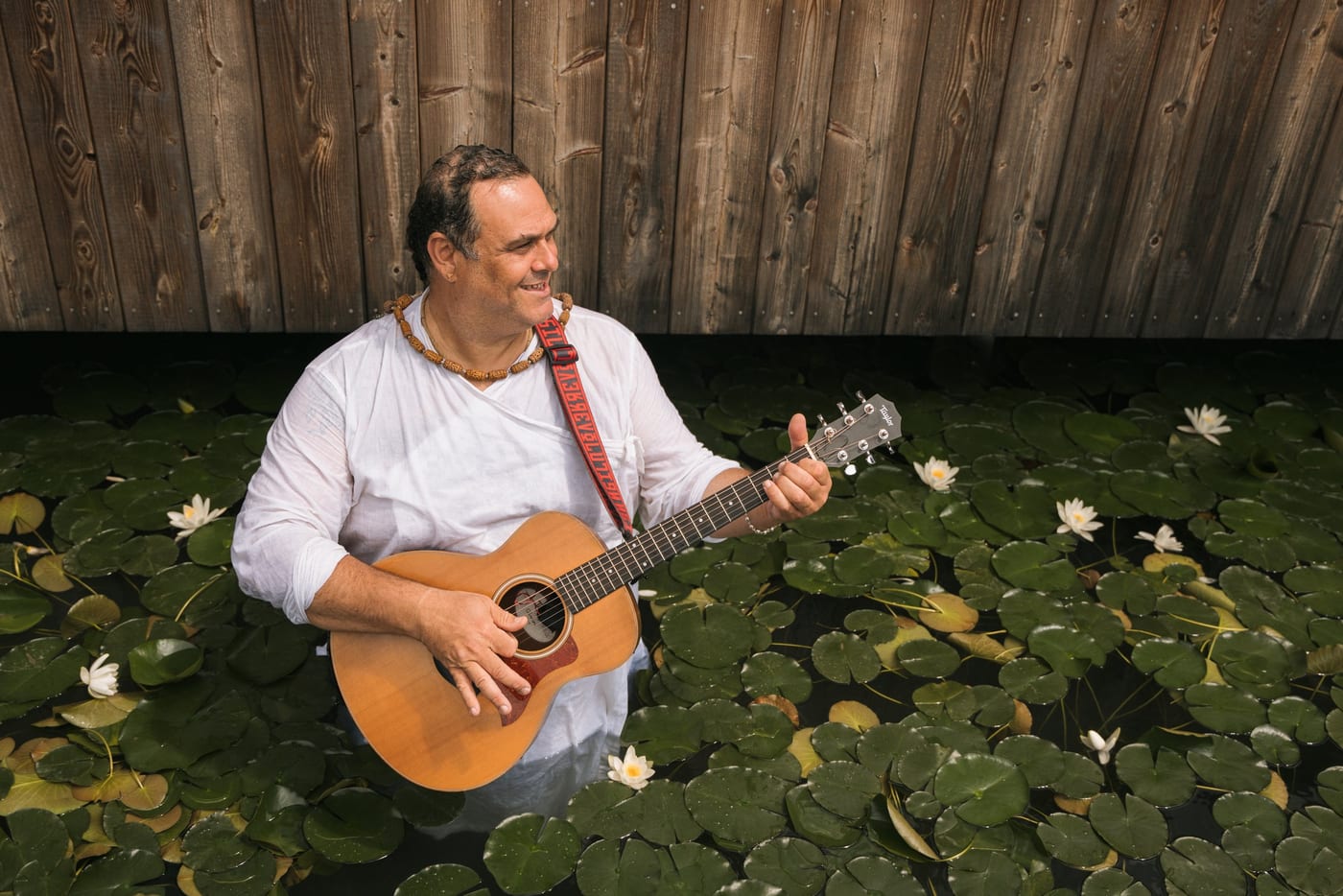

"Dona Nobis Pacem" is a single, released in 2024 with one track. It is not a full album, so this guide treats it as a focused listening object rather than a record with a sequence to follow. That matters in the context of a career that now runs about two decades. The catalog includes studio albums such as Like a River to the Sea (2015), Nine Islands (2019), Love (2022) and Meditation & Mantra (2023), and since 2021 the release pattern has leaned toward singles. This piece belongs to that later stream.
The title is a Latin phrase meaning "grant us peace." Gaura Vani is a kirtan leader whose work is grounded in bhakti, and he was raised by monks in temples from the age of four. Hearing him take up a title from outside the Sanskrit default is part of what makes this release worth noticing. His career has never been confined to one room: it has taken in temples, opera houses, yoga studios and festivals from Lollapalooza to Bhakti Fest.
I can't responsibly itemize the instrumentation of this single. The available record does not list the players or the arrangement for this track, and Spotify credits or the official site at gauravani.com are the places to verify them. What can be said comes from the shape of his work generally: the human voice sits at the center, repetition is part of the design, and pacing tends toward the sustained and meditative in his studio material.
A title that is itself a short, repeated petition suits that approach. Expect to listen for how a single phrase is shaped, returned to, and allowed to change in weight. Newcomers often find the first listen slower than expected. The repetition is the point, not a flaw.
With a one-track release, the signature track is the release itself.
"Dona Nobis Pacem." What makes it land is the directness of the ask. Much of his catalog uses Sanskrit names and named deities, which can present a learning curve for listeners new to Hindu devotional language. Here the plea is a plain three-word prayer that many listeners already know the meaning of, even if they come from a different background. It is a modest entry point to his voice for someone who might hesitate at a longer Sanskrit text.
If you want to hear how he handles more traditional material by comparison, his single Armor of Narasimha (Narasimha Kavacha) from 2022 is built on a named devotional text, and Bhaja Govindam (We All Bleed Blood), recorded live at the Royal Opera House Mumbai in 2026, shows the concert-hall side. Both make a useful contrast with this quieter, more compact piece.
His work sits in the bhakti tradition, the devotional path centered on love for the divine expressed through song, with kirtan and bhajan as the working vocabularies. The public record does not name a specific guru lineage or sampradaya, and this guide won't assign one. What is documented is the temple upbringing, which predates any career decision.
A Latin peace petition is therefore a notable choice rather than a standard one. It fits a pattern in which he has moved between formats: solo devotional recording, the East-West fusion of As Kindred Spirits, and festival kirtan with The Juggernauts. It also echoes a documented strand of his life outside standard concerts, singing with nurses at hospitals in Mumbai and mixing mantras with English-language songs. I'd resist calling this release ambient or generic wellness music. The framing is devotional, even when the language is not Sanskrit.
This single suits listeners who are curious about bhakti but not yet fluent in its vocabulary, and anyone who wants a short, quiet piece of sung prayer rather than a long communal chant. It is likely to resonate in moments when peace feels like something to ask for: after a hard week, during a period of grief or tension, or at the close of a day.
It is a poor fit for listeners who want high-energy, percussive kirtan or electronic production. Those listeners should look to his festival work instead. People who want strictly orthodox temple sound may also find his range a departure.
Listen alone, in the evening, with headphones, and give it your full attention rather than treating it as background. Because the release is one track, the whole experience is brief, which makes it easy to hear twice: once to take in the shape, and once to sing or hum the phrase quietly yourself. If you use it as part of a personal practice, such as a few minutes of sitting at the end of the day, let the repetition do its work rather than waiting for variation.
For the fuller picture, pair it afterward with Meditation & Mantra (2023), the most direct entry point in his catalog for mantra as practice.
