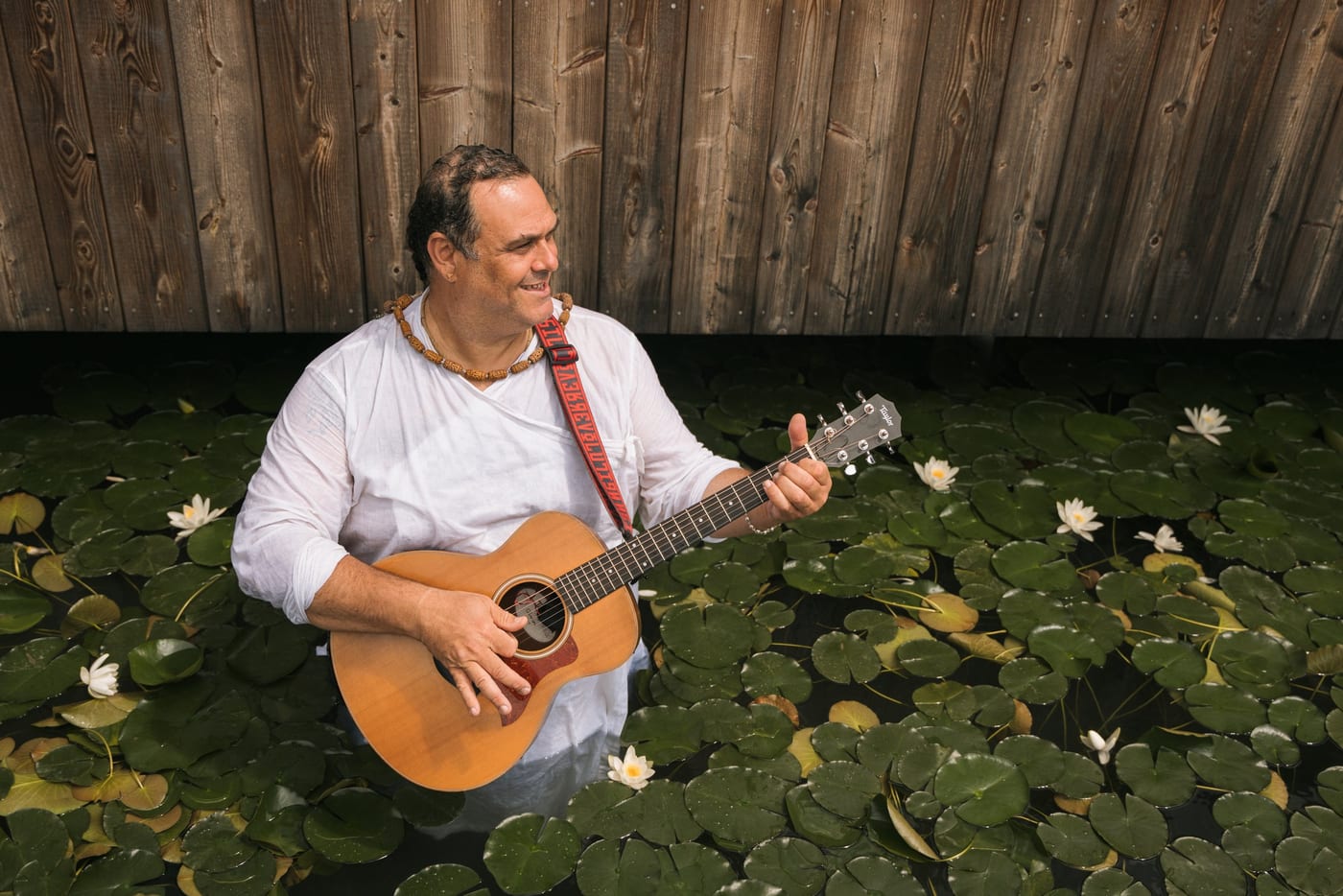

"Bhaja Govindam (We All Bleed Blood) [Live at Royal Opera House Mumbai]" is a single, one track released on April 30, 2026. It belongs to a 2026 run of singles that also includes a live "Wade in the Water" from the same Mumbai venue in January and "Unlimited" in July. It is a live document rather than a studio statement, and it arrives after roughly two decades of touring and recording.
The setting matters because of the life behind it. Gaura Vani was raised by monks in temples from the age of four, steeped in mantra and ritual as daily routine. He rebelled in his teens and acted in Hollywood, appearing in films with Michelle Pfeiffer, Denzel Washington, and Ethan Hawke. His bio places his music in temples, yoga studios, festivals like Lollapalooza and Bhakti Fest, and opera houses. This recording is the opera house chapter: a formal concert hall hosting a devotional song.
The core of his music is the human voice carrying Sanskrit mantra and bhajan lines, with emphasis on repetition and the names of the divine rather than melodic showmanship. Live, that means the pacing follows the room. Expect a build shaped by call-and-response, where the audience's presence is part of the arrangement.
A caveat on instrumentation: the available record does not itemize what was played on this recording, so I won't name instruments or musicians for the Mumbai performance. Spotify's credits or gauravani.com are the places to confirm the lineup. What can be said is that his broader work moves between stripped-back and layered settings, and that his ensembles, such as As Kindred Spirits and The Hanumen, draw on world percussion, chant, and harmony.
The mood invited by the title is communal and humane. "We All Bleed Blood" frames the devotional line in terms of shared humanity, and the concert-hall setting gives that idea a public, collective frame.
This is a single, so there is one track to discuss, and it is the whole release.
"Bhaja Govindam (We All Bleed Blood)" lands for three reasons. First, the pairing of a Sanskrit devotional title with a plain-spoken English subtitle reflects something his work does often: it holds sacred language and everyday language together. The bio notes he has sung with nurses at hospitals in Mumbai, mixing mantras with English-language songs, so that bridge is part of his documented practice. Second, it shows how chant behaves in a formal hall. The 2026 Royal Opera House recordings show the material can sit in a concert setting without losing its devotional center. Third, repetition is the engine. Newcomers often find a first listen slower than expected, but the repetition is the design, not a flaw.
The work sits in the bhakti tradition, the devotional path within Hinduism centered on love for the divine expressed through song. Kirtan, the call-and-response chanting of names and mantras, and bhajan, the devotional song form, are his working vocabularies, with Sanskrit as the default language rather than decoration. His formation came from inside temple life, so the practice predates any career decision. The public record does not name a specific guru lineage or sampradaya, and this guide won't assign one.
Within the modern kirtan world, he has shared stages with Jai Uttal and Krishna Das. Compared with many kirtan leaders who work in a single format, he moves among solo devotional recording, the East-West fusion of As Kindred Spirits, and festival kirtan with The Juggernauts. This single represents the concert-hall side of that range.
This suits a listener curious about bhakti who is willing to hear chant as a sung, communal, performed practice. It is a good next step for someone who has already spent time with the studio work and wants to hear the room energy of a concert. It may also resonate with listeners in a moment of seeking common ground, since the subtitle points to something shared across people.
It is a poor fit for anyone wanting high-BPM electronic sound or remix-style kirtan, or for those who expect devotional music to be wordless. Listeners unfamiliar with Hindu names will face a learning curve. Live recordings also change the feel of a room through crowd energy, so they are not the best choice for quiet meditation. For that, Meditation & Mantra (2023) is the more direct tool.
Give it active attention. The live recordings reward focus, and treating them as background misses the point. Headphones in the evening, with nothing else competing, will let you follow how the call-and-response gathers momentum. Listen once straight through without skipping, then again while following the repetition and letting the phrase settle. If you are new to Gaura Vani, consider starting with Kirtan: The Bhakti Yoga of Chanting Mantras (2018) for context, then return here to hear how the same approach fills a hall.