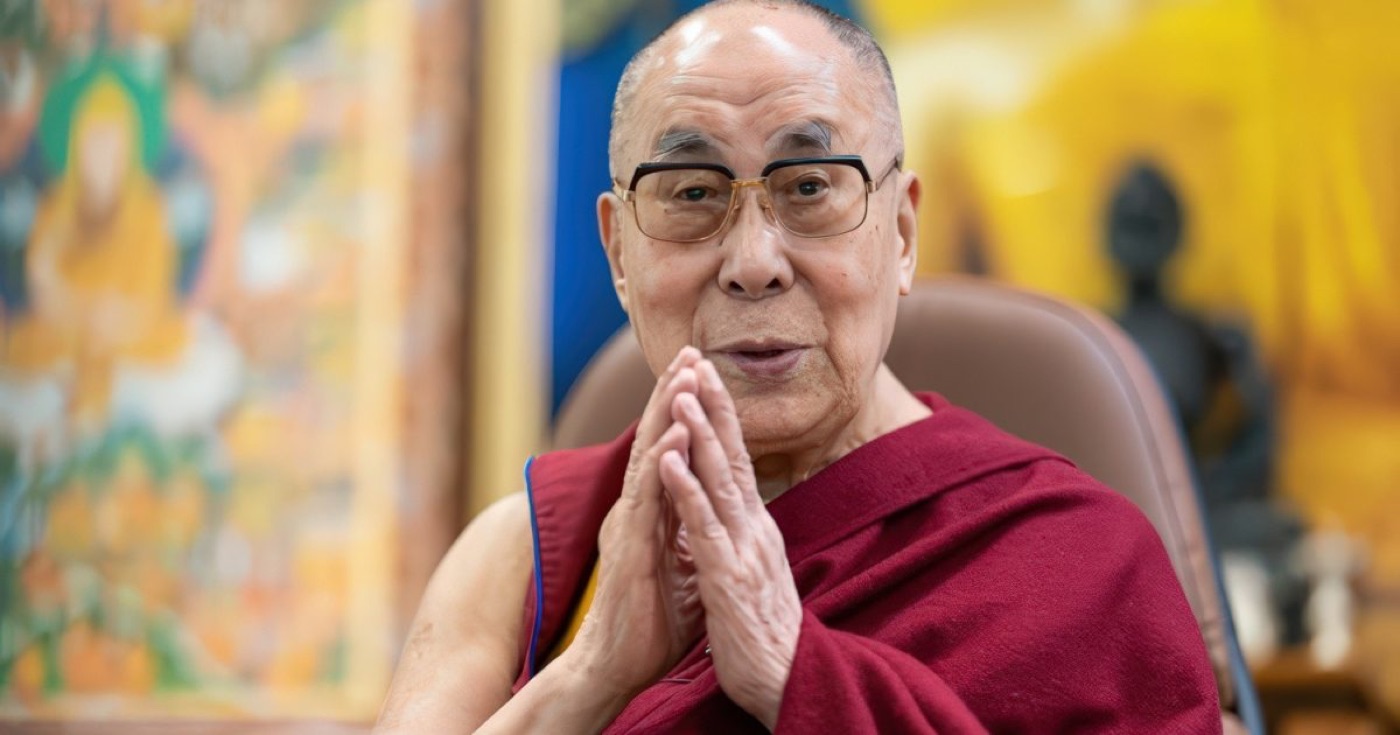

The 14th Dalai Lama was born Lhamo Thondup on 6 July 1935 to a farming family in Taktser, in the Amdo region of Tibet. Little in that setting, a village household in a farming community, would have signaled the path ahead. Yet within Tibetan Buddhism the Dalai Lama line is understood as a succession of reincarnations, and in 1939 the child was recognised as the 14th Dalai Lama. The recognition carried enormous weight. It marked the end of an ordinary childhood and the beginning of a life defined by a role that is at once spiritual, cultural and, historically, political.
He was enthroned in Lhasa in 1940. He is a monk of the Gelug school, the tradition within Tibetan Buddhism that shapes the scholastic structure of his teaching. The facts available to us do not record the details of his early schooling or the names of his teachers, and this profile does not guess at them. What the record does establish is the arc: a boy from Amdo, recognised young, placed at the center of a tradition and a nation.
In 1950 he took on temporal leadership of Tibet. In 1959 he went into exile in India, a rupture that reshaped both his life and the future of Tibetan Buddhist culture. From exile he established the Tibetan government in exile, which has been based in Dharamshala since 1960.
This is the pivot of his public life. A teacher who might have remained a figure of monastic and national authority inside Tibet became instead the steward of a displaced community and its heritage. The work of preserving Tibetan religious and cultural life outside Tibet became inseparable from his teaching. In 2011 he retired as political head to make way for a democratically elected leadership, a decision that separated the spiritual role from the governing one. Few lineage teachers carry a history like this: he led a government in exile and then deliberately stepped back from political office.
Asked what guides his life, he names three major commitments. The first is promoting basic human values, or secular ethics, in the interest of human happiness. The second is fostering inter-religious harmony. The third is preserving Tibet's Buddhist culture, which he describes as a culture of peace and nonviolence.
These commitments give his work a public, ethical shape. Compassion and nonviolence run through nearly everything he presents, framed less as sentiment than as practical positions that can be argued and tested. His secular ethics material is also the most accessible way into his work, since it does not require Buddhist vocabulary to follow. Alongside these commitments he has engaged in dialogue with scientists, particularly on how contemplative insight relates to the empirical study of the mind, and he has voiced concern for the environment as an ethical extension of the same framework. He was awarded the Nobel Peace Prize in 1989, the most significant recognition on record for his commitment to nonviolence.
For many years he travelled widely to give Buddhist teachings. Among the most notable were his Kalachakra teachings and initiations, which drew international gatherings. These belong to the tantric side of the tradition and are advanced events, multi-day occasions combining public teaching with initiation. His public work therefore spans both open dharma talk and high-level tantra.
His style, by most accounts of his talks, is conversational and direct. Teachings are typically delivered in Tibetan with live translation, which gives them an unhurried rhythm. He often returns to a few core ideas rather than presenting long lists of techniques, and humor and direct address to the audience are common. Because his teaching draws on Gelug scholarship, sessions tend to have a text-based structure.
It is worth being plain about what is not in the record. The directory lists no published books or albums under his name, so this profile names no titles. The body of work that can be pointed to is the teaching and messages shared by his office in Dharamshala. As a long-standing policy, he accepts no fees for his talks, which means that archive is freely accessible, an unusual position among teachers who run paid retreats.
Today he teaches on a reduced schedule within India. He sometimes addresses international audiences through live webcasts, and his office in Dharamshala shares his teachings, news and messages through its official site, dalailama.com, as well as an official YouTube channel. Dharamshala remains the place most closely tied to his day-to-day life and work.
For those hoping to follow his schedule, no upcoming events were available at the time of writing, and anyone planning to attend something should verify details directly with the official office. Because he accepts no fees for talks, a ticketed event presented as an appearance by him deserves careful checking.
Why does he matter to so many people? Part of the answer is the combination of roles. His authority rests on more than a meditation center or a personal following: it comes from a lineage, a history of leadership, and decades as the visible face of a people in exile. Part of it is reach. His secular ethics speak to listeners who have no interest in Buddhism as a religion, his dialogue with scientists carries his teaching beyond monastic audiences, and his advocacy of inter-religious harmony addresses people of many faiths.
His work is not for everyone. Listeners wanting a quick, technique-only meditation method, or high-energy spiritual content, will find his measured delivery slow. Those who come mainly for political commentary on Tibet may find the teaching more concerned with ethics and compassion than geopolitics. And some observers have questioned how a religious leader should combine that role with political office, a debate worth weighing alongside the praise.
For patient listeners comfortable with ideas built step by step, the reward is a body of teaching grounded in a living tradition and a long, unusual life. The 14th Dalai Lama's legacy is still being written, but its outline is clear: a monk from a farming family in Taktser who became a refugee, a head of government, a Nobel laureate and, above all, a teacher who has asked his audiences to take compassion seriously as a practical discipline.