Alex Grey's Teaching: Approach, Method, and Voice
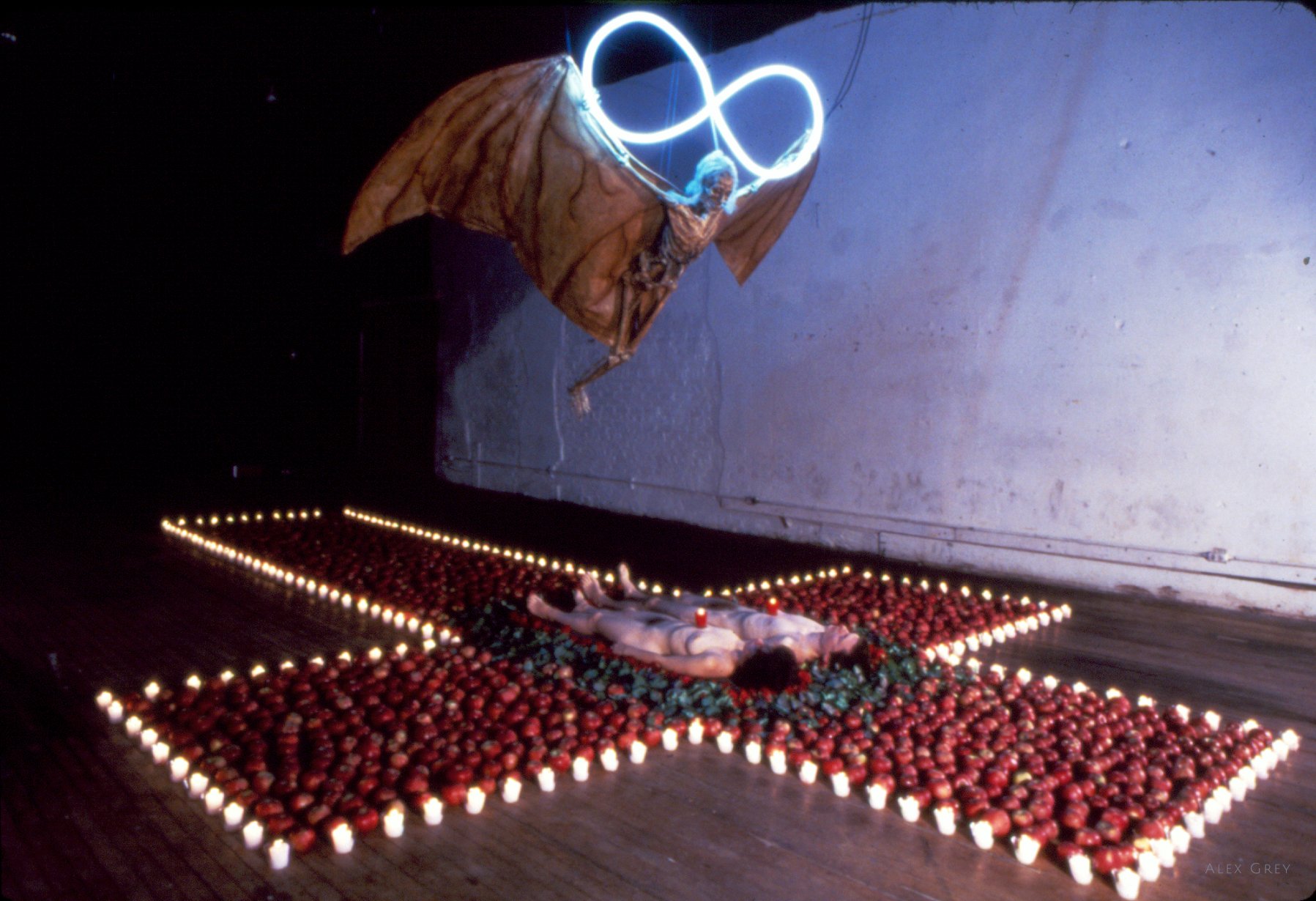
A teaching session with Alex Grey typically unfolds in the charged space between looking and seeing. Whether in a weekend workshop at CoSM (Chapel of Sacred Mirrors) or a lecture hall presentation, Grey stands before students with anatomical drawings, slides of his luminous paintings, and often a human skeleton. The atmosphere is less dharma hall than artist's studio—concrete rather than cushioned, lit to see detail rather than dimmed for inwardness. Students are asked to draw, to look at their own hands as if they've never seen them before, to trace the path of breath through the body's chambers. There's little sitting in silence for its own sake; the method is visual meditation, the mind steadied not by watching breath but by rendering it.
Grey's sessions move fluidly between demonstration and discourse. He might spend thirty minutes guiding students through sketching the energy body—not from imagination but from felt sensation, asking them to notice where attention actually pools and flows in their own frame. Then he'll pivot to slides, walking through his own paintings with the precision of both anatomist and mystic, describing exactly how he built up translucent layers to show skeleton, vasculature, and chakras occupying the same space. The teaching happens in this oscillation: look closely at what's actually there, then recognize what "actually there" might include beyond the materially visible.
Recurring Themes and Central Questions
Grey returns obsessively to a handful of interlocking questions: What does consciousness look like? How can direct visionary experience be documented with the same rigor we bring to documenting physical anatomy? What responsibility does the artist bear to report truthfully from non-ordinary states? These aren't rhetorical questions but genuine research inquiries that structure his teaching.
The concept of "universal human" appears constantly—the notion that beneath cultural conditioning lies a shared architecture of body, nervous system, and potential consciousness. Grey asks students to consider whether the energy body is metaphor or morphology, whether the third eye and crown chakra can be located as precisely as the pineal gland and cortex. He's suspicious of purely symbolic interpretations, pushing instead toward something like phenomenological cartography: mapping what's actually experienced in meditation, in altered states, in moments of connection or transcendence.
Another persistent theme is the mission of art itself. Grey positions creative practice not as self-expression but as a form of transmission—the artist as antenna, receiver, and broadcaster of states of consciousness that need to be made visible for others to recognize in themselves. This is teaching that asks: What have you actually seen? Can you paint it accurately enough that others might see it too?
Aesthetic and Delivery
Grey's delivery carries almost no humor. This isn't dourness but a kind of earnest precision, the tone of someone describing an expedition to a real place that others doubt exists. He speaks in complete paragraphs, building explanations methodically, often using language borrowed from both Eastern spiritual traditions and Western neuroscience without irony or self-consciousness. Where other teachers might leaven heavy concepts with jokes or casual asides, Grey stays focused, almost didactic.
He does use personal narrative—accounts of his own visionary experiences, often facilitated by psychedelics, described with careful attention to visual detail and emotional content. These aren't confessional stories but field reports. Scripture appears rarely; when Grey references tradition, it's more likely to be tantric texts describing the subtle body than biblical passages. The aesthetic is less pastoral guidance than laboratory notebook from consciousness research.
Who It Lands For
Grey's teaching finds its audience among those who've had their own visionary experiences and are looking for a vocabulary and method to integrate them. It appeals to serious practitioners at the intersection of meditation, psychedelics, and creative practice—people willing to draw badly in service of seeing clearly. Those comfortable with mysticism that insists on its own empiricism, that treats the visionary as reportable phenomena rather than ineffable mystery, will recognize Grey's approach.
It may bounce off students seeking traditional contemplative instruction, those uncomfortable with psychedelic experience as legitimate spiritual technology, or anyone looking for teaching that emphasizes letting go of visions rather than documenting them. Grey's fusion of anatomical materialism and mystical experience requires accepting both as equally real, equally worth careful attention.
Lineage and Tradition
Grey belongs to a lineage that includes both tantric Buddhism's visualization practices and Western esoteric anatomy, from Hildegard of Bingen's illuminated visions to Rudolf Steiner's spiritual science. More immediately, he emerges from 1960s-70s psychedelic mysticism, but distinguished by his insistence on technical skill and systematic documentation. He's teaching a peculiarly American fusion: democratic access to visionary states, combined with rigorous, almost scientific attention to what those states reveal.
