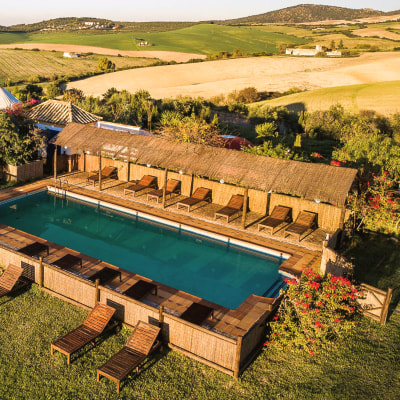
Suryalila Retreat Centre — Villamartín, Spain
Award-winning yoga retreat centre in the Andalusian hills, Villamartín, Spain
Suryalila Retreat Centre rises from the Andalusian hills like a sun-drenched mirage, a renovated olive hacienda turned yoga sanctuary that has quietly become one of Europe's most celebrated retreat destinations. Founded in 2007 by Vidya Heisel alongside Peter Simmons and Harry Dijkshoorn, this 45-acre working farm sits in the foothills of the Sierra de Grazalema, roughly an hour south of Seville, where rolling hills give way to fields of sunflowers and distant white villages shimmer on lakeshores. Vidya, an English-born yoga teacher who began her practice in 1975 at the Shree Rajneesh Ashram in Poona, India, spent decades teaching across continents before crystallizing her vision for Suryalila. After founding Frog Lotus Yoga studio in Massachusetts in 2002 and traveling the world with her teacher training programs for nearly a decade, she recognized what was missing: a European retreat center that combined world-class yoga instruction, gourmet vegetarian cuisine, beautiful accommodation across all price points, and the kind of human warmth that turns strangers into sangha. Peter Simmons discovered the property online, a cortijo of eight interconnected houses surrounding two inner courtyards fragrant with orange and lemon trees, and the trio fell instantly in love. By 2014, Vidya became sole director, and by the time Harry returned to Holland with his family, Suryalila had grown into a phenomenon. The crown jewel is the Om Dome, a geodesic structure built in 2010 that has been called the most magnificent yoga hall in Europe. Its sacred geometry creates a cathedral-like space that can hold 80 practitioners, with murals of Indian deities and Tibetan imagery adorning the walls, underfloor heating and cooling, and panoramic views over olive groves and a ruined convent. The center also houses the Ganesha Shala with its wooden ceilings and skylight, and the Moon Shala for intimate practices. Beyond the yoga halls, guests find a chlorine-free saltwater pool, an eco-sauna built from natural materials, hammock-strewn olive groves with 350 trees (still producing the center's own oil), and Danyadara, a nonprofit permaculture project greening the land through regenerative agriculture. Suryalila has been nominated by Yoga Journal as the best retreat in Europe, voted #1 by Om Yoga Magazine readers in 2023 and 2024, and honored with TripAdvisor's Travellers' Choice Award. In 2024, Vidya won the OM YOGA Award for Favourite Yoga Teacher Trainer, a testament to the Frog Lotus Yoga teacher training programs that have certified over 3,500 instructors worldwide. The center hosts both Vidya's Frog Lotus trainings, comprehensive 200-hour and advanced certifications blending Iyengar precision with Ashtanga flow, Kundalini energy, and Forrest intensity, and visiting teachers leading everything from adventure yoga retreats with hiking and canyoning to contemplative weeks with dharma teachers. Every room is individually decorated with treasures Vidya collected during her years as a fashion designer in Bali and her travels through India, Morocco, and Spain. The aesthetic is maximalist bohemia: Balinese carved furniture, Moroccan tilework, Indian textiles, all arranged with an interior designer's eye. The kitchen, staffed by classically trained chefs including culinary lead Gemma, serves three gourmet vegetarian meals daily, drawing from the center's organic gardens and local farms. The all-female management team oversees a staff of roughly 28, including Tanea, the assistant director from nearby Prado del Rey, whose strategic vision has helped steer Suryalila through challenges including the near-closure during COVID. What sets Suryalila apart is its refusal to choose between rigor and ease. You can come for a serious three-week teacher training, immersing yourself in anatomy, philosophy, and teaching methodology, or design your own "Retreat Yourself" package with daily drop-in classes, pool time, and zero agenda. The center runs a weekly community yoga class in Spanish for locals, hosts retreats that contribute 10% of profits to charity, and has installed solar panels funded by EU NextGenerationEU programs. It is at once a working farm, a yoga school, a wellness hotel, and a laboratory for sustainable living, all animated by Vidya's belief that yoga is not a trend but a path to holistic health, and that beauty, nourishment, and authentic human connection are non-negotiable.
Traditions: Vinyasa Flow, Hatha Yoga, Yin Yoga, Restorative Yoga, Iyengar Yoga, Yoga Nidra, Pranayama, Cacao Ceremony
Programs: Retreat Yourself Packages, Frog Lotus Yoga Teacher Training, 50-Hour Restorative Yoga, Yoga Nidra and Pranayama Training, Winter Wellness Retreat, Nourish Yoga and Indian Cooking Retreat, Iyengar Yoga Retreat, MATKA Women Retreat, Hiking and Yoga Retreat, Daily Vinyasa Flow Classes, Yin and Restorative Classes
Amenities: Saltwater Pool, Eco Sauna, Yoga Shalas, Organic Farm, Olive Oil Plantation, Amrita Café, Shakti Boutique, Massage Rooms, Bike Rental, Yurts and Domes
Spiritual Influences
Osho (Bhagwan Shree Rajneesh) (Teacher): Founder Vidya Heisel lived and taught for five years at his Poona ashram, where she received her initial yoga training and spiritual guidance in 1975.
Iyengar Yoga (Lineage): Vidya's foundational training tradition that provides the precision and alignment principles integrated throughout Suryalila's Frog Lotus Yoga style.
Ashtanga Vinyasa Yoga (Lineage): A core influence woven into Suryalila's intelligent vinyasa flow practice alongside Iyengar alignment principles.
Permaculture (Movement): Suryalila operates as a permaculture nonprofit actively reversing desertification on its 45-acre working olive farm.
Yogic Philosophy (Philosophy): The centre honors traditional yogic teachings through study of the Yoga Sutras and Bhagavad Gita integrated into its programs.
Regenerative Agriculture (Ethos): Suryalila's values-driven sustainability commitment manifests through its working olive farm, solar panels, water reclamation, and land restoration practices.
Frequently Asked Questions
What makes Suryalila different from other yoga retreat centres in Spain?
Suryalila functions as both a working organic farm — the Danyadara olive oil plantation is operational on site — and a full-spectrum yoga hub, which means you're smelling citrus and tilled earth, not just incense. The centre was purpose-built in 2007 around Vidya Jacqueline Heisel's Frog Lotus Yoga system, so the morning Vinyasa Flow classes follow a specific energising methodology rather than generic sequences that vary by teacher. Unlike coastal retreat centres that cycle through weekend groups, Suryalila hosts long-form teacher trainings, independent "Retreat Yourself" packages, and visiting teachers like Maggie Dunne who've been returning for over a decade — the community skews older, more committed, less Instagram-oriented. The Andalusian hills location means you're inland near Villamartín, not beachside; it's dry, rural, and genuinely remote. If you want polished spa luxury or ocean views, this isn't it — but if you want a serious practice container in a landscape that feels like rural India relocated to southern Spain, few places in Europe deliver this combination.
Who should probably skip Suryalila and go somewhere else?
If you need air conditioning, nightlife, or the ability to slip out for a proper restaurant meal, Villamartín is a small Andalusian town and the cortijo is isolated — you'll feel stranded without a car. The food is entirely vegetarian with vegan and gluten-free defaults; carnivores and picky eaters have struggled here, despite reviewers praising the kitchen's quality. Suryalila attracts a lot of teacher training groups and solo retreaters in their 40s and 50s doing deep work; if you're looking for a social wellness vacation with cocktails by the pool and group excursions, the vibe skews too earnest and inward. The yurt and dome accommodations are charming in photos but genuinely rustic — shared bathrooms, no climate control, olive grove insects — and some first-timers arrive expecting boutique hotel comfort at the $$$ price point and leave disappointed. Finally, if your yoga practice is casual or you're hoping to avoid early starts, the 8:00am Vinyasa Flow is the anchor of the daily schedule and skipping it feels like missing the point of being there.
What does the yoga practice actually feel like day-to-day at Suryalila?
The 8:00am morning sessions are 90 minutes of Frog Lotus Vinyasa Flow — Vidya Heisel's signature style, which is athletic, breath-synchronized, and structured around specific peak poses rather than freeform creativity. Expect a room full of serious practitioners, many of whom are mid-training or returning alumni; the energy is focused and the sequencing is consistent enough that regulars know what's coming. Afternoon sessions at 5:30pm shift completely — Yin and Restorative classes that incorporate singing bowls, aromatherapy, sometimes live music, occasionally guided Yoga Nidra, and the vibe drops from dynamic to meditative. Teachers rotate depending on the retreat calendar, but Heisel's methodology underpins the programming even when she's not personally teaching. If you prefer Iyengar precision or Ashtanga's fixed series, visiting Iyengar retreats do run periodically, but the house style is Frog Lotus and it's unapologetically vigorous in the mornings. What surprised me most is how little talking happens outside class — the grounds are so spread out and the community so self-directed that you can go hours without casual conversation if you choose solitude.
What does a typical day at Suryalila actually look like, hour by hour?
Most guests wake naturally around 7:00-7:30am — there's no formal wake-up bell — and drift toward the yoga shala or grab tea from the Amrita Café before the 8:00am Vinyasa Flow class. Breakfast is served around 9:30am in the communal dining hall, buffet-style, and then the day opens completely: some people book massage appointments in the Lotus Lounge or Dakini Lounge, others walk the olive groves or lie in hammocks, many nap or journal in their casas. Lunch arrives at 1:00pm, again communal and leisurely, and the afternoon is similarly unstructured until the 5:30pm Yin or Restorative session. Dinner is at 7:30pm, often the most social meal, and evenings might include a sauna night by the saltwater pool, a sound healing session, or simply silence under the stars. If you're on a "Retreat Yourself" package, the complimentary 60-minute massage gets scheduled whenever you want; if you're part of a teacher training cohort, your afternoons fill with anatomy lectures or teaching practice. The rhythm is loose enough to feel like a real retreat, not summer camp, but structured enough that you're never wondering what to do next.
What's the food situation really like — and will I leave hungry?
The dining hall serves three vegetarian buffet meals daily, and reviewers consistently rank the food as a highlight — think Spanish-inflected bowls with roasted vegetables from the organic gardens, tahini-dressed grains, homemade breads, and desserts that don't taste virtuously sugar-free. Vegan and gluten-free options aren't special requests; they're the default baseline, and dairy appears only occasionally as an optional addition. The dining tables are long, communal, and boho-decorated; meals skew quiet but not silent, and the vibe is more companionable than performatively monastic. Portions are generous and you can return for seconds, but if you're used to high-protein omnivore meals or need frequent snacking, bring your own nut butter and bars — the Amrita Café offers tea and light snacks, but it's not a full-service operation. What catches people off guard is how slowly meals unfold; dinner can stretch 90 minutes if you let it, and the kitchen isn't accommodating last-minute substitutions or off-menu requests. If you have serious allergies beyond gluten or dairy, communicate directly with the team before arrival rather than hoping they'll improvise on-site.
How do the accommodation options actually compare, and what are the real tradeoffs?
The named casas — Casa Kali, Casa Tara, Casa Padma, Casa Govinda, Casa Ananda — are the most conventional option: private or shared rooms in traditional cortijo buildings with en-suite or shared bathrooms, proper beds, and climate you can mostly control. The yurts and mini domes are where Suryalila leans bohemian: canvas or wood structures scattered across the olive groves, charming and Instagram-ready but genuinely rustic with shared bathroom blocks, no A/C, and real exposure to summer heat or winter cold. The honeymoon yurt is the most private and romantic but still a yurt — beautiful at sunset, less so at 3:00am when you need the toilet. The dormitory is exactly what it sounds like: bunk beds, backpacker vibe, the cheapest option and perfectly fine if you're used to hostels or ashram stays. What I wish I'd known before my first visit is that "eco-casa" doesn't mean "casa with solar panels" — it means a step down in finish and amenities, often farther from the main facilities. If you're heat-sensitive, avoid yurts in July and August; if you value ensuite bathrooms and aren't charmed by glamping aesthetics, pay up for a named casa and don't romanticize the domes.
What surprises first-timers about Suryalila, good and bad?
The good surprise is how genuinely remote and quiet it feels — you're on a working farm with no ambient noise except birds and wind, and the 24-hour access to the saltwater pool means you can swim naked at midnight under absurd stars. The bad surprise is how isolated the cortijo actually is: Villamartín is small, there's no walkable village life, and if you don't have a car, you're fully dependent on the centre's schedule and optional excursions. First-timers also underestimate the Andalusian summer heat — it's inland and unshaded in parts, and even the yoga shalas can feel stifling in July despite fans. The inclusivity of the community surprises people positively; solo travellers and older guests consistently mention feeling welcomed rather than sidelined, and the lack of performative wellness posturing makes it easier to relax. On the downside, the "boho global décor" leans heavily into Orientalist aesthetics — Balinese pagodas, Moroccan textiles, a sacred Banyan Tree — which some find enchanting and others find culturally appropriative or dated. Finally, the complimentary massage included in "Retreat Yourself" packages is a legitimate 60-minute session, not a 45-minute upsell preview, and that generosity catches people off guard in the best way.
How much does Suryalila actually cost, and what hidden expenses should I budget for?
The $$$ price range translates to roughly €100-€180 per night depending on accommodation tier and season, with "Retreat Yourself" packages starting around €700 for five nights including all meals, daily yoga, and one massage — mid-range for European retreat centres but not cheap. That base price covers nearly everything: breakfast, lunch, dinner, two daily yoga classes, access to the pool and sauna, and use of all communal facilities. Where costs creep up: private yoga sessions, additional massage or bodywork appointments beyond your included treatment, ceremonial cacao add-ons, and excursions to Ronda or nearby canyoning sites, which run €40-€80 each. If you're attending a Frog Lotus 200-hour teacher training, expect €2,800-€3,200 for the full residential programme, and that's separate from accommodation and meals. The centre doesn't prominently advertise scholarships or work-exchange, though some visiting retreat leaders arrange their own sliding-scale pricing. Honestly, if you're budget-constrained, Suryalila isn't the place to stretch — you'll feel nickel-and-dimed by add-ons, and there are cheaper ashram-style centres in Spain where simplicity is part of the ethos rather than a tier you're paying to avoid.
What are the unspoken etiquette rules and norms I should know before arriving?
Phones aren't banned, but the WiFi is intentionally weak and the social norm is to leave devices in your room — pulling out a phone at meals or in the yoga shala will earn you side-eye. Silence isn't enforced outside meditation sessions, but the grounds are spread out enough that quiet conversation is the default; if you're a loud processer or need constant social stimulation, you'll feel the pressure to modulate. Shoes come off before entering any yoga space or treatment room, and walking the olive groves barefoot is encouraged but watch for stones and insects. The sauna nights are clothing-optional and communal; if that makes you uncomfortable, skip them or clarify norms with staff beforehand. Leaving a retreat early or skipping scheduled sessions isn't frowned upon if you're on a "Retreat Yourself" package — it's genuinely self-directed — but if you're part of a teacher training or hosted group retreat, attendance expectations are strict and leaving mid-programme is awkward. Finally, tipping isn't standard in Spain, but leaving a small contribution for kitchen or housekeeping staff at the end of your stay is appreciated and noticed.
What's the land and built environment actually feel like to inhabit?
The cortijo sits on working farmland — olive groves stretch in every direction, the organic gardens supply the kitchen, and you'll see staff tending crops or pressing oil depending on season. The architecture is rustic Andalusian: whitewashed stone buildings with terracotta roofs, clay-built treatment rooms, and imported Balinese pagodas that either charm you or feel like theme-park eclecticism depending on your taste. The saltwater pool is the visual centrepiece, infinity-edge and positioned to frame the rolling countryside, and it's genuinely stunning at sunset — but it's also unheated, so shoulder-season swims are bracing. The yoga shalas are simple, open-air or high-ceilinged, with good natural light and basic props; don't expect heated floors or state-of-the-art sound systems. What I didn't anticipate is how much the landscape shapes your daily rhythm: the lack of shade means midday feels punishingly bright in summer, and the wide-open sky makes early mornings and late evenings the most pleasant times to move around. The Garden of Stillness and meditation spaces are genuinely peaceful, not performative, and the sacred Banyan Tree is impressive if you can get past the incongruity of a South Asian species transplanted to southern Spain. It's beautiful and real, but also dusty, bug-filled, and occasionally rough around the edges — a working farm first, a luxury resort never.
What should I actually pack that most people forget or underestimate?
Andalusia in summer is brutally hot and dry — bring a wide-brimmed hat, high-SPF reef-safe sunscreen, and a refillable water bottle you'll carry everywhere, because shade is limited outside the buildings. Even if you're visiting in May or September, pack layers; the temperature drops sharply after sunset and the yurts and domes don't hold heat. A headlamp or small flashlight is essential if you're in outlying accommodations, since the paths between casas and the dining hall aren't well-lit at night and you'll be navigating olive groves in the dark. The yoga props are adequate but well-used; if you're particular about mat thickness or want your own bolster, bring it. Insect repellent is non-negotiable in warmer months — the organic gardens and olive trees attract mosquitoes and flies, and the open-air shalas aren't screened. Finally, bring cash in euros for the Shakti Boutique, massage tips, or optional excursions, because card readers are inconsistent and the nearest ATM is in Villamartín. What I wish someone had told me: pack earplugs if you're a light sleeper, because the dorms and shared-wall casas transmit sound, and early risers practicing pranayama in adjacent rooms are audible.
How accessible is Suryalila for people with mobility limitations or disabilities?
Honestly, Suryalila is not designed for wheelchair users or anyone with significant mobility challenges — the grounds are sprawling and uneven, with gravel paths, steps between buildings, and accommodations scattered across olive groves that require walking on unpaved terrain. The yoga shalas are ground-level and accessible once you reach them, but getting there from some casas or yurts involves inclines and uneven surfaces. The saltwater pool has steps but no lift, and the sauna area isn't ADA-compliant. Some of the named casas are closer to central facilities and have fewer stairs, so if you have moderate mobility concerns, request Casa Govinda or Casa Ananda and communicate your needs directly with the team before booking — they'll try to accommodate, but the infrastructure has real limits. There's no accessible bathroom signage, no hearing loop systems, and no stated accessibility policy in the venue data. If you require consistent mobility support, dietary precision beyond vegetarian/vegan/gluten-free, or accessible transportation to the site, plan extensively in advance and consider whether a more purpose-built facility might serve you better. The staff is warm and willing, but the cortijo's bones are old and rural, and retrofitting accessibility hasn't been a priority.