BrightStar
ブログマイチケット
Language
Saved eventsブログマイチケット
ログイン新規登録
  • すべてのイベントを見る
  • 探求者向け
  • ヨガ
  • 瞑想
  • ブレスワーク
  • 気功
  • 聖なる音楽
  • ワールドミュージック
  • メディスンミュージック
  • サウンドヒーリング
  • エクスタティックダンス
  • セレモニー
  • リトリート
  • ワークショップ
  • すべてのカテゴリ →
  • Bali
  • Sedona
  • Los Angeles
  • Costa Rica
  • Byron Bay
  • San Francisco
  • Austin
  • New York
  • San Diego
  • Seattle
  • すべての都市 →
  • 無料でイベントを掲載
  • Join the Movement
  • Why we list
  • Sell Globally
  • クリエイター向け
  • チーム向け
  • ライター向け
  • 講師向け
  • キルタンアーティスト向け
  • スタジオ向け
  • フェスティバル向け
  • リトリートセンター向け
  • 非営利団体向け
  • ブランドアンバサダー
  • 無料チケット販売
  • Elevate
  • Amplify
  • 50万人以上のバイヤーネットワーク
  • カート放棄リカバリー
  • スマートダイナミックプライシング
  • チケットカテゴリ
  • 定期イベント
  • 座席指定
  • アフィリエイトシステム
  • ウェイトリスト / 通知
  • チケットスキャナー
  • 埋め込みウィジェット
  • イベント配信
  • メッセージセンター
  • インテグレーション
  • レポート
  • すべての機能 →
  • 概要
  • エコシステム
  • ブログ
  • 用語集
  • インスピレーション
  • ヘルプセンター
  • お問い合わせ
  • APIドキュメント
  • ブランドアセット
  • 採用
  • プレス
  • 利用規約
  • プライバシーポリシー

イベント

  • すべてのイベントを見る
  • 探求者向け
  • ヨガ
  • 瞑想
  • ブレスワーク
  • 気功
  • 聖なる音楽
  • ワールドミュージック
  • メディスンミュージック
  • サウンドヒーリング
  • エクスタティックダンス
  • セレモニー
  • リトリート
  • ワークショップ
  • すべてのカテゴリ →

目的地

  • Bali
  • Sedona
  • Los Angeles
  • Costa Rica
  • Byron Bay
  • San Francisco
  • Austin
  • New York
  • San Diego
  • Seattle
  • すべての都市 →

クリエイター向け

  • 無料でイベントを掲載
  • Join the Movement
  • Why we list
  • Sell Globally
  • クリエイター向け
  • チーム向け
  • ライター向け
  • 講師向け
  • キルタンアーティスト向け
  • スタジオ向け
  • フェスティバル向け
  • リトリートセンター向け
  • 非営利団体向け
  • ブランドアンバサダー
  • 無料チケット販売
  • Elevate
  • Amplify

機能

  • 50万人以上のバイヤーネットワーク
  • カート放棄リカバリー
  • スマートダイナミックプライシング
  • チケットカテゴリ
  • 定期イベント
  • 座席指定
  • アフィリエイトシステム
  • ウェイトリスト / 通知
  • チケットスキャナー
  • 埋め込みウィジェット
  • イベント配信
  • メッセージセンター
  • インテグレーション
  • レポート
  • すべての機能 →

会社

  • 概要
  • エコシステム
  • ブログ
  • 用語集
  • インスピレーション
  • ヘルプセンター
  • お問い合わせ
  • APIドキュメント
  • ブランドアセット
  • 採用
  • プレス
  • 利用規約
  • プライバシーポリシー
アプリを入手
App StoreからApp StoreGoogle Playで手に入れようGoogle Play
© 2026 BrightStar. 全著作権所有. 写真クレジット ·
✨ Nastya Saraswati’s profile is unclaimedClaim Profile
Nastya Saraswati
NS
Nastya Saraswati

Nastya Saraswati

Violinist · St. Petersburg and Mumbai

紹介

Nastya Saraswati is a violinist and vocalist whose work bridges the classical traditions of Russia and India. Based between St. Petersburg and Mumbai, she performs and records music that draws on Hindustani classical forms, devotional kirtan, and the European string repertoire she trained in from childhood. Her stage name references the Hindu goddess of knowledge and the arts, a nod to the synthesis that defines her sound.

Saraswati's approach to the violin is rooted in bel canto phrasing and the microtonal ornaments of raga performance. She adapts her instrument to Indian classical music by integrating slides, gamakas, and drone-based improvisation, techniques more commonly associated with the sarangi or esraj. Her performances often include vocal work in Sanskrit, Hindi, and Russian, and she collaborates with tabla players, sitar accompanists, and electronic producers working in ambient and world fusion genres.

In 2017, Saraswati appeared as a finalist on Dil Hai Hindustani, a televised singing competition on Star Plus that drew millions of viewers across India. The program, judged by playback singers Badshah, Shalmali Kholgade, and Shekhar Ravjiani, showcased her ability to perform Bollywood repertoire alongside devotional bhajans. Her performances on the show introduced her work to a mainstream Indian audience and expanded her following beyond the classical and spiritual music circuits.

Saraswati was trained in classical violin in Russia before relocating to India to study Hindustani music and immerse herself in the country's devotional traditions. She has spent extended periods in ashrams and pilgrimage sites across India, studying with traditional vocal and instrumental teachers. Her time in Varanasi, Rishikesh, and rural Maharashtra has informed both her musical vocabulary and her understanding of the spiritual contexts in which ragas and mantras are performed.

She has performed at venues and festivals across India and Russia, including kirtan gatherings, classical recitals, and fusion concerts that pair traditional Indian instruments with Western strings. Her work has been covered by Indian lifestyle and music media, and she maintains an active presence on social platforms where she shares performance videos, studio sessions, and recordings from live events. She teaches violin and vocal technique to students interested in cross-cultural improvisation and devotional music.

Saraswati continues to tour between Russia and India, performing solo concerts and collaborating with musicians in both countries. She records regularly, releasing singles and session work that blend Indian ragas with ambient and neoclassical production. Her current projects include live kirtan performances in Mumbai and St. Petersburg, and she is developing new material that explores the overlap between Russian Orthodox chant and Vedic recitation.

For listeners encountering her work today, Saraswati offers a model of how classical training can be adapted to serve devotional and cross-cultural expression without flattening either tradition.

ViolinistMusicianSingerViolinIndian MusicClassical MusicSoul SearchingTravel
11K on Instagram

Read & Watch

Stories & Insights

All articles
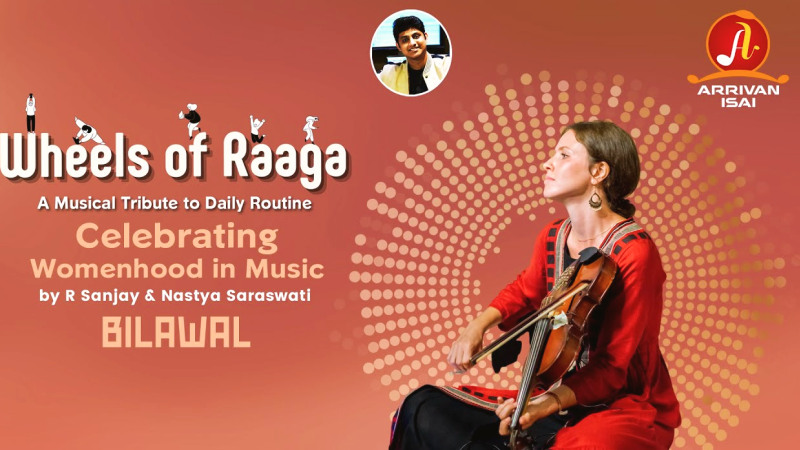
Raga Bilawal: Morning Connection to Nature Through Violin
Video

Raga Bilawal: Morning Connection to Nature Through Violin

Raga Bilawal and the Wheels of Raaga project connect daily human experience to Indian classical music's cyclical time theory. Nastya Saraswa…

Watch →
Khamoshiyan Violin Cover: Silence Through String
Video

Khamoshiyan Violin Cover: Silence Through String

Nastya Saraswati performs a violin cover of the Hindi romantic song Khamoshiyan, capturing the meaning of silence through instrumental music…

Watch →
すべて見るStories & Insights→

Connect

Instagram11K followers

Stay in Touch

Create your BrightStar account

Follow Nastya Saraswati and discover other retreats, teachers, and gatherings across the conscious wellness world. New programs, early-bird pricing, and seasonal guides — once a month.

Subscribed. Welcome.

or

Free BrightStar account. Follow venues and teachers, save events, get personalized recommendations across the conscious wellness ecosystem.

For Event Creators

Be the Change.Keep the Change!

A free ticketing platform built for retreats, kirtans, and festivals. Set up an event in minutes — no contracts, no per-ticket fees, no catch.

$0
Forever
∞
Events
0
Contracts
100%
Yours
Try the Demo→Learn more

Read More

About Nastya Saraswati

  • For Beginners

    Where to Start with Nastya Saraswati: A Beginner's Guide

    3 min read

  • Discography

    Essential Nastya Saraswati Albums: A Listening Guide

    1 min read

  • Music

    The Music of Nastya Saraswati: Sound, Sacred Texture, and Lineage

    4 min read

  • Biography

    Who Is Nastya Saraswati? Life, Work, and Legacy

    4 min read

Worth Knowing

Questions

Nastya Saraswati is a violinist and musician who reached the finals of Dil Hai Hindustani, Star Plus TV's prestigious music competition, marking her as a serious contender in India's contemporary classical music landscape. What distinguishes her from the competition pool is her deliberate positioning as both a classical musician and a cross-cultural traveler — she maintains a working life between Mumbai and St. Petersburg, a geographic split that directly shapes her artistic sensibility. Listeners and booking agents follow her work because she represents a generation of Indian classical musicians uninterested in purely preservationist approaches; instead, she treats the violin as a vehicle for soul-searching and cultural dialogue. Her availability for direct bookings reflects an artist deeply engaged with the communities she performs for, rather than operating through conventional label machinery. What surprises newcomers is that Nastya Saraswati's work resists easy categorization — she is simultaneously rooted in Indian music tradition and productively unsettled by it, which appeals to listeners seeking authenticity without nostalgia.

Nastya Saraswati's foundation is in Indian classical music, evidenced by her participation in and advancement through Dil Hai Hindustani, a competition that evaluates mastery of Hindustani vocal and instrumental traditions. The violin in Indian classical music occupies a distinctive position — it entered the subcontinent through European colonization but was rapidly assimilated into Hindustani and Carnatic practice, requiring both Western technical training and deep study of raga, taan, and improvisational oral tradition. Her choice to maintain active performance bases in both Mumbai and St. Petersburg suggests an engagement with the violin's doubled heritage: the Western classical instrument and its transformed role within Indian music. The label 'soul-searcher' in her self-description hints at a lineage concern with the instrument as a vehicle for interiority and spiritual inquiry, rather than merely technical display. Her work sits within the contemporary Indian classical music ecosystem, where musicians increasingly see themselves as cultural translators and explorers rather than strict adherents to a single guru-disciple lineage.

The most direct entry point is to research her appearance on Dil Hai Hindustani, which provides both context for her level of technical mastery and a sense of her artistic personality under competitive pressure. Watching her performance clips from the show will immediately signal what makes her violin voice distinctive — listeners will hear whether she emphasizes melodic purity, improvisational complexity, emotional restraint, or virtuosic display. Beyond competition footage, potential listeners should seek out any live performances or recordings available through her direct booking contact, as these will reflect her mature artistic choices outside the Star Plus format. The 'soul-searcher' and 'traveler' aspects of her identity suggest she likely performs in intimate settings and at cultural exchange events rather than only traditional concert hall circuits — so checking for performances at cultural centers, cafés, or retreat spaces in Mumbai and St. Petersburg will yield more complete understanding of her current work. What matters for newcomers is to approach her not as a heritage purist but as a working musician actively shaping what Indian classical violin can be in the 21st century.

The most visible distinctive marker is her geographic split between Mumbai and St. Petersburg — this is not a touring pattern but a deliberate dual-base existence, which shapes artistic identity in ways that rival musicians operating from a single homeland rarely experience. Most Indian classical violinists either remain rooted in the Indian subcontinent, studying intensively within a guru-disciple lineage, or emigrate and navigate diaspora identity from a distance. Nastya Saraswati's positioning suggests she refuses that binary; she maintains active engagement with both musical ecosystems, which inevitably colors her approach to raga, to the instrument's voice, and to what 'classical' even means. Her self-identification as a 'soul-searcher' rather than a 'virtuoso' or 'raga master' also sets her apart — this language prioritizes inner exploration and personal authenticity over mastery-as-accumulation, which appeals to listeners fatigued by hypercompetitive classical music culture. Finally, her availability for direct bookings indicates an artist building community through accessible performance and dialogue, rather than pursuing the hermetic prestige model that still dominates Indian classical music's institutional hierarchy.

Listeners seeking pure heritage preservation or strict Hindustani raga tradition taught by a recognized guru-disciple lineage may find Nastya Saraswati's work frustratingly exploratory rather than definitive. If you are drawn to the Indian classical violin specifically for its technical exhibition or speed — the kind of performance that commands standing ovations in classical concert halls — her emphasis on soul-searching suggests a different priority entirely, one that may read as understated or introspective rather than virtuosic. Casual listeners expecting pop-music accessibility or devotional chant-style simplicity will likely find the violin's complexity and the improvisational demands of Indian classical music a barrier rather than an entry point. Her work is also not suited for audiences seeking a single, finished artistic statement; the 'traveler' identity and geographic split between cultural bases implies ongoing questioning and evolution, not the consolidation of a signature sound. Finally, those looking for heavily produced, studio-engineered recordings with contemporary electronic elements should look elsewhere — her traditional involvement with Indian classical violin suggests acoustic integrity and instrumental purity as core values.

Direct contact through her booking email is the primary way to stay connected with Nastya Saraswati's current availability and performance calendar — her positioning as an artist available for direct bookings means she likely manages her schedule and engagement personally rather than through a centralized label or management company. Listeners should expect that her performances may appear as one-off events in cultural spaces, retreat centers, or intimate venues in Mumbai and St. Petersburg rather than as a traditional touring circuit posted on major concert platforms. Following any social media accounts she maintains — Instagram, Facebook, or other platforms where Indian classical musicians typically announce performances — will yield real-time updates about upcoming appearances and possible new recordings. Given her emphasis on travel and soul-searching, it's worth checking if she appears at cultural festivals, yoga and wellness retreats, or cross-cultural music events that bridge European and Indian artistic communities. The fact that she maintains active bases in both Mumbai and St. Petersburg suggests that listeners in either location have reasonable proximity to her work, though booking her may require more intentional outreach than purchasing a ticket to an established concert series.

Without extensive recording data available, the most reliable way to hear her actual sound is through her Dil Hai Hindustani performances, which will reveal whether her tone is warm or crystalline, her approach to ornamentation minimal or elaborate, and her improvisational style melodically conservative or harmonically adventurous. The fact that she advanced to the finals of a televised competition suggests technical fluency with both rapid passages and sustained, expressive tone — the two pillars of violin mastery in Indian classical music. Her self-identification as a 'soul-searcher' hints at an aesthetic that prioritizes emotional authenticity and interiority over display; this typically manifests as restraint in vibrato, careful attention to each note's attack and decay, and improvisations that follow emotional logic rather than technical complexity for its own sake. The violin in Indian classical practice sits somewhere between the Western violin's emphasis on linear melody and the vocal tradition's emphasis on microtonal inflection and ornament — where Nastya Saraswati lands on that spectrum will significantly determine her artistic signature. Direct listening to her available recordings remains the only reliable way to understand her actual sonic personality; the descriptions above provide context but not substitutes for hearing her voice on the instrument itself.

The primary instrument is the violin itself, which in Indian classical music performance typically does not perform in isolation — it requires rhythmic and harmonic support from tabla (drums), tanpura (drone), and often harmonium or sarangi (bowed string instrument) to create the full musical texture. Without detailed discography or collaboration data, the specifics of her typical ensemble configuration remain unknown, though performers at Nastya Saraswati's level of competition entry typically perform with established session musicians or accompanists who specialize in supporting soloists. Her dual residence between Mumbai and St. Petersburg raises the question of whether she collaborates differently in each geographic base — Mumbai would offer access to traditional Hindustani accompanists, while St. Petersburg might involve European classical musicians or world-music collaborators. Direct inquiry through her booking contact would be the surest way to understand her preferred working ensemble and to learn whether she performs solo, with traditional Indian classical accompaniment, or in cross-cultural configurations. Her role as a 'traveler and soul-searcher' suggests openness to unconventional collaborations, but without concrete evidence, speculation remains exactly that.

Her most visible public achievement is her finalist status on Dil Hai Hindustani, Star Plus TV's major music competition, which represents significant recognition within India's contemporary classical music landscape. Reaching the finals of a televised competition of that scale indicates both technical mastery and screen presence — she has passed through multiple rounds of adjudication by established musicians and has performed in front of large television audiences, which carries substantial career weight. Beyond that competition milestone, detailed press coverage, major publication features, or institutional recognition data is not yet available through standard channels, which suggests she may operate more in independent performance spaces, cultural centers, and direct-booking contexts than in the traditional classical music media apparatus. As her work develops and she continues performing across Mumbai and St. Petersburg, it would be reasonable to expect coverage in cultural journals, music magazines focusing on Indian classical practice, and international world-music publications — particularly if she pursues more explicit cross-cultural collaborations. For the most current information about any recent press mentions or awards, direct contact through her booking email remains the most reliable source.

The Indian classical violin is deeply rooted in traditions that understand music as a vehicle for spiritual experience and inner exploration — raga music specifically is designed to evoke emotional and psychological states through tonal relationships and improvisational development over time. Nastya Saraswati's self-identification as a 'soul-searcher' strongly suggests that her approach to the instrument is informed by this spiritual dimension; listeners seeking music for yoga practice, meditation, or ceremony would likely find her work receptive to these contexts. The violin's capacity for sustained, expressive tone and its ability to follow the breath and heartbeat make it naturally compatible with meditative listening, particularly if her aesthetic emphasizes emotional depth over technical display. However, without access to specific recordings or performance documentation, it remains unclear whether her work is explicitly designed for these purposes or whether it emerges from them naturally through her spiritual orientation. Those interested in using her music for practice should reach out directly through her booking contact to discuss both her available recordings and whether she performs or creates work specifically for meditation, yoga, or ceremonial contexts.

Discover More

Kindred Spirits

Dana Devi

Dana Devi

2K listeners
Jahnavi Harrison

Jahnavi Harrison

3K listeners
Jessy Greene

Jessy Greene

141 listeners
Mona Pirzad

Mona Pirzad

Socko

Socko

Diana Nash

Diana Nash

1 listeners
Michelle Shanti

Michelle Shanti

Ida Jo

Ida Jo

ご本人ですか? このページを登録 ›

Continue your journey

There's more where this came from.

BrightStar is the global directory of artists, teachers, and healers in the wellness and spiritual movement. Find your next experience — or add yourself.

Discover More Artists

Browse 14,000+ curated profiles across kirtan, yoga, meditation, and beyond.

Explore directory →

Find an Event Near You

Kirtan, retreats, sound baths, breathwork, ceremonies — happening this week.

Browse events →

Add Your Profile

Are you an artist, teacher, or healer? Get listed — free, AI-assisted, live in minutes.

Get started →