The Chamunda mantra—Om Aim Hrim Klim Chamundayay Vichay Namaha—calls upon Chamunda, a fierce form of the Divine Feminine in Hindu tantra and Shakti tradition. Unlike softer, nurturing aspects of the Goddess, Chamunda embodies destruction of negative forces, ego-based patterns, and internal obstacles. This kirtan practice is designed to build inner confidence, emotional resilience, and spiritual wisdom by aligning the practitioner with this fierce, protective power of the Divine.
Chamunda represents one of the most intense and dynamic expressions of Shakti—the primordial feminine energy in Hindu philosophy. Unlike peaceful or nurturing Goddess forms, Chamunda embodies a wrathful, destructive aspect. In classical iconography and tantric texts, she is depicted as fierce, fierce with multiple arms, often shown trampling negative forces and demons. Her name itself is composed of two demon names—Chanda and Munda—whom she defeated, signifying her power to annihilate obstacles and harmful influences both external and internal.
In the broader context of Shakti worship, every form of the Goddess serves a purpose. While some aspects offer comfort, healing, and maternal love, Chamunda's role is to eliminate what no longer serves the spiritual seeker. This is not destruction for its own sake, but rather the fierce compassion of a teacher who burns away illusions and ego-based patterns. In tantric practice, working with Chamunda requires courage and a genuine commitment to inner transformation, not merely comfort.
The mantra Om Aim Hrim Klim Chamundayay Vichay Namaha is traditionally understood to invoke specific qualities and remove specific obstacles. Breaking down the mantra syllables:
- Om — The universal sound, representing consciousness and the fundamental reality underlying all existence.
- Aim — The seed syllable (bija mantra) associated with Saraswati, goddess of wisdom, learning, and clarity.
- Hrim — The bija mantra of Maya/illusion, often used to remove veils and reveal truth; it activates the heart center and inner light.
- Klim — The bija mantra of attraction and the magnetic power of Shakti; it magnetizes positive forces toward the practitioner.
- Chamundayay Vichay Namaha — Direct invocation and salutation to Chamunda, requesting her fierce intervention and blessing.
When chanted as part of a kirtan (call-and-response devotional singing), the mantra creates a vibrational field that practitioners report as clarifying, empowering, and protective. Unlike mantras focused on peace or dissolution, Chamunda's mantra is active and assertive. It is meant to activate the dormant power within the practitioner, strengthen the will, and build the inner resolve necessary to face life's challenges without being overwhelmed by fear or self-doubt.
One of the primary purposes of working with Chamunda is the development of confidence and inner strength. In modern spiritual language, this might be called "empowerment," but the traditional understanding goes deeper. Confidence rooted in Chamunda practice is not ego-based bravado; it is the unshakeable inner knowing that one has the capacity to face adversity, overcome obstacles, and protect oneself and others from harmful influences.
This inner strength develops through repeated invocation and attunement to Chamunda's energy. By singing her mantra in a kirtan setting, the nervous system begins to recalibrate. Instead of defaulting to freeze, fight, or flight responses, the practitioner's body and mind learn to access a grounded, resourced state—one in which boundaries are clear, discernment is sharp, and power is available. This is why Chamunda practices have historically been used by spiritual warriors, ascetics, and those engaged in intensive inner work.
The description of Chamunda as "utterly destructive to negative forces/influences" refers both to external and internal dimensions. Externally, invoking Chamunda is believed to create a protective barrier against harmful people, situations, and energies. Internally—and this is the more profound level—Chamunda's energy targets the negative patterns, doubts, fears, and limitations that prevent the practitioner from accessing their full power and wisdom.
In tantric psychology, negative forces are not separate demons but rather our own unhealed wounds, trauma patterns, and ego-defensive structures that keep us small, contracted, and disconnected from our authentic power. Chamunda's fierce destruction acts as a spiritual surgery: she cuts through denial, burns away self-pity, and annihilates the victim consciousness that keeps us bound. This is intense work and explains why Chamunda practice is not for everyone—it requires willingness to be radically honest about one's limitations and to actually change.
Kirtan—the practice of call-and-response devotional singing—is a particularly effective vehicle for working with Chamunda's mantra. Unlike silent meditation, which can sometimes allow the mind to drift or even reinforce habitual thought patterns, kirtan engages the whole body and psyche. The singing of the mantra creates vibrations that resonate through the nervous system, the vocal cords, the chest cavity, and the energetic centers of the body.
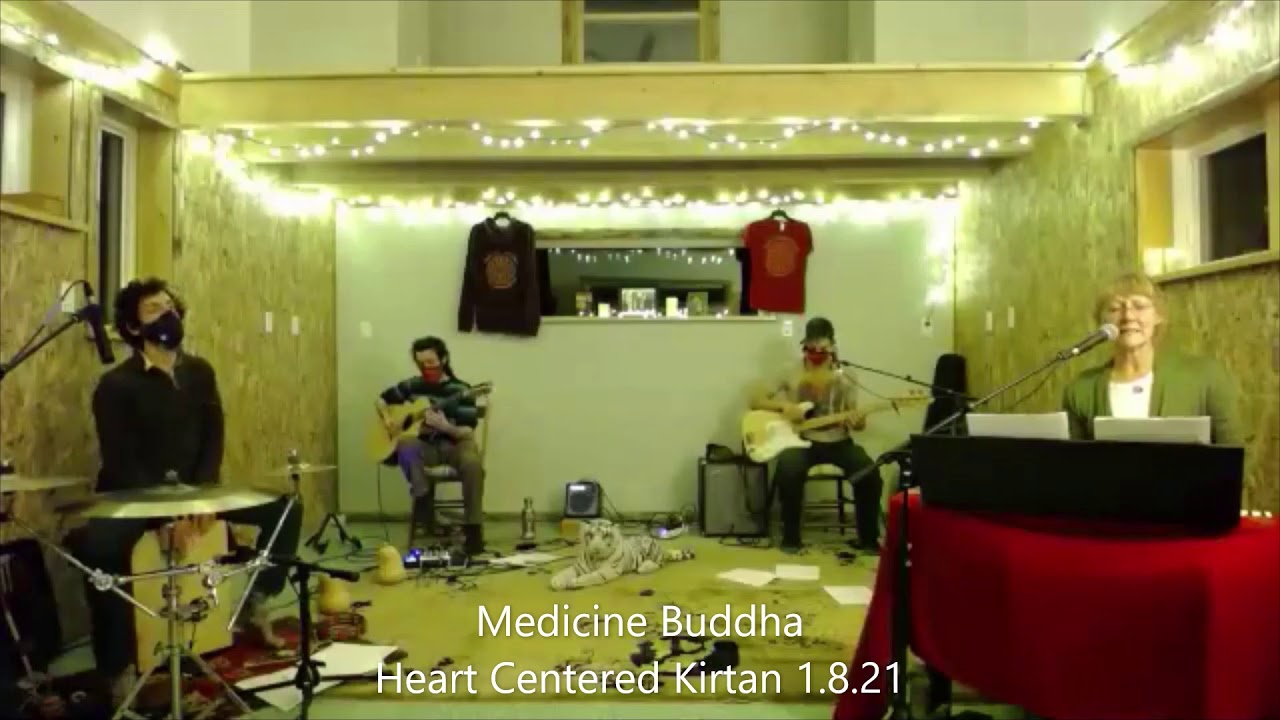
When sung in a group setting, as recorded at Bethel Farm Yoga & Living Arts Center in New Hampshire with musicians Libby Volckening (keys/vocals), Ezra Landis (guitar), Owen Landis (percussion), and Walker Landis (bass), the kirtan becomes a collective invocation. The individual voice joins with others, creating a field of unified intention. This amplifies the practice's effect and allows participants to feel held by something larger than themselves—the collective power of devotion and the presence of Chamunda herself.
Another stated benefit of Chamunda practice is the cultivation of wisdom. This is not intellectual knowledge but rather viveka—the discriminative wisdom to distinguish the real from the unreal, the essential from the superficial, the true self from the false self. Chamunda's fierceness operates as a teaching. Her energy reveals what we have been avoiding, shows us the ways we have compromised ourselves, and illuminates the gap between who we pretend to be and who we actually are.
This wisdom is gained not through comfort but through confrontation with truth. Practitioners who work with Chamunda often report sudden clarity about situations they had been in denial about, the strength to leave relationships or situations that no longer serve them, and the courage to speak their truth even when it is unpopular. These are not gentle gifts; they are the fruits of being burned clean by the fierce grace of the Divine Feminine in her most powerful form.
Chamunda practice is particularly valuable during times of transition, when facing significant obstacles, when one needs to reclaim personal power, or when engaged in spiritual work that requires clearing old patterns. It is less appropriate for someone in acute crisis or early trauma recovery—those situations typically require gentler, more stabilizing practices first. Chamunda works best when the practitioner has some foundation of stability and is ready to do the work of genuine transformation rather than seeking merely to feel better.
If you are drawn to Chamunda practice, begin by learning and singing the mantra regularly—daily practice will produce noticeable shifts in confidence, clarity, and inner strength within weeks. Study the iconography and mythology of Chamunda to deepen your intellectual understanding of what you are invoking. Consider joining a kirtan circle where this mantra is sung; the group field will amplify the practice's effects. Finally, be honest with yourself about your capacity for transformation. Chamunda does not work with timidity or half-measures. If you are ready to actually change, to face your limitations, and to step into your power, Chamunda is a fierce and loyal ally.