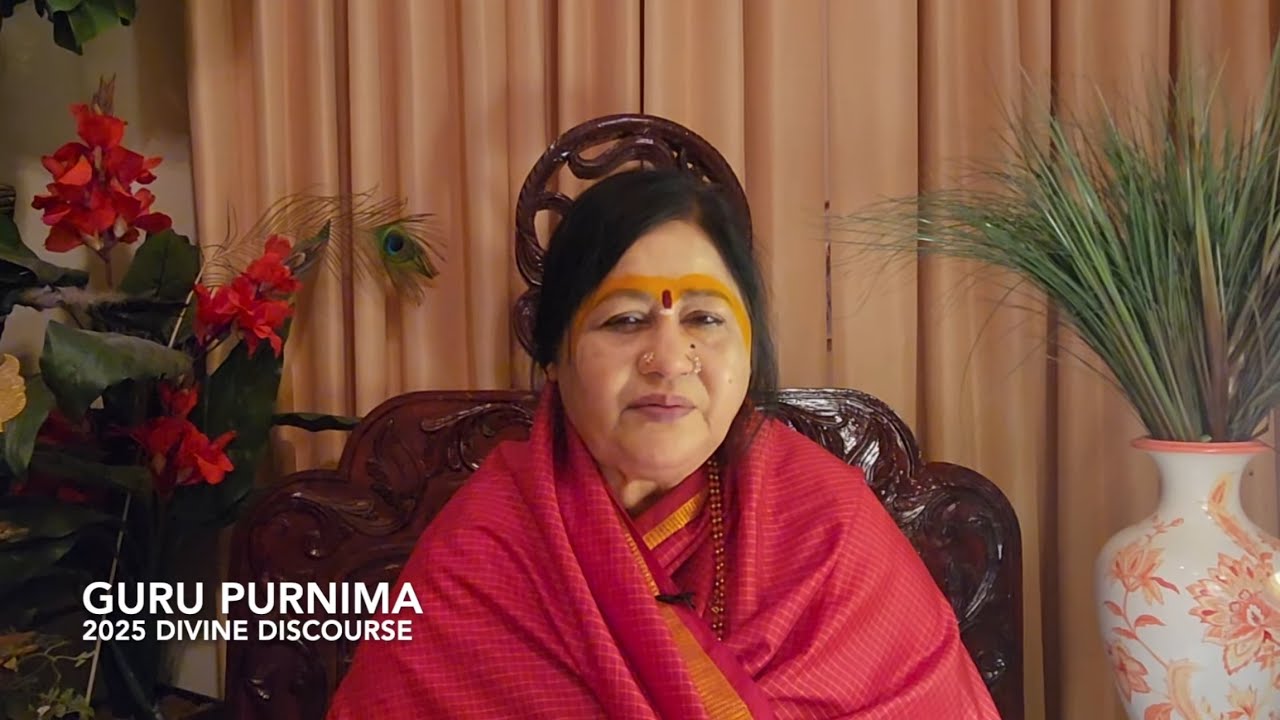
"This year the name itself is not auspicious because of so many challenges we are facing from the beginning of this year," Sri Karunamayi begins her message about Navarathri 2026, cutting through pleasantries to name what many have felt: a cascade of "nature calamities and war problems" that have defined recent months. The world tilts uncertain. And yet she offers neither platitude nor escape—instead, recognition and remedy.
Navarathri, the nine-day festival honoring the Divine Mother in her many forms, arrives this year not as quaint tradition but as cosmic intervention. A sacred portal when ordinary spiritual practice multiplies beyond measure. For those attuned to it, the timing is no accident. For those skeptical, it becomes an invitation to test the teaching: that certain moments in the celestial calendar concentrate power in ways the rest of the year cannot.
How Navarathri Answers a Year of Crisis
The core revelation is staggering and mathematically specific. When a devotee performs the Lalita Sahasranama puja—a ritualized chanting of the thousand names of the Divine Mother—outside Navarathri, the spiritual merit accumulated is real but bounded. During Navarathri, specifically the full moon nights like Shashthi, Saptami, Ashtami, Navami, and Purnima, the same practice yields merit multiplied by one thousand into one crore—that is, ten million times. Not poetically. Mathematically.
"The benefits are incredible, countless," she teaches, noting that the Sanskrit word sahasra means not merely a thousand but "infinite times." The fruit of worshipping the Divine Mother during Navarathri through Lalita Sahasranama puja is "1,000 into 1 crore times merits."
Why? The answer folds theology, astronomy, and neuroscience into a single teaching about how the cosmos works and how a human being—body, mind, spirit—aligns with its currents. In a year when calamities and wars have shadowed nearly every month, Navarathri offers what ancient kings understood: a strategic spiritual technology, deployed at a moment of maximum cosmic power.
Why Do People Return Again and Again to Sacred Places?
Sri Karunamayi begins with an observation that feels almost casual but contains seeds of her entire teaching: people return again and again to sacred places without always knowing why.
"When you go to some areas or temples, some houses, some of friends constantly one or two times, three times," she explains. "Without our knowledge, there is some divine connection dragging you to the temple or to the divine areas. Without that our divine connection is impossible to go again and again to that area."
The mechanism is subtler than tourism or curiosity. She suggests past-life karmic connections—threads linking a soul to particular sacred geography. The peninsula where she teaches, "a very interior forest area" with "no entertainments," attracts seekers precisely because it is "a place of enlightenment not the entertainment place." People arrive there again and again, drawn not by marketing but by the soul's own recognition of an ancient tie.
This teaching prepares the ground for understanding Navarathri itself: not merely as a festival in time but as an alignment—a moment when the barriers between visible and invisible worlds thin, when pilgrimage becomes magnetism, when the devotee becomes a receiver of grace already flowing toward them.
What Is Shakti and Why Does Every Power Depend on It?
At the heart of Karunamayi's message lies a theological restatement that reframes everything: Shakti is not optional. She recounts an ancient teaching in which Brahma, the creator, addresses the Devas (celestial beings). Each had their own powers, their own spheres of influence. Indra had strength, others their specific efficiencies. Yet Brahma told them all the same thing:
"If you want Shakti you have to worship. Without Shakti you never do anything in the life. This absolutely we have to think about this word," she teaches with emphasis.
The implication unfolds: in seeking to accomplish anything—"to talk, to do, to walk, to do so many other things in the world"—we require an underflow of divine feminine power. It is not decorative. It is not supplementary. It is foundational. "The Shakti comes from the absolute Shakti of divine mother," she says.
This is why ancient kings performed Durga Puja and Devi Puja during Navarathri not as ceremonial duty but as strategic practice. "All kings did the puja to the divine mother. They live their lives glorifyful with the dharma," she says, distinguishing between the glory of possessions and the glory of dharmic values: "inner values, purity, truthfulness, all these attributes are the glory of that life." Through sustained worship of Shakti during the nine-night festival, "people have unbelievable cosmic energy in their hearts… They lead a great life and pure life and they finally attain Krishna and salvation because of the divine mother puja."
How Does Moonlight During Navarathri Transform the Brain?
Where Karunamayi's teaching becomes especially contemporary is her integration of empirical observation with metaphysical instruction. Navarathri's most powerful days coincide with the full moon—Shashthi, Saptami, Ashtami, Navami, and Purnima. The moonlight during this period carries a specific energetic signature.
"Moonlight is very special at that time. Nectar rays in the moon. We have to capture that nectar rays by doing the Lalita Sahasranama puja in the evening time. That is the main secret," she teaches.
Scientifically, the benefits are measurable. Exposure to moonlight during the Navarathri full moon nights, particularly during evening practice, sharpens the brain, prevents memory loss and Alzheimer's disease, softens the emotional body, and cultivates what Hindu philosophy calls sattvic nature—clarity, purity, harmony. "Brain will become sharper, more soft nature come to the people, satwa nature come to the people," she explains.
The mechanism is rooted in understanding the three gunas—qualities of nature. Every human being carries mixed dosages of tamas (inertia, darkness), rajas (activity, passion), and sattva (harmony, light). Some people naturally tend toward tamasic temperament, others toward rajasic. "But Navarathri time when we do the worship in the moonlight in the right time, especially for the divine mother puja, we are capturing through the bija mantras moon bija mantras and the brain system will become very powerful."
Here is where devotion becomes neurological, where prayer becomes physiological, where the ancient and the modern converge: a human being in communion with the moon's cycles, the mother's names, the subtle energies of the earth, experiences measurable shifts in cognitive function and emotional stability. The practice is not metaphorical. It works on the body.
What Is Mantra Shastra and How Do Sacred Sounds Work?
Underlying all of this is a sophisticated technology Karunamayi calls Mantra Shastra—the science of sacred syllables and their effects. The Lalita Sahasranama is not, she emphasizes repeatedly, merely a list of poetic epithets. Each name is a mantra. Each mantra carries specific frequencies and powers encoded in Sanskrit letters.
"We must not think are just some names we are chanting… In that division we must not in any circumstances mantra any mantra is one—a like state," she teaches, distinguishing between utterance and invocation. "Nalita is a mantra shastram. Unbelievable vic scripture. In this each mantra have when we collect all these mantras Vedas and innumerable shastras are in different different mantras."
She outlines a classification system: A bija mantra (seed mantra) contains one to nine syllables, each letter a carrier of particular vibrational power. Examples include GAM (Ganesha), KLEEM (Krishna), and AIM (Saraswati). These are condensed, high-potency formulas.
A mahamantra (king of mantras) contains 15 to 24 letters and represents a higher order of complexity and power. Examples include Panchaksari and Shadaksari—sacred syllable groupings that function as complete spiritual technologies. When these mantras are collected and organized, as in the Lalita Sahasranama, the text becomes what Karunamayi calls "a god of mantra"—a supreme scripture containing within it the compressed wisdom of the Vedas and innumerable Shastras. To chant the Sahasranama is not to list names but to activate codes.
The specificity matters. During Navarathri, the effectiveness of this sonic technology amplifies exponentially. Outside Navarathri, one does the work and receives the benefit. During Navarathri, one does the same work and receives benefit multiplied infinitely.
Why Is the Peninsula a Kundalini Zone?
Late in her message, Karunamayi returns to sacred geography with a specific revelation about the land itself. The peninsula where she teaches is not merely a nice place to gather. It is a kundalini zone—a geographical location where the earth's subtle energy flows with particular intensity and where spiritual practice yields accelerated results.
"In this kundalini zone. What a beautiful peninsula. Peninsula is your parental home," she says, addressing devotees who gather there. "Our total life is in her lap."
The implication is that practice in such locations generates not just spiritual benefit but a sense of homecoming, a return to a place where the soul recognizes itself. This adds a dimension to the Navarathri teaching: the convergence of multiple amplifying factors. You are practicing at a moment of cosmic alignment (full moon during Navarathri). You are practicing with a technology of immense power (Lalita Sahasranama and Shakti puja). You are practicing in geography where the earth itself supports transformation. The multipliers stack.
"When we do sadena here, it is going to multiply to 100,000 times. What a beautiful binding divine energy in this area," she teaches.
Yet the essential technology is portable. The devotee sitting in a home far from the peninsula, performing the same practices during the same cosmic window, also receives benefit—though perhaps without the geographical amplification. The outer circumstances vary. The cosmic principle remains constant: Navarathri concentrates power. The full moon amplifies it. Mantra channels it. Shakti delivers it. The devotee who aligns with these currents swims with them rather than against them.
Where to go from here
The practical invitation from Karunamayi's teaching is clear: this week matters differently than other weeks. If you have considered deepening a spiritual practice, if you have felt the pull toward meditation, mantra, or devotion but lacked momentum, Navarathri presents a temporal advantage. The ordinary effort yields extraordinary results. The same practice performed outside this window requires vastly more repetition to yield equivalent benefit.
Begin with evening worship during the full moon nights. Sit in moonlight if possible. Chant the Lalita Sahasranama or another sacred mantra if you have one. If Sahasranama feels too lengthy, even brief passages carry the encoded wisdom. The key is sincere devotion—what Karunamayi calls "100% parami, intense devotion, pure love on the divine mother." Approach it not as intellectual exercise but as communion.
If you are drawn to a sacred place, trust that pull. Past-life karmic threads may be tugging at your soul. There is no wasted pilgrimage. And remember the fundamental teaching: Shakti is not luxury. It is the foundation of any accomplishment in life. By honoring the Divine Mother during Navarathri, you are not performing a ritual. You are aligning with the current that moves everything—accessing the power without which nothing occurs. In a year of calamities and wars, in a time when the world tilts uncertain, this alignment is both urgent and available.