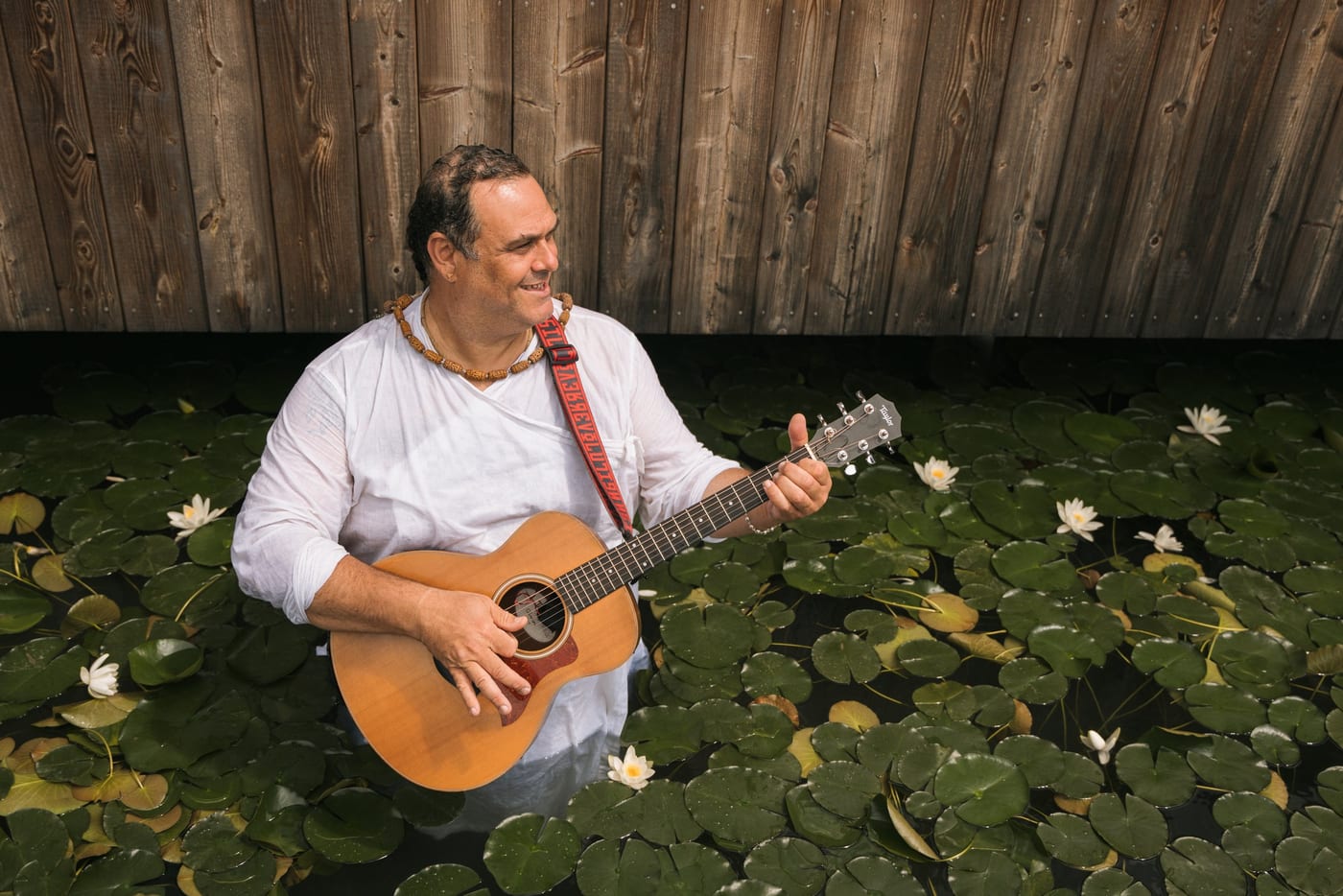

Gaura Vani is first a musician, storyteller, and kirtan leader, and only secondarily anything that resembles a teacher. The public record does not describe a curriculum, a certification, or a formal school. What can be said is drawn from his bio and the stated shape of his work: two decades of touring, a devotional practice rooted in bhakti, and a habit of treating song as an invitation. This profile reads the teaching through that music and does not claim more than the record supports.
The bio describes a range of settings: temples, opera houses, yoga studios, festivals, and what it calls "intimate gatherings" as well as "global stages." The format across them is kirtan, the call-and-response chanting of names and mantras. The leader sings a line, the room answers, and the teaching happens in the repetition rather than in explanation. Anyone expecting a lecture with music as garnish will find the proportions reversed.
The experience changes with the container. His verified material describes sustained, meditative chant on the studio records, a crowd-driven build in live kirtan, and a louder, more percussive energy with The Juggernauts at festivals. A session in a yoga studio is not the same event as a Bhakti Fest set. The constant is the communal, performed nature of the practice. The room is expected to sing, not watch. The record does not document retreat structures, so nothing here should be read as a claim about how a multi-day retreat is organized.
The central theme is bhakti, the devotional path within Hinduism centered on love for the divine expressed through song. Mantra and the names of deities are the working material, with Sanskrit as the default language. Titles such as Armor of Narasimha (Narasimha Kavacha), named for a devotional text, show an instinct to anchor songs in sacred words and named figures rather than abstraction.
A second theme is the heart. The bio closes by calling his music "an invitation for the heart to sing," and describes a traveler gathering "stories and songs around the world to heal the heart and soothe the soul." A third is movement between worlds: temple and stage, East and West, sacred and secular. The bio's account of singing with nurses at hospitals in Mumbai, in both mantras and English songs, shows the same refusal to wall devotion off from ordinary life.
He has not published a list of questions for students, and none should be invented. The questions are implied by the work and the biography. What does it mean to sing something you were raised inside and later rebelled against? Can devotion survive a Hollywood career, a rock band, and a festival field? Does chant hold up in an opera house as well as a temple? And the practical one the form itself asks: can you stay with repetition long enough that it stops being performance? The verified material notes that newcomers often find the first listen slower than expected, and that the repetition is part of the design. Staying with that is the discipline on offer.
The bio calls him a storyteller, and story is a named part of the delivery alongside song. His own life supplies the material: raised by monks in temples from the age of four, a teenage rebellion, acting alongside Michelle Pfeiffer, Denzel Washington, and Ethan Hawke, then a return to music. The record gives no sample of his humor and no account of how he uses silence, so neither can be characterized honestly. Scripture appears through the texts and mantras he sets rather than through documented commentary.
The sound centers on the human voice carrying Sanskrit lines, with an emphasis on repetition over melodic showmanship. Within As Kindred Spirits, the verified collaborators include Shyam Kishore on tabla and sarod, Acyuta Gopi on vocals, and Ananta Govinda on mrdanga (khol). Ben Leinbach, known for his work with Jai Uttal, co-produced Ten Million Moons. The ensemble work signals a taste for blending Indian instruments with Western approaches while keeping the devotional center.
It lands for listeners curious about bhakti who are willing to hear chant as a sung, communal, performed practice. People who want mantra as a sitting practice have a clear entry in Meditation & Mantra. Those who want to hear how the form handles scale can turn to the 2026 live recordings from the Royal Opera House Mumbai.
It will frustrate several kinds of people. Those who want electronic, high-BPM, or remix-style kirtan will not find it, since even the energetic material rests on call-and-response. Listeners unfamiliar with Hindu names face a learning curve, because Sanskrit and named deities are central, not decorative. Strict traditionalists may find the Hollywood background and the fusion projects a departure from liturgical purity. People seeking quiet background sound may tire of live material that rewards active attention. Those who need constant variation may find the pacing demanding.
The work sits in the bhakti tradition, and the verified record is careful on this point. His formation came from inside temple life, so mantra and ritual predate any career decision. The public record names no specific guru, lineage, or sampradaya, and this profile assigns none. He has shared stages with Jai Uttal and Krishna Das, which places him among contemporary chant and kirtan artists, but that is a statement about company, not about descent. What the record supports is a temple upbringing, a long non-linear path, and a practice that treats song as the teaching.